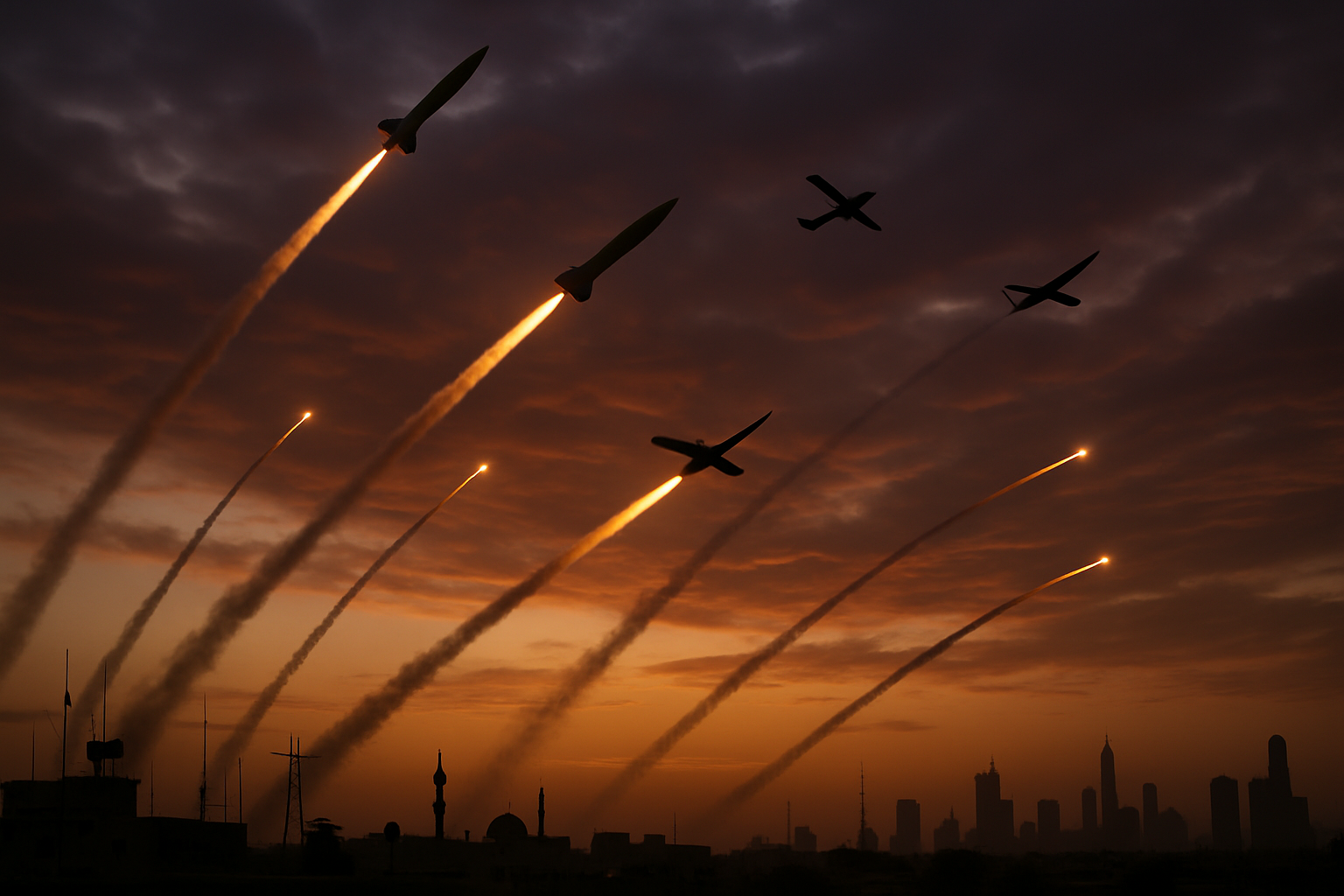
Iran has launched massive coordinated missile and drone strikes against multiple Gulf nations including Kuwait, UAE, Qatar, and Bahrain, targeting US military installations and civilian infrastructure in direct retaliation for the US-Israeli "Operation Epic Fury" military operations against Iranian facilities.
The Iranian Revolutionary Guard Corps (IRGC) declared this the "first wave" of retaliation with "no red lines remain," marking the most significant regional military escalation since the collapse of nuclear negotiations despite recent diplomatic breakthroughs achieving "broad agreement on guiding principles."
Casualties and Damage Across the Gulf
The United Arab Emirates confirmed at least one civilian death in Abu Dhabi from falling missile debris, while multiple Gulf capitals reported direct strikes on critical infrastructure. Dubai's Jebel Ali port caught fire following the impact of missile interception debris, according to the Dubai Media Office.
Kuwait's international airport was struck by drones, causing injuries to airport employees and forcing the suspension of all flights. Prime Minister Sheikh Ahmad Abdullah Al-Ahmad Al-Sabah visited Al-Farwaniya Hospital to check on the condition of those injured in the attack on Kuwait International Airport.
In Qatar, authorities detected 65 ballistic missiles and 12 drones originating from Iran, with at least eight people injured by missile fragments despite successful Patriot missile system interceptions, according to the Interior Ministry.
Greece reported that a fire broke out at the Burj Al Arab hotel in Dubai following an Iranian drone attack, while Dubai International Airport - the world's busiest international hub - was forced to evacuate and suspend operations indefinitely.
Operation "True Promise 4" Targets Regional Infrastructure
The IRGC announced the fifth wave of "Operation True Promise 4," specifically targeting the MSP ammunition supply vessel at Jebel Ali port responsible for supplying American ships. The vessel was reportedly disabled by four successive drone strikes causing "complete service disruption due to damage and consecutive explosions."
Iranian state media confirmed strikes against the US Naval Base in Kuwait and combat support ships in the Indian Ocean, representing a significant expansion of Iran's retaliatory capabilities beyond traditional boundaries.
Bahrain's Manama area, home to the US Fifth Fleet headquarters, reported smoke rising from targeted facilities, while residential buildings in the capital were also hit during the coordinated assault.
Nuclear Diplomacy Collapse Context
The strikes followed the dramatic breakdown of US-Iran nuclear negotiations despite achieving what Iranian Foreign Minister Abbas Araghchi called "broad agreement on guiding principles" - the most significant diplomatic progress since the JCPOA collapse in 2018.
The fundamental obstacle remained unchanged: Iran excluded ballistic missiles and regional proxies as "red lines" demanding nuclear-only talks, while US Secretary of State Marco Rubio insisted on a comprehensive agreement including missiles, armed groups, and human rights issues.
Dr. Yusri Abu Shadi, a former IAEA inspector, confirmed Iran possesses over 400kg of uranium enriched to 60% purity - approaching the 90% weapons-grade threshold - making nuclear weapons "easily achievable."
Unprecedented Military Buildup Precedes Crisis
The escalation occurred against the backdrop of the largest US military presence in the Middle East since the 2003 Iraq invasion, with the unprecedented dual-carrier deployment of USS Gerald R. Ford and USS Abraham Lincoln representing approximately one-third of the active US Navy fleet positioned 800km from Iran's coast.
Trump had issued a historic 10-day ultimatum warning "bad things will happen" if no meaningful nuclear deal was reached, while making his most explicit regime change comments declaring Iranian government overthrow "the best thing that could happen."
Regional Coalition Disrupted
The strikes severely strained the unprecedented regional coalition of Saudi Arabia, UAE, Qatar, and Egypt that had been backing the diplomatic process. Egypt condemned the attacks on "sisterly Arab countries," warning of "comprehensive chaos" across the region.
President Trump received a phone call from Kuwait's Crown Prince Sheikh Sabah Khaled Al-Hamad Al-Sabah, with Trump expressing strong US condemnation of the "blatant Iranian aggression" and affirming America's commitment to stand with Kuwait.
Multiple European governments issued immediate travel warnings, with embassy evacuations ordered from Sweden, Serbia, and other nations citing the "extremely uncertain" security situation.
Global Aviation Crisis Emerges
The attacks triggered a massive global aviation crisis as Iran, Iraq, Israel, UAE, and Qatar all closed their airspace to civilian traffic. Flight tracking data showed Iranian and Iraqi airspace completely empty, with major international carriers including Emirates, Air France-KLM, Wizz Air, and Bulgaria Air suspending Middle East operations.
Over 18,000 flights were delayed or cancelled worldwide, affecting hundreds of thousands of passengers as the Middle East serves as a critical Europe-Asia connecting hub now severely disrupted by the regional conflict.
Energy Market Impacts
Oil prices rose immediately on concerns over the Strait of Hormuz, through which 40% of global oil transit passes. The New Zealand government confirmed reports that Iran's Revolutionary Guard Corps told global shipping operators that travel through the strait is "not allowed," raising serious concerns about worldwide energy security.
Natural gas prices increased 24% in Europe and 78% in the US amid geopolitical pressures, while regional war risks threaten to disrupt supply chains far beyond the immediate Middle East region.
International Diplomatic Response
The UN Security Council scheduled an emergency session following requests from France, China, Russia, Colombia, and Bahrain. Russia condemned what it called "reckless actions by Washington and West Jerusalem" as direct violations of international law.
The crisis occurs against the broader nuclear governance breakdown, with New START having expired on February 5 - marking the first time in over 50 years without US-Russia nuclear constraints - while China expands its nuclear arsenal and UN Secretary-General Guterres warns nuclear risks are at their "highest in decades."
Civilian Impact and Humanitarian Concerns
Jordan's Public Security Directorate reported handling 73 incidents of falling objects and debris across multiple governorates including the capital, Zarqa, Jerash, Madaba, Irbid, West Balqa, Aqaba, and the Central Badia, resulting in material damage but no loss of life.
International human rights organizations are demanding investigations into potential Geneva Conventions violations, particularly regarding the targeting of civilian educational infrastructure. A strike on a girls' school in Minab, Iran, during the US-Israeli operations reportedly killed over 100 students and staff, becoming a tragic symbol of the diplomatic failure's human cost.
Template-Setting Implications
This rapid transition from diplomatic framework breakthrough to military escalation demonstrates the fragility of modern crisis management mechanisms in the multipolar era. The stakes extend far beyond the immediate region, affecting global nuclear governance credibility, international law enforcement, and the template for 21st-century conflict resolution.
Success in containing the escalation could provide a framework for future nuclear crisis resolution, while failure may accelerate military solutions over diplomatic approaches, potentially reshaping Middle Eastern geopolitics for decades and encouraging nuclear proliferation elsewhere.
The coming hours and days will be decisive in determining whether this represents a contained regional confrontation or the beginning of a broader Middle Eastern war with global implications for energy security, nuclear governance, and international stability.