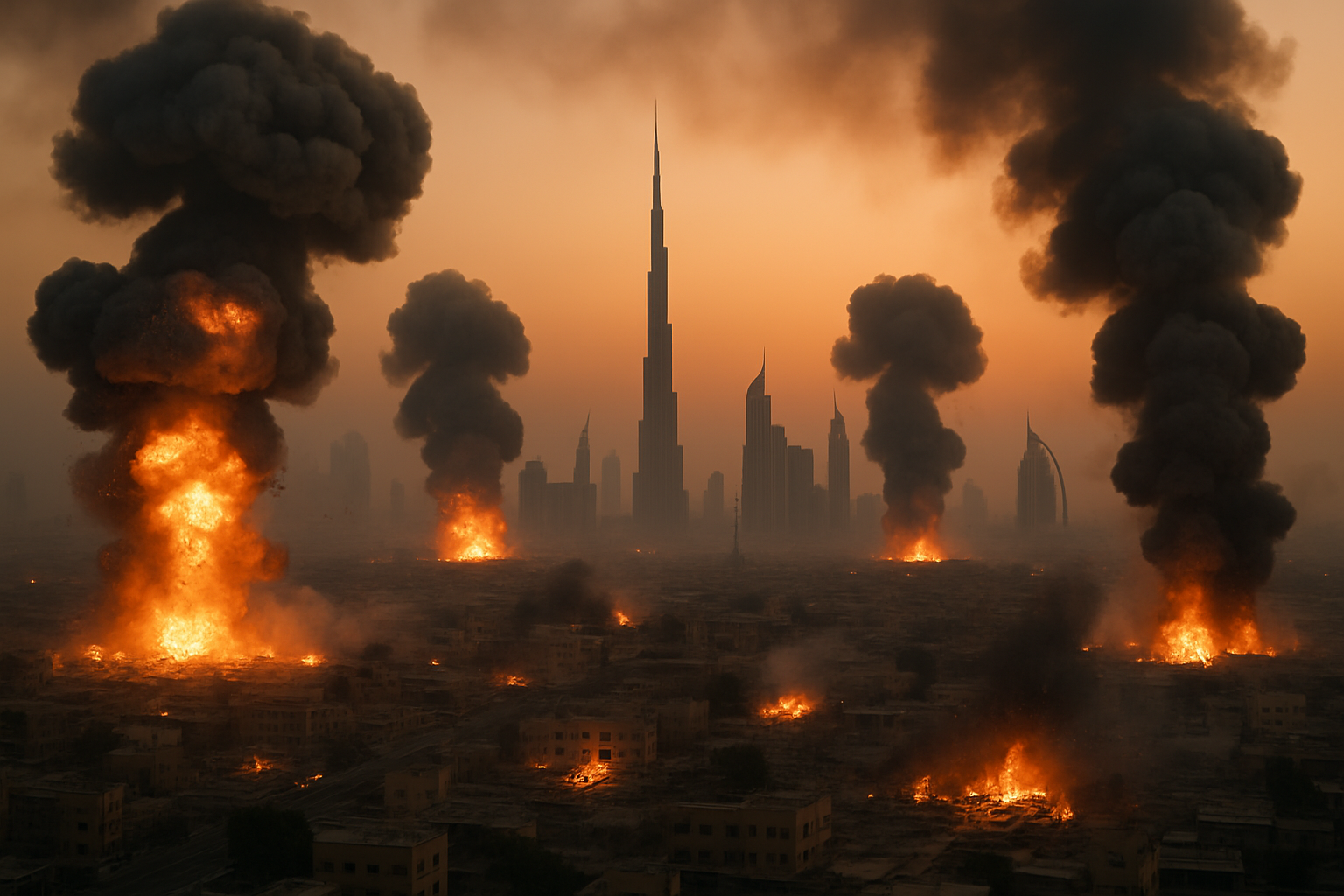
Iran has unleashed a devastating wave of retaliatory strikes across the Middle East, targeting Israeli cities, Dubai, and US military installations following the largest coordinated US-Israeli military operation against Iran since 2003, plunging the region into its most dangerous crisis in decades.
The Iranian Revolutionary Guard Corps (IRGC) launched what it termed "Operation True Promise 4," declaring "no red lines remain" as missiles and drones struck targets from Tel Aviv to Dubai International Airport, marking an unprecedented escalation that has killed civilians and shut down major transportation hubs across the Gulf region.
Casualties Mount Across Multiple Countries
The coordinated Iranian assault has resulted in confirmed casualties across several Gulf nations. In the United Arab Emirates, one civilian was killed in Abu Dhabi from falling missile debris, while Dubai's world-famous Fairmont Palm hotel caught fire after being struck by drone fragments, injuring four people. The iconic Palm Jumeirah district suffered extensive damage as debris rained down on the luxury resort area.
Dubai International Airport, the world's busiest, sustained "minor damage" in what officials described as a missile strike, with four airport workers injured. The facility has been completely shut down, creating operational chaos for Emirates and Etihad Airways and affecting hundreds of thousands of passengers worldwide.
In Israel, the situation proved even more dire. Iranian missiles struck a residential block in Tel Aviv, killing at least one woman and injuring 27 others, including an infant. First responders report heavy damage to two apartment buildings in what represents the first civilian death in Israel during this renewed conflict cycle.
"This is a historic moment that will reshape the Middle East for decades to come. The scale of Iranian retaliation demonstrates their willingness to escalate beyond all previous boundaries."
— Regional Security Analyst
Global Aviation Crisis Unfolds
The attacks have triggered the most comprehensive aviation disruption since COVID-19, with Iran, Iraq, Israel, UAE, and Qatar completely closing their airspace to civilian traffic. Over 18,000 flights have been cancelled worldwide, affecting major carriers including Emirates, Air France-KLM, Wizz Air, and Bulgaria Air.
Flight tracking data shows vast empty zones across the Middle East, a critical Europe-Asia transportation hub now rendered inaccessible. The crisis extends far beyond the immediate region, forcing complex rerouting of international flights and leaving hundreds of thousands of passengers stranded globally.
Nuclear Diplomacy Collapse Triggers Crisis
The massive retaliation comes following the complete breakdown of nuclear negotiations that had achieved the most significant progress since the 2018 JCPOA collapse. Despite Geneva talks reaching "broad agreement on guiding principles," fundamental disagreements proved insurmountable.
Iran had maintained that ballistic missiles and regional proxies remained "red lines" excluded from nuclear-only talks, while the US demanded comprehensive agreements addressing missiles, armed groups, and human rights issues. The same structural obstacle that prevented breakthroughs for over a decade ultimately triggered the military escalation.
At the time of the strikes, Iran was enriching uranium at 60% purity—approaching the 90% weapons-grade threshold—with sufficient material for multiple weapons if weaponized, according to former IAEA inspector Dr. Yusri Abu Shadi.
Operation Epic Fury Sparks Retaliation
The Iranian strikes came in direct response to US-Israeli "Operation Epic Fury," which utilized an unprecedented dual-carrier deployment of the USS Gerald R. Ford and USS Abraham Lincoln—representing approximately one-third of the active US Navy fleet positioned 800 kilometers from Iran's coast.
President Trump had issued a historic 10-day ultimatum warning that "bad things will happen" if no nuclear deal was reached. The subsequent military operation targeted Iranian government facilities and military infrastructure in what Israeli Defense Minister Katz described as "preemptive strikes to eliminate threats."
The operation also reportedly resulted in family casualties of Iran's Supreme Leader, with multiple Iranian family members killed during the strikes, representing an unprecedented escalation in targeting practices.
Regional Coalition Under Severe Strain
The crisis has severely tested an unprecedented regional coalition of Saudi Arabia, UAE, Qatar, and Egypt that had backed the diplomatic process. Egyptian President Sisi condemned the attacks on "sisterly Arab countries," warning of "comprehensive chaos" as Iranian missiles targeted member territories.
Multiple countries have ordered embassy evacuations, with Sweden and Serbia implementing immediate citizen evacuations from Iran citing "extremely uncertain" security conditions. European nations have issued widespread travel warnings covering the entire Middle East region.
Energy Security Under Threat
Oil prices are rising sharply amid concerns over the Strait of Hormuz, through which 40% of global oil transit flows. Iran has reportedly warned shipping operators that passage through the strait is "not allowed," raising fears of supply chain disruptions extending far beyond the Middle East.
Natural gas prices have surged 24% in Europe and 78% in the United States as markets react to the potential for prolonged conflict affecting global energy security and supply chains.
Historical Context and Global Implications
The crisis occurs against the backdrop of broader nuclear governance breakdown. The New START treaty between the US and Russia expired February 5—marking the first time in over 50 years without US-Russia nuclear constraints. Combined with China's nuclear expansion, UN Secretary-General António Guterres has warned that nuclear risks are at their "highest in decades."
The rapid transition from diplomatic framework to military escalation represents a template-setting moment for 21st-century conflict resolution. The collapse of the most promising US-Iran diplomatic opening in years raises fundamental questions about the viability of diplomatic solutions for modern nuclear crises.
International Response
The UN Security Council has scheduled an emergency session requested by France, China, Russia, Colombia, and Bahrain. Russia condemned what it termed "reckless actions by Washington and West Jerusalem" as violations of international law, while European allies scramble to prevent further escalation.
The crisis tests multilateral diplomacy's capacity to address rapidly evolving conflicts in an increasingly multipolar world, with implications extending decades beyond the current crisis for international approaches to nuclear disputes and territorial sovereignty enforcement.
What Happens Next
The coming phase will determine whether this represents contained regional confrontation or the beginning of a broader Middle Eastern war with global implications. Success in containing the escalation could provide a framework for future nuclear crisis resolution, while failure may accelerate military solutions over diplomatic approaches worldwide.
The stakes include regional war prevention, global energy security, nuclear governance credibility, and the international legal architecture that has maintained relative stability since World War II. As smoke rises over multiple Middle Eastern capitals, the world watches to see whether diplomacy can still prevail over the logic of military escalation.