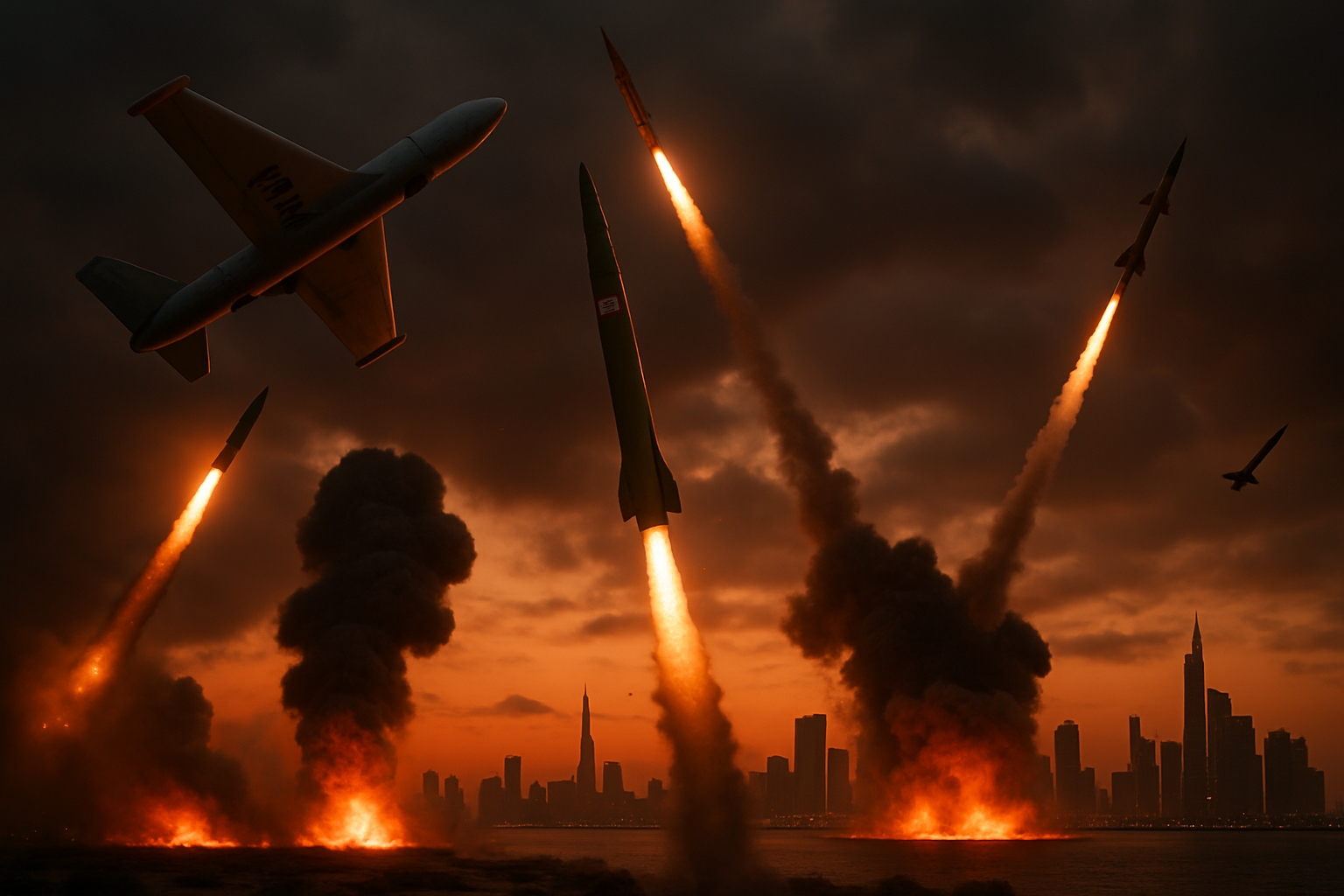
Iran launched a massive coordinated wave of missile and drone strikes across multiple Gulf states on Saturday, targeting US military installations and civilian infrastructure in the UAE, Kuwait, Qatar, and Bahrain in direct retaliation for the US-Israeli "Operation Epic Fury" attacks on Iranian territory.
The unprecedented assault marked the most significant regional military escalation since the devastating 12-day Iran-Israel war in June 2025, shattering the fragile stability that had emerged from months of intensive nuclear negotiations and diplomatic engagement.
Widespread Casualties and Damage Across the Gulf
The Iranian Revolutionary Guard Corps (IRGC) launched what it termed the "first wave" of retaliation, declaring that "no red lines remain" and all US and Israeli assets in the region were now "legitimate targets." The attacks resulted in confirmed casualties across multiple countries:
In the UAE, one civilian was killed in Abu Dhabi when missile debris fell in residential areas, while dramatic explosions rocked Dubai's luxury Palm Jumeirah district. The iconic Fairmont The Palm hotel caught fire after debris from intercepted missiles struck the building, forcing emergency evacuations and injuring four people.
Kuwait International Airport's Terminal 1 was struck by a drone attack, resulting in injuries to several airport employees and significant material damage to the facility. The Kuwait Ministry of Defense confirmed that three armed forces personnel were wounded when debris fell at Ali Al Salem Air Base during operations to intercept incoming missiles and drones.
Military Installations Under Fire
The Iranian strikes systematically targeted key US military installations across the region. Qatar's Al Udeid Air Base, which houses the largest US military presence in the Middle East, came under sustained missile attack, though Qatari forces successfully intercepted most projectiles using Patriot defense systems.
In Bahrain, the US Navy's Fifth Fleet headquarters in Manama faced direct targeting, with several residential buildings in the capital reportedly hit. Civil defense forces were conducting ongoing firefighting and rescue operations at affected sites, according to Bahraini Interior Ministry statements.
"Iran has crossed every red line with these attacks on sovereign Gulf territories. This represents a fundamental escalation that threatens the entire regional security architecture."
— Regional Security Official
The strikes demonstrated Iran's capability to project force across the Gulf despite facing the largest US naval presence in the region since 2003, with the dual-carrier deployment of the USS Gerald R. Ford and USS Abraham Lincoln representing approximately one-third of the active US Navy fleet.
Diplomatic Collapse and Nuclear Crisis Context
The retaliatory strikes followed the complete breakdown of Iran-US nuclear negotiations, despite achieving what Iranian Foreign Minister Abbas Araghchi had described as "broad agreement on guiding principles" - the most significant diplomatic progress since the JCPOA collapse in 2018.
The fundamental obstacle that ultimately doomed the talks remained unchanged from decade-old diplomatic challenges: Iran maintained ballistic missiles and regional proxy activities as "red lines" excluded from nuclear-only discussions, while US Secretary of State Marco Rubio insisted on a comprehensive agreement addressing missiles, armed groups, and human rights.
Iran's nuclear program had reached critical thresholds at the time of the strikes, with uranium enrichment at 60% purity approaching the 90% weapons-grade level. Former IAEA inspector Dr. Yusri Abu Shadi confirmed Iran possessed over 400 kilograms of enriched uranium, making nuclear weapons capability "easily achievable" if weaponized.
Regional Coalition Disrupted
The Iranian strikes severely disrupted an unprecedented regional coalition that had emerged to support diplomatic solutions. Saudi Arabia, the UAE, Qatar, and Egypt had formed an extraordinary Middle Eastern consensus backing the nuclear negotiations - a unity that now faces severe strain as member nations experience direct attacks on their territories.
Egyptian President Abdel Fattah al-Sisi conducted emergency phone calls with Gulf leaders, condemning what he termed Iranian attacks on "sisterly Arab countries" and warning of the potential for "comprehensive chaos" threatening regional stability.
Aviation Crisis and Global Impact
The military escalation triggered an immediate global aviation crisis as multiple Middle Eastern countries closed their airspace to civilian traffic. Iran, Iraq, Israel, the UAE, and Qatar all announced airspace closures, with flight tracking data showing completely empty airspace over vast Middle Eastern areas.
Major international carriers faced operational chaos: Emirates and Etihad Airways suspended operations due to UAE airspace closures, Air France-KLM cancelled flights to Tel Aviv and Beirut, and Bulgaria Air suspended all Israeli routes through March. The crisis affected hundreds of thousands of passengers worldwide, as the Middle East serves as a critical connecting hub between Europe and Asia.
Energy Security Concerns
Oil prices rose immediately following the attacks, with markets responding to potential threats to the Strait of Hormuz, through which 40% of global oil transit passes. The targeting of Gulf infrastructure raised concerns about broader energy security implications, as regional conflict could disrupt worldwide supply chains far beyond the immediate Middle Eastern scope.
Trump Administration Response
The strikes came hours after President Trump had issued what he termed his final warning to Iran, declaring that the world would learn "over the next 10 days" whether negotiations would succeed or military action would begin. Trump had deployed unprecedented military assets to the region, describing the dual-carrier presence as preparation "in case we don't make a deal."
The President had also made his most explicit regime change comments, calling Iranian government overthrow "the best thing that could happen" - representing a policy evolution from nuclear-focused negotiations to broader political transformation objectives.
International Nuclear Governance Crisis
The military escalation occurred against the backdrop of a broader nuclear governance crisis. The New START treaty between the US and Russia had expired on February 5, marking the first time in over 50 years without bilateral nuclear constraints between the superpowers. China's nuclear expansion further complicated multilateral frameworks, with UN Secretary-General António Guterres warning that nuclear risks were at their "highest levels in decades."
Template-Setting Implications
The rapid transition from diplomatic framework to military escalation within days represents a template-setting moment for 21st-century conflict resolution. The collapse of the most promising US-Iran diplomatic opening in years raises fundamental questions about the viability of diplomatic solutions for modern nuclear crises.
The stakes extend far beyond the Middle East, potentially influencing how future territorial and nuclear disputes are approached globally, with implications for international law enforcement, territorial sovereignty principles, and diplomatic credibility in the multipolar era.
"This represents the breakdown of the most intensive diplomatic effort in years. The precedent could accelerate military solutions over negotiated agreements for decades to come."
— International Relations Expert
Looking Ahead
As emergency UN Security Council sessions convene and international leaders call for immediate de-escalation, the region faces its most serious crisis since the 2003 Iraq invasion. The Iranian declaration that "no red lines remain" suggests the potential for broader retaliatory campaigns, while the disruption of regional partnerships essential for counter-terrorism, energy security, and diplomatic stabilization threatens to reshape Middle Eastern geopolitics for decades.
The success or failure of containing this escalation will likely determine whether diplomatic solutions remain viable for future international crises or whether military confrontation becomes the dominant approach to resolving complex geopolitical challenges in the 21st century.