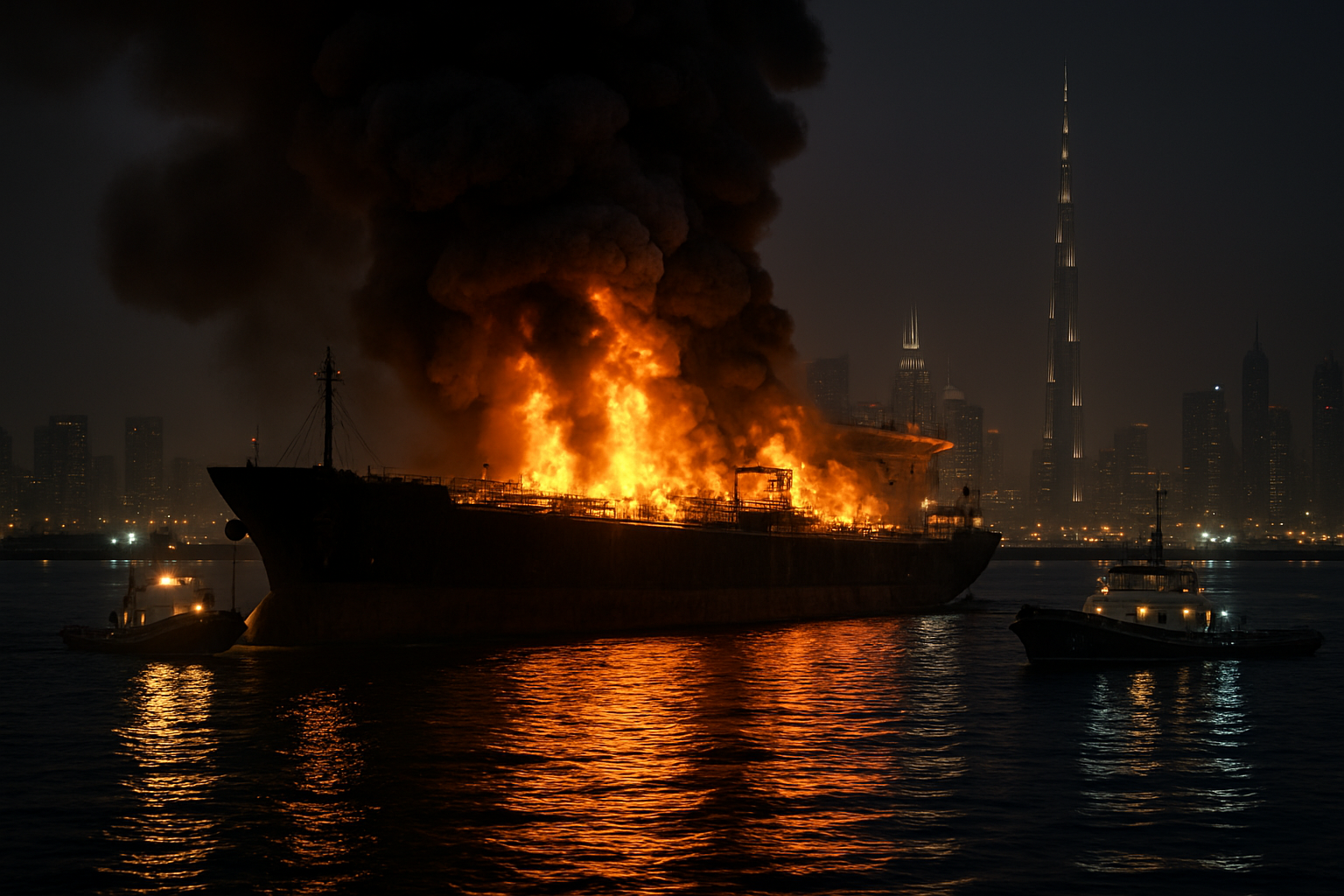
The Iran-Middle East war has entered its most dangerous phase yet as Iranian forces attacked a fully loaded Kuwaiti oil tanker in Dubai port, setting it ablaze and damaging its hull, while simultaneously Israel's Knesset passed a controversial death penalty law specifically targeting Palestinians convicted of deadly acts of terror.
The attack on the Kuwait-flagged Al-Salmi tanker occurred Monday evening at Dubai Port's anchorage, according to Kuwait's state news agency, which warned of a possible oil spill. The apparent strike represents the latest escalation in a month-long conflict that has become the most dangerous international crisis since the Cold War ended.
Oil Markets Surge as Strategic Waterway Threatened
Global oil prices surged dramatically in response to the tanker attack, with US crude futures rising more than $3 per barrel to $105.91, while Brent crude reached $115.49 - gains of up to 3.9%. The attack underscores Iran's continued targeting of critical energy infrastructure as part of its broader "Operation True Promise 4" campaign.
The Revolutionary Guards have effectively closed the Strait of Hormuz through naval mining operations, deploying an estimated 2,000-6,000 mines that have blocked 40% of global seaborne oil transit. Over 150 tankers worth billions in cargo remain stranded in the Persian Gulf as major shipping companies Maersk and MSC have suspended operations.
"This is just the latest in a string of assaults on merchant vessels by missiles or explosive air and sea drones in the Gulf and Strait of Hormuz since the US and Israel attacked Iran on February 28."
— Analysis by maritime security experts
Israel Passes Controversial Death Penalty Law
In a move that has drawn international condemnation, Israel's Knesset approved legislation mandating the death penalty for Palestinians convicted of deadly terrorist acts. The measure, backed by Prime Minister Netanyahu, mandates hanging and bars the right to appeal, despite opposition from security and legal officials.
Rights groups and opposition parties have vowed to petition the High Court to cancel the law, describing it as a violation of international law that puts Palestinian prisoners at risk. The Palestinian Authority condemned the legislation as a "flagrant violation of international humanitarian law" and a "war crime."
Month-Long Conflict Reaches Critical Phase
The current escalation marks day 30 of Operation Epic Fury, the largest US-Israeli coordinated military campaign since the 2003 Iraq invasion. The conflict began following the complete breakdown of nuclear negotiations in Geneva, despite achieving what diplomats called "broad agreement on guiding principles" - the most progress since the JCPOA collapse in 2018.
The war has claimed unprecedented casualties, with Iran's Red Crescent reporting over 787 civilian deaths from US-Israeli strikes. The Pentagon has confirmed responsibility for an elementary school attack that killed between 165-185 students due to "outdated targeting data."
Global Aviation Crisis Continues
The conflict has paralyzed global air travel, with over 18,000 flights cancelled worldwide - the most extensive disruption since COVID-19. Eight Middle Eastern countries maintain simultaneous airspace closures, creating an "aviation black hole" that severs critical Asia-Europe corridors.
Dubai International Airport, the world's busiest with 86 million annual passengers, remains shuttered due to missile damage. Major carriers including Emirates, Air France-KLM, and Wizz Air have suspended operations indefinitely, affecting hundreds of thousands of passengers globally.
European Territory Attacked for First Time Since WWII
Iran's expansion of attacks beyond the Middle East reached a historic milestone when Iranian drones struck RAF Akrotiri in Cyprus - the first attack on European territory since World War II. The unprecedented assault prompted a massive naval coalition response, with HMS Dragon leading Spanish, Italian, French, Dutch, and Greek vessels to protect European interests.
The European Union activated its ESTIA evacuation plan for Cyprus for the first time in the bloc's history, fundamentally altering the conflict's geographic scope and drawing Europe directly into the crisis.
Regional Coalition Under Severe Strain
The conflict has severely tested the unprecedented diplomatic consensus among Saudi Arabia, UAE, Qatar, and Egypt that had supported diplomatic resolution. Iranian retaliation has directly targeted these coalition members' territories:
- UAE: 1 civilian killed in Abu Dhabi, Dubai International Airport shutdown
- Kuwait: 32 people injured in airport drone strikes
- Qatar: 8 people injured despite successfully intercepting 65 missiles and 12 drones
- Cyprus: RAF Akrotiri attacked, marking European territorial expansion
Egyptian President Sisi condemned the attacks on "sisterly Arab countries," warning of "comprehensive chaos" spreading across the region.
Nuclear Diplomacy Breakdown
The military confrontation emerged from the complete collapse of nuclear negotiations despite the Geneva framework achieving "broad agreement on guiding principles." The fundamental scope disagreement proved insurmountable: Iran demanded nuclear-only talks excluding ballistic missiles and regional proxies as "red lines," while the US insisted on comprehensive agreements including missiles, armed groups, and human rights.
Iran continues uranium enrichment at 60% purity with over 400kg of weapons-grade material - sufficient for multiple nuclear weapons if weaponized. The crisis occurs against the broader context of the New START treaty's expiration in February 2026, creating the first 50-year gap in US-Russia nuclear constraints.
Iranian Leadership Transition
Following the death of Supreme Leader Ali Khamenei on March 1, Iran witnessed its first hereditary succession in the Islamic Republic's 47-year history. Mojtaba Khamenei, the former leader's son, has consolidated power with unprecedented Revolutionary Guards military control, marking a fundamental shift from clerical to military governance during active warfare.
CIA assessments suggest this military influence consolidation will likely drive Iran toward more hardline positions, reducing prospects for diplomatic resolution.
Trump's Regime Change Demands
President Trump has escalated from nuclear-focused objectives to explicit regime change demands, claiming the right to personally choose Iran's next Supreme Leader and rejecting Mojtaba Khamenei as "lightweight." This represents the most direct assertion of American control over Iranian internal affairs since 1979.
Trump's demand for Iran's "unconditional surrender" has effectively eliminated diplomatic solution possibilities, transforming the conflict into a comprehensive political confrontation with global implications.
Congressional and Public Opposition
Domestic opposition to the conflict continues mounting, with bipartisan lawmakers demanding answers about strategy, costs, and potential ground troop deployment. Senator Blumenthal expressed being "more concerned than ever" about boots on the ground.
Operation Epic Fury has cost $11.3 billion in the first week alone, with Pentagon operations planned through September - far beyond the initial 4-6 week timeline. The conflict faces "almost unprecedented" unpopularity with only 25% American public support.
Diplomatic Mediation Efforts
Pakistan has emerged as a key diplomatic mediator, with Saudi, Qatari, and Jordanian leaders meeting as Iran continues retaliatory attacks on Gulf nations. Foreign Minister Ishaq Dar confirmed both the US and Iran have expressed confidence in Pakistan's ability to facilitate talks, with China offering "full support" for the initiative.
However, Iranian officials have categorically rejected Trump administration proposals as "excessive, unrealistic and unreasonable," while maintaining their systematic targeting campaign under the "no red lines remain" doctrine.
Global Economic Impact
The energy crisis has triggered the International Energy Agency's largest strategic petroleum reserve release in its 50-year history - 400 million barrels from 32 countries. Natural gas prices have surged 24% in Europe and 78% in the US, while Qatar has halted LNG production representing 20% of global exports.
Airlines are implementing emergency fuel surcharges as jet fuel costs have jumped from $85-90 to $150-200 per barrel. Major stock markets have crashed, with Pakistan's KSE-100 experiencing its largest single-day decline in history at -8.97%.
Humanitarian Crisis Escalates
The humanitarian toll continues mounting with the largest international evacuation operation since the Arab Spring in 2011. Australia reports 115,000 nationals trapped in the region, while Germany has 30,000 stranded tourists requiring evacuation.
The conflict has displaced over 832,000 people in Lebanon as Hezbollah joined the fighting following the complete collapse of the November 2024 ceasefire. Systematic targeting of medical personnel has resulted in 26 paramedics killed and 51 wounded, raising concerns about potential Geneva Conventions violations.
Template-Setting Crisis for 21st Century
UN Secretary-General António Guterres has called the crisis the "greatest test of multilateral cooperation and crisis management in the modern era." The rapid transition from diplomatic breakthrough to military escalation demonstrates the fragility of crisis management in the multipolar era.
The conflict's outcome will establish crucial precedents for 21st-century international relations, determining whether diplomatic or military solutions become the preferred approach for future territorial and nuclear disputes globally.
"The stakes include regional war prevention, global energy security, nuclear governance credibility, and international law enforcement of post-WWII order principles - all being tested simultaneously."
— International Relations Analysis
As the conflict enters its second month, the world watches whether diplomatic mediation efforts can succeed where previous attempts have failed, or whether the crisis will continue escalating toward a broader regional war with implications extending decades beyond the current events. The coming days may prove decisive for international stability and the future of conflict resolution in an increasingly complex global order.