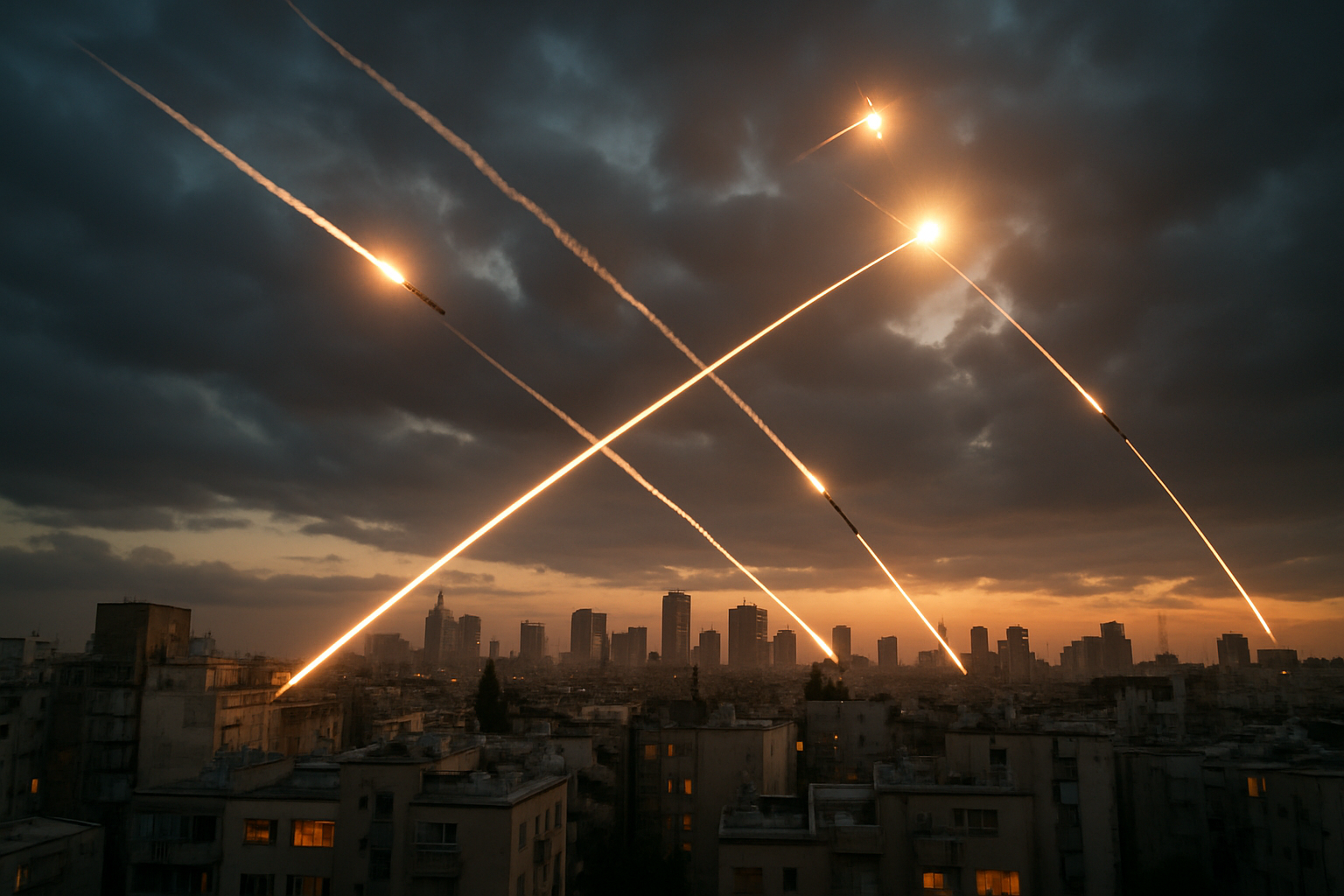
Iran launched a devastating wave of missile attacks against Israel and its Gulf neighbors on Wednesday, March 18, 2026, using cluster warheads that successfully penetrated Israeli air defenses to strike the Tel Aviv metropolitan area, killing two civilians in what marks a dangerous escalation in the ongoing Middle East conflict.
The Iranian Islamic Revolutionary Guard Corps (IRGC) launched what it termed the fourth wave of "Operation True Promise 4," firing four separate barrages throughout the night that targeted central Israel. The attacks killed Yaron and Ilana Moshe, a couple in their seventies, in Ramat Gan as they attempted to reach their apartment's safe room.
Cluster Warheads Evade Iron Dome
In a significant tactical development, Iran deployed cluster warheads specifically designed to cause damage even if intercepted by Israel's Iron Dome defense system. The attacks demonstrated the vulnerability of even advanced air defense systems to sophisticated weapons designed to spread destruction over wider areas.
Israeli authorities confirmed that falling munitions hit multiple sites across central Israel during the overnight barrage, which triggered air raid sirens throughout the greater Tel Aviv region. The national railway company announced that shrapnel from intercepted missiles disrupted train services, while emergency responders worked to clear debris from residential areas.
"An Iranian missile barrage killed two people near Israel's commercial hub Tel Aviv. Authorities reported that falling munitions had hit multiple sites in central Israel in the overnight barrage that triggered air raid sirens across the area."
— France 24 Report from Jerusalem
Systematic Regional Campaign
The attacks on Israel were part of a broader Iranian campaign targeting Gulf states that have supported diplomatic initiatives or provided territorial assistance to U.S. and Israeli forces. The IRGC has maintained its position that "no red lines remain," systematically targeting what it considers legitimate military and civilian infrastructure.
Iran's coordinated assault represents retaliation for the killing of Ali Larijani, Iran's Secretary of the Supreme National Security Council, who was eliminated in an Israeli airstrike along with his son Morteza and security aide Ali Reza Bayat. Israeli Foreign Minister Gideon Saar claimed responsibility for the operation, stating there had been a "$10 million bounty on Ali Larijani - we did it for free."
Global Crisis Deepens
The escalation occurs within the context of the most dangerous international crisis since the end of the Cold War. The conflict, which began with the confirmed death of Iranian Supreme Leader Ali Khamenei on March 1, 2026, has now entered its 18th day with unprecedented global implications.
Over 18,000 flights have been cancelled worldwide as multiple Middle Eastern countries have closed their airspace. Dubai International Airport, the world's busiest, remains completely shut down due to missile damage. Oil prices have surged past $100 per barrel as Iran has effectively closed the Strait of Hormuz with naval mines, cutting off 40% of global oil transit.
Humanitarian Crisis Mounting
The conflict has resulted in mounting civilian casualties across the region. Iran's Red Crescent reports over 1,300 Iranian civilian deaths from U.S.-Israeli strikes, while Lebanon has seen more than 900 killed as Hezbollah joined the conflict in solidarity with Iran. Israeli casualties, while lower, continue to mount with each retaliatory strike.
The systematic targeting of medical personnel in Lebanon has drawn international condemnation, with 26 paramedics killed and 51 wounded since the conflict's expansion. In Gaza, ceasefire violations have resulted in an additional 614 Palestinian deaths during what was supposed to be a peace period.
Nuclear Diplomacy in Ruins
The current military escalation emerged from the complete breakdown of nuclear negotiations that had achieved the most significant progress since the 2018 collapse of the Joint Comprehensive Plan of Action (JCPOA). Despite reaching "broad agreement on guiding principles" in Geneva talks, fundamental disagreements over scope proved insurmountable.
Iran had excluded its ballistic missile program and regional proxy networks as "red lines" in nuclear-only discussions, while the United States demanded comprehensive agreements covering missiles, armed groups, and human rights issues. Iran continues to enrich uranium at 60% purity with over 400 kilograms of material, approaching the 90% threshold needed for weapons-grade nuclear material.

Regional Coalition Under Strain
The unprecedented coalition of Saudi Arabia, UAE, Qatar, and Egypt that had supported diplomatic resolution is now severely strained as Iranian attacks have directly targeted member territories. Egyptian President Abdel Fattah al-Sisi condemned attacks on "sisterly Arab countries," warning of "comprehensive chaos" spreading across the region.
The targeting of civilian infrastructure in Gulf states marks a significant escalation in Iran's retaliation strategy. Kuwait has been forced to relocate Jazeera Airways operations to Saudi Arabia due to repeated drone attacks on its airports, while the UAE reported civilian casualties from missile debris in Abu Dhabi.
European Territory Under Attack
In an unprecedented development, Iranian drones have struck RAF Akrotiri in Cyprus, marking the first attack on European territory since World War II. This has prompted the largest European naval mobilization in the Eastern Mediterranean since 1974, with France deploying the Charles de Gaulle carrier group alongside British, Spanish, Italian, Dutch, and Greek vessels.
The European Union activated its ESTIA evacuation plan for the first time in the bloc's history, coordinating the emergency withdrawal of European nationals from conflict zones across the Middle East.
Economic Warfare Intensifies
Iran's mining of the Strait of Hormuz with an estimated 2,000-6,000 naval mines has created a global energy crisis. The International Energy Agency has authorized the largest strategic petroleum reserve release in its 50-year history, releasing 400 million barrels to stabilize markets.
Major shipping companies Maersk and MSC have suspended Persian Gulf operations, stranding over 150 tankers worth billions in cargo. Airlines are implementing emergency fuel surcharges as jet fuel costs have jumped from $85-90 per barrel to $150-200 per barrel.
Congressional Opposition Mounts
Operation Epic Fury, the U.S.-Israeli military campaign against Iran, has now cost $11.3 billion in its first week alone, with Pentagon operations planned through September—far beyond the initial 4-6 week timeline. The conflict has drawn bipartisan Congressional scrutiny, with Senator Richard Blumenthal expressing being "more concerned than ever" about potential ground troop deployment.
Trump administration intelligence official Joe Kent resigned in protest over the Iran war, objecting that there was "no imminent threat" justifying the military action. Public support for the conflict remains at an unprecedented low of only 25% approval.
Template-Setting Crisis
UN Secretary-General António Guterres has described the situation as "the greatest test of multilateral cooperation in the modern era." The crisis represents a template-setting moment for 21st-century international relations, determining whether diplomatic or military solutions will take precedence in future territorial and nuclear disputes.
The rapid transition from diplomatic breakthrough to military confrontation demonstrates the fragility of crisis management in the multipolar era. The collapse of the Geneva framework, despite achieving the most progress in years, raises fundamental questions about the viability of diplomatic solutions to modern nuclear crises.
With Iran's Revolutionary Guards now wielding unprecedented military control over governance following the hereditary succession of Mojtaba Khamenei as Supreme Leader, the conflict shows no signs of de-escalation. The stakes include regional war prevention, global energy security, nuclear governance credibility, and international law enforcement—all being tested simultaneously.
As rescue crews continue to search through rubble in Ramat Gan and missile defense systems remain on high alert across the region, the world faces the most dangerous international crisis since the end of the Cold War, with implications extending decades beyond the current events.