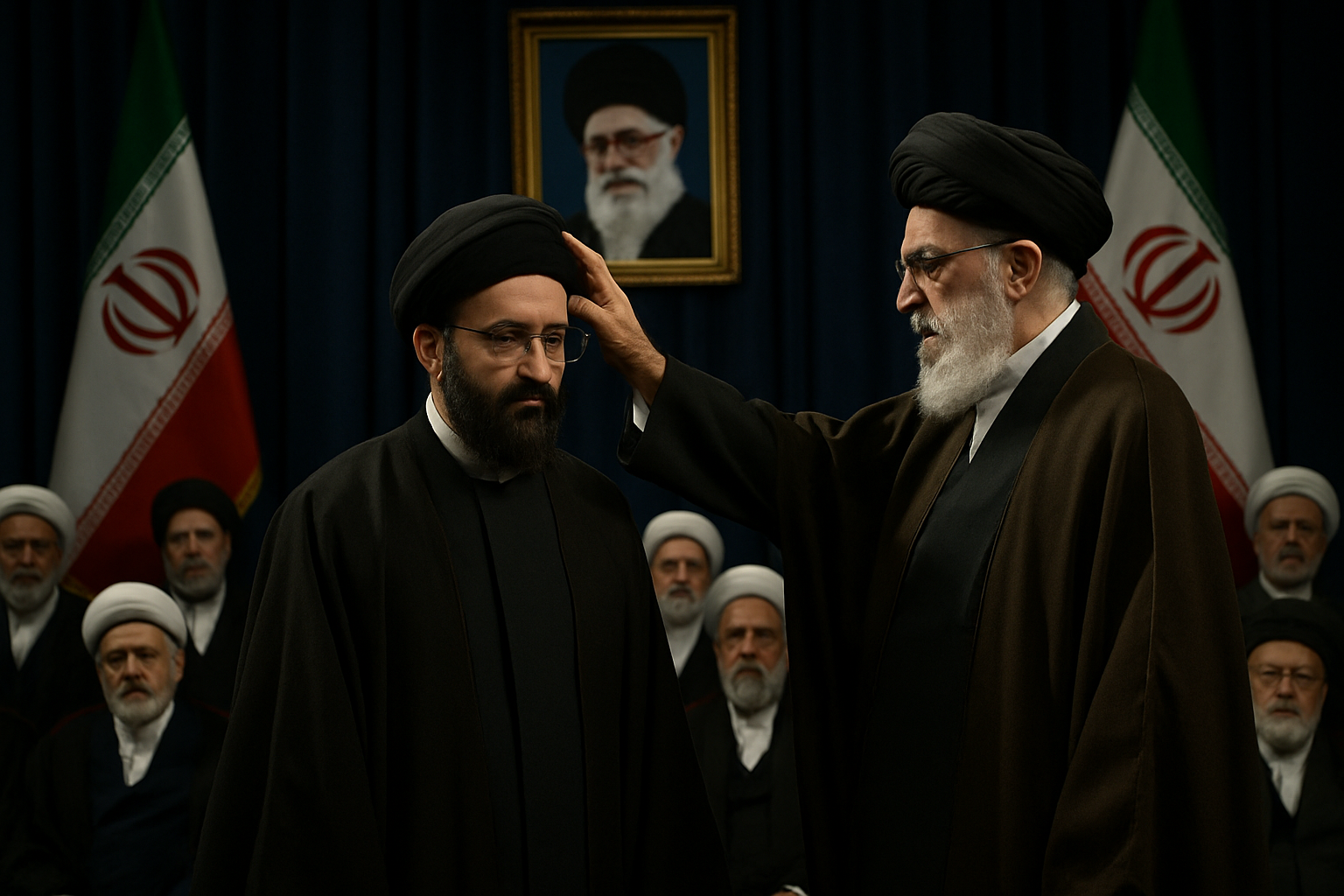
Iran's Assembly of Experts officially appointed Mojtaba Khamenei as the nation's new Supreme Leader on March 9, 2026, marking the first hereditary succession in the Islamic Republic's 47-year history, even as President Trump suggested the devastating war with Iran and Israel was approaching its conclusion.
The historic appointment of the 56-year-old son of deceased Supreme Leader Ali Khamenei comes amid the most dangerous international crisis since the Cold War, with global markets on a rollercoaster ride following Trump's optimistic assessment that the conflict is "very complete" despite ongoing regional violence and unprecedented economic disruption.
Historic Hereditary Succession Breaks Islamic Republic Tradition
The selection of Mojtaba Khamenei, known as the "invisible soldier" for his behind-the-scenes influence, represents a fundamental shift from clerical to military governance in Iran. Multiple sources confirmed that pressure from the Revolutionary Guards was decisive in the Assembly of Experts' unprecedented wartime selection.
According to intelligence assessments from the CIA, the appointment signals Iran's transformation from a theocracy to what critics describe as a "clerical monarchy," breaking the founding principle that succession should be based on religious credentials rather than family connections.
"This dynastic succession contradicts the revolutionary ideology and represents the consolidation of military influence over traditional clerical governance,"
— Regional Intelligence Analyst
The new Supreme Leader inherits an advanced nuclear program with 60% uranium enrichment and over 400 kilograms of weapons-grade material, sufficient for multiple nuclear weapons if weaponized. His appointment comes just nine days after his father's death in the March 1 US-Israeli "Operation Epic Fury" strikes.
Trump's Contradictory Signals on War Status
Despite Trump's declaration to CBS News that "the war is very complete," with Iran having "no navy, no communications, no air force," the conflict continues to escalate across multiple fronts. The President's comments triggered significant market volatility, with oil prices initially surging past $100 per barrel before falling following his optimistic assessment.
Trump simultaneously rejected Mojtaba Khamenei's appointment as "unacceptable" and claimed the right to choose Iran's next leader, representing the most direct assertion of American control over Iranian affairs since 1979. His phone conversation with Vladimir Putin on Monday focused on seeking a "quick political and diplomatic settlement" to the crisis.
Global Economic Crisis Deepens
The Iran war has triggered the most severe global economic disruption in years, with over 18,000 flights cancelled worldwide – the most extensive aviation crisis since COVID-19. The Strait of Hormuz, carrying 40% of global oil transit, remains effectively closed as Iran continues its "Operation True Promise 4" retaliation campaign.
Energy markets remain in chaos with natural gas prices up 24% in Europe and 78% in the United States. Major shipping companies including Maersk and MSC have suspended operations in the Persian Gulf, leaving over 150 tankers stranded with billions in cargo.
Stock markets worldwide have experienced severe volatility, with Pakistan's KSE-100 suffering its largest single-day decline in history at -8.97%. The conflict has exposed fundamental vulnerabilities in global supply chains dependent on Middle Eastern trade routes.
Regional Violence Spreads Across Middle East
Iran's retaliation campaign has caused casualties across multiple countries, marking the first attack on European territory since World War II when Iranian drones struck RAF Akrotiri in Cyprus. This prompted an unprecedented naval coalition response from European powers, including HMS Dragon and frigates from Spain, Italy, France, Netherlands, and Greece.
Regional casualties from Iranian strikes include one civilian killed in the UAE, 32 injured in Kuwait from airport attacks, and eight wounded in Qatar despite successful Patriot missile interceptions. The violence has severely strained the previously unprecedented coalition of Saudi Arabia, UAE, Qatar, and Egypt that had supported diplomatic solutions.
Egyptian President Sisi condemned the attacks on "sisterly Arab countries," warning of "comprehensive chaos" spreading across the region if the conflict continues to escalate.
Nuclear Diplomacy Completely Collapses
The current crisis represents the complete breakdown of nuclear diplomacy, despite recent progress in Geneva talks that had achieved "broad agreement on guiding principles" – the most significant advancement since the 2018 JCPOA collapse. The fundamental disagreement over scope proved insurmountable, with Iran excluding ballistic missiles and proxy groups as "red lines" while the US demanded comprehensive agreements covering missiles, armed groups, and human rights.
The nuclear governance crisis occurs amid the broader context of the New START treaty expiration on February 5, marking the first time in over 50 years without US-Russia nuclear constraints. UN Secretary-General António Guterres has warned that nuclear risks are at their "highest in decades."
Congressional Scrutiny Intensifies
Bipartisan lawmakers in Congress are demanding comprehensive briefings on strategy, costs, and potential ground troop deployment. Senator Richard Blumenthal expressed being "more concerned than ever" about the possibility of boots on the ground, while the conflict's unpopularity among Americans has been described as "almost unprecedented" in early stages of military operations.
Operation Epic Fury has cost $3.7 billion in its first week, with daily expenditures of $891.4 million making it the most expensive military campaign since the 2003 Iraq invasion. Financial markets are emerging as an "ultimate constraint" on further escalation.
International Evacuations Reach Massive Scale
The crisis has triggered the largest coordinated international evacuation since the Arab Spring of 2011. Australia has 115,000 nationals trapped in the region, while Germany is evacuating 30,000 stranded tourists. The European Union activated its ESTIA evacuation protocol for Cyprus for the first time in its history.
Multiple countries have ordered immediate evacuations from Iran, citing "extremely uncertain" security conditions. The scale of the humanitarian crisis reflects the global reach of what began as a regional conflict.
Template-Setting Moment for 21st Century
UN Secretary-General Guterres has called the crisis "the greatest test of multilateral cooperation and crisis management in the modern era." The rapid transition from diplomatic breakthrough to military confrontation demonstrates the fragility of crisis management in the multipolar era.
The stakes extend far beyond the Middle East, encompassing regional war prevention, global energy security, nuclear governance credibility, and international law enforcement mechanisms. Success in containing the crisis could provide a diplomatic template for future nuclear disputes, while failure may accelerate military solutions and encourage proliferation globally.
The appointment of Mojtaba Khamenei as Supreme Leader, combined with Trump's contradictory signals about the war's status, represents a watershed moment in international relations with implications that will reverberate for decades. As the most dangerous crisis since the Cold War's end, the decisions made in the coming days and weeks will determine whether the world moves toward diplomatic conflict resolution or sets a precedent for military solutions to territorial and nuclear disputes in the 21st century.