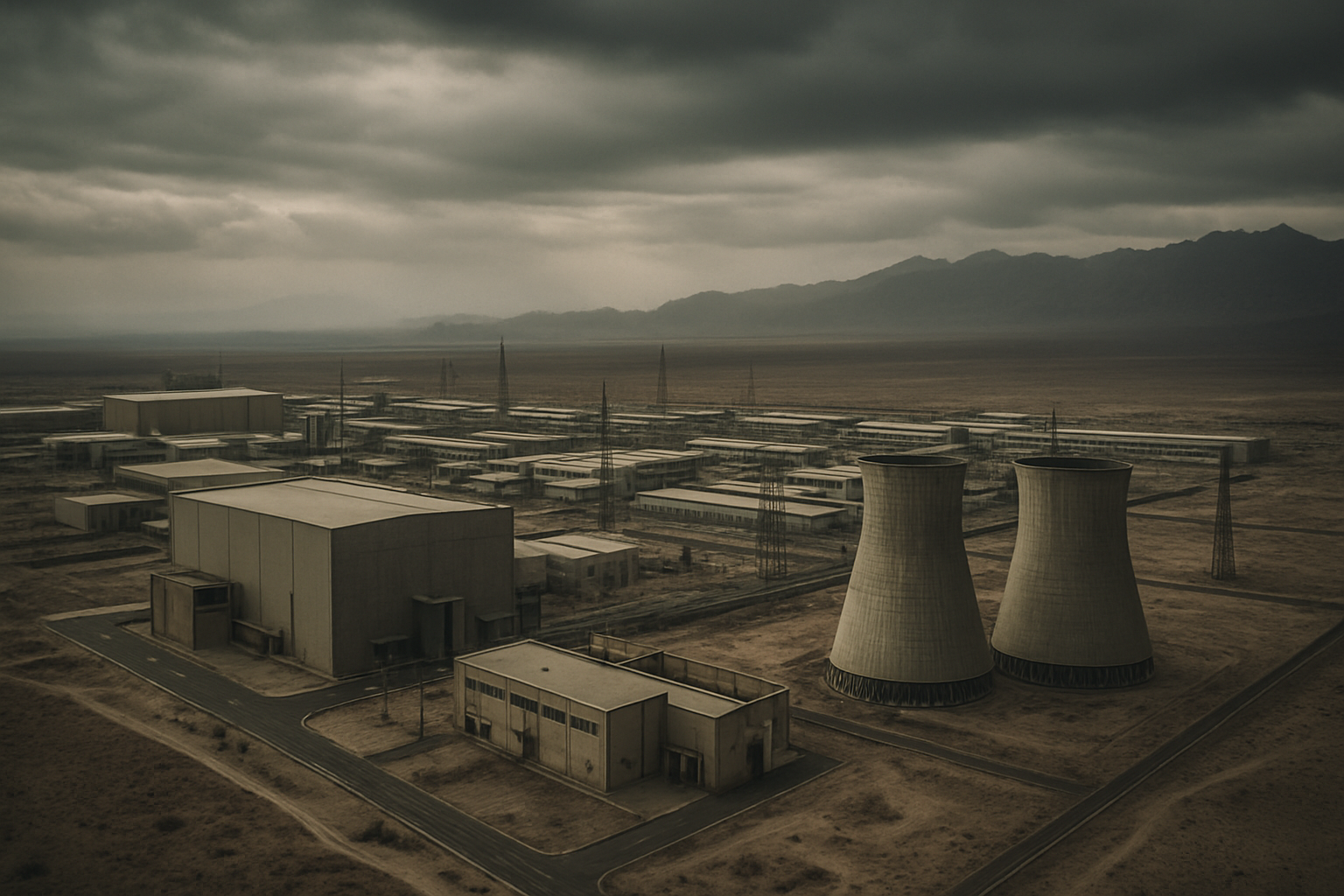
The United States and Israel launched coordinated military strikes against Iran's Natanz uranium enrichment facility on Saturday morning, marking the first direct attack on Iranian nuclear infrastructure during the escalating three-week Middle East conflict that has become the most dangerous international crisis since the Cold War.
According to Iranian state media and international sources, the Shahid Ahmadi Roshan uranium enrichment complex at Natanz was targeted in what Iran's semi-official Tasnim news agency described as a joint US-Israeli operation. The facility, central to Iran's nuclear program, houses advanced centrifuges used for uranium enrichment.
Iran's Atomic Energy Organization immediately conducted technical investigations to assess potential radioactive contamination in the surrounding area. "Based on the results obtained, no leakage of radioactive materials has been reported at this complex, and there is no danger threatening residents of the surrounding areas," Iranian officials stated, according to multiple sources including Bosnia's N1 Info and Germany's Tagesschau.
International Atomic Energy Agency Responds
The International Atomic Energy Agency (IAEA) confirmed receiving reports about the strike and announced it was evaluating the situation. Director General Rafael Grossi has repeatedly warned about the need for "maximum restraint" to avoid nuclear accidents during the ongoing conflict.
Italian news agency ANSA reported that the IAEA confirmed "no increases in radiation levels have been recorded at Natanz," while the organization continues monitoring the facility through its safeguards systems.
Context of Escalating Conflict
The Natanz attack represents a significant escalation in the ongoing "Operation Epic Fury" - the largest US-Israeli coordinated military campaign since the 2003 Iraq invasion. The conflict began on February 28, 2026, following the collapse of nuclear diplomacy talks in Geneva, despite achieving what experts called "broad agreement on guiding principles" - the most progress since the 2018 JCPOA collapse.
The crisis has already resulted in unprecedented global consequences:
- Over 18,000 flights cancelled worldwide - the most severe aviation disruption since COVID-19
- Oil prices surging past $100 per barrel as Iran has mined the Strait of Hormuz, which carries 40% of global oil transit
- Eight Middle Eastern countries maintaining simultaneous airspace closures
- Dubai International Airport, the world's busiest, completely shut down from missile damage
Iranian Leadership Crisis
The nuclear facility strike occurs amid Iran's most severe leadership crisis since the 1979 revolution. Supreme Leader Ali Khamenei was confirmed killed on March 1, 2026, ending his 37-year rule. His son, Mojtaba Khamenei, has been appointed as his successor - marking the first hereditary succession in the Islamic Republic's 47-year history.
Intelligence assessments suggest the Revolutionary Guards have gained unprecedented control over Iranian governance during the crisis, representing a shift from traditional clerical leadership to military governance.
Nuclear Diplomacy Breakdown
The current military confrontation emerged from the complete collapse of nuclear negotiations. Despite Geneva talks achieving significant progress, fundamental disagreements proved insurmountable. Iran maintained that ballistic missiles and regional proxies were "red lines" to be excluded from nuclear-only discussions, while the US demanded comprehensive agreements including missiles, armed groups, and human rights issues.
Iran continues uranium enrichment at 60% purity - approaching the 90% level needed for weapons-grade material - with over 400 kilograms of enriched uranium that experts say would be sufficient for multiple nuclear weapons if weaponized.
Regional Coalition Under Strain
The Natanz attack further strains the unprecedented Saudi Arabia, UAE, Qatar, and Egypt coalition that had supported diplomatic efforts. Iranian retaliation under "Operation True Promise 4" has directly targeted these countries' territories, with casualties reported across the region:
- UAE: 1 civilian killed in Abu Dhabi from missile debris, Dubai International Airport shut down
- Kuwait: 32 injured in airport drone strikes
- Qatar: 8 injured despite successfully intercepting 65 missiles and 12 drones using Patriot systems
- Cyprus: RAF Akrotiri base struck - the first attack on European territory since World War II
Egyptian President Abdel Fattah el-Sisi condemned Iranian attacks on "sisterly Arab countries," warning of "comprehensive chaos" spreading across the region.
Global Economic Impact
The crisis has created the most severe energy security challenge in decades. The International Energy Agency released a record 400 million barrels from strategic petroleum reserves - the largest intervention in the agency's 50-year history. Major shipping companies Maersk and MSC have suspended Persian Gulf operations, with over 150 oil tankers stranded worth billions in cargo.
Natural gas prices have surged 24% in Europe and 78% in the US, while Qatar has halted LNG production affecting approximately 20% of global exports. Airlines worldwide are implementing emergency fuel surcharges as jet fuel costs jumped from $85-90 per barrel to $150-200.
Congressional Scrutiny Intensifies
The Natanz nuclear facility attack has intensified already unprecedented Congressional scrutiny of the conflict. Bipartisan lawmakers are demanding answers about strategy, costs, and the potential for ground troop deployment. Operation Epic Fury has cost $11.3 billion in its first week alone, with Pentagon operations reportedly prepared through September - far beyond the initial 4-6 week timeline.
Senator Richard Blumenthal expressed being "more concerned than ever" about potential ground troop deployment, while conflict approval ratings remain at historically low levels of just 25% public support for early-stage military operations.
"This administration must provide Congress with a clear strategy and exit plan. The American people deserve to know where this is heading."
— Senator Richard Blumenthal
Humanitarian Crisis Mounts
Iran's Red Crescent reports over 787 civilian casualties from US-Israeli strikes, including the devastating attack on a girls' elementary school in Minab that killed 53-85 students and staff. The Pentagon has confirmed responsibility for the school attack, citing "outdated targeting data."
International evacuations are now the largest coordinated effort since the Arab Spring in 2011, with Australia reporting 115,000 nationals trapped in the region and Germany attempting to evacuate 30,000 stranded tourists. The European Union has activated its ESTIA evacuation plan for Cyprus for the first time in the bloc's history.
Trump's Escalating Demands
President Trump has demanded Iran's "unconditional surrender" and claimed the right to personally choose Iran's next Supreme Leader, rejecting Mojtaba Khamenei as a "lightweight." These represent the most direct assertions of American control over Iranian internal affairs since the 1979 revolution.
The President's position eliminates diplomatic solution possibilities and transforms what began as nuclear-focused operations into comprehensive regime change objectives.
Template-Setting Crisis
UN Secretary-General António Guterres has called the crisis "the greatest test of multilateral cooperation and crisis management in the modern era." The rapid transition from diplomatic breakthrough to military confrontation demonstrates the fragility of crisis management in the multipolar era.
Nuclear governance experts note this occurs in the context of the New START treaty's expiration on February 5 - the first time in over 50 years without US-Russia nuclear constraints - while China continues expanding its nuclear arsenal.
Looking Ahead
The Natanz nuclear facility attack marks a dangerous new phase in the conflict, with direct targeting of nuclear infrastructure raising unprecedented proliferation risks. The success or failure of containing this crisis will establish precedents for international dispute resolution, nuclear proliferation prevention, and territorial sovereignty enforcement that will influence 21st-century conflict resolution approaches for decades.
Stakes include regional war prevention, global energy security, nuclear governance credibility, and international law enforcement mechanisms - all tested simultaneously in what has become the most consequential international crisis affecting Middle East stability since the Cold War's end.
As the conflict enters its fourth week, the international community faces critical decisions that will reverberate through international relations for decades, determining whether diplomatic or military solutions become the preferred approach for future territorial and nuclear disputes worldwide.