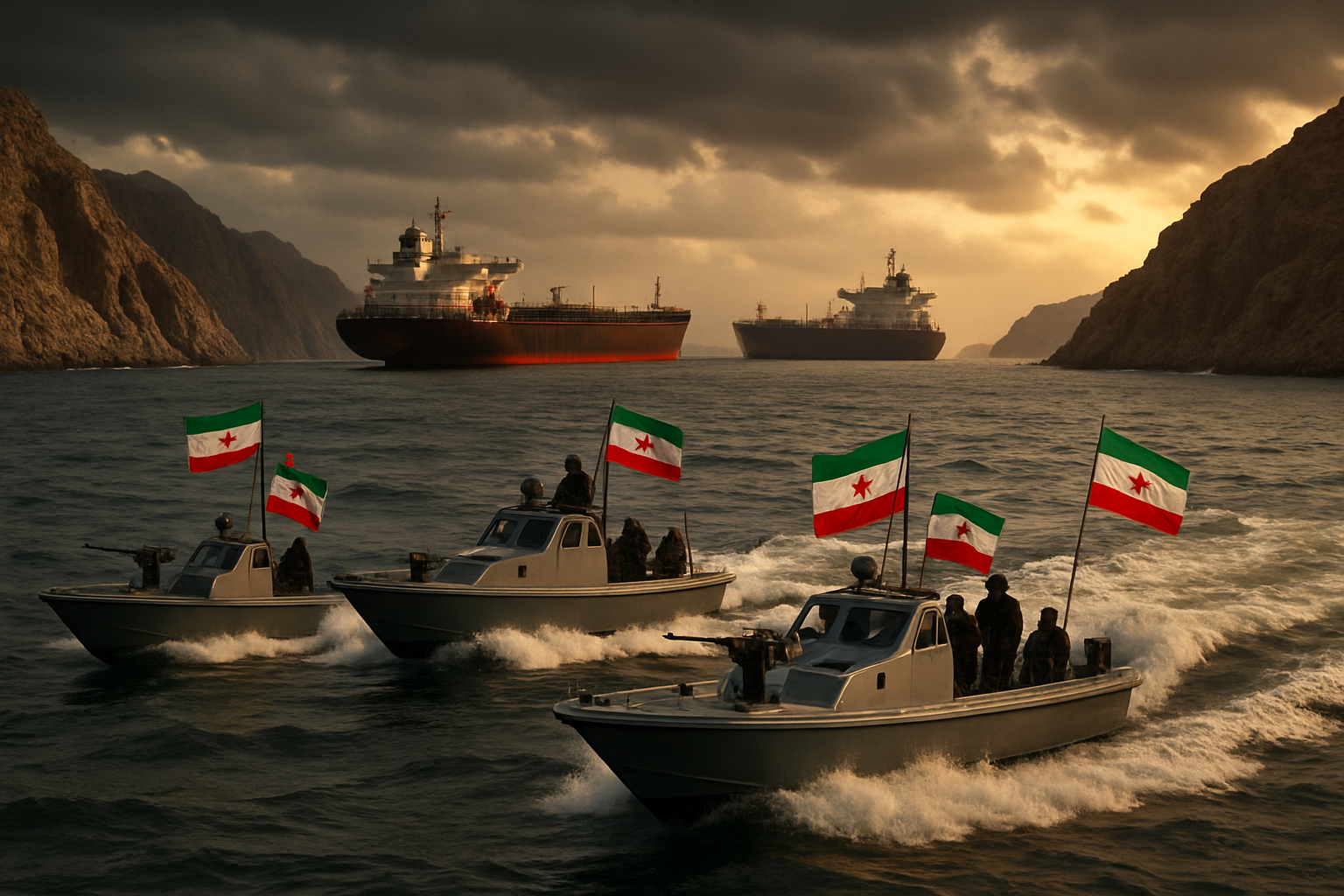
Iran's Islamic Revolutionary Guard Corps seized multiple commercial vessels in the Strait of Hormuz on Wednesday, dramatically escalating the international maritime crisis and threatening the fragile ceasefire between Tehran and Washington that has teetered on the brink of collapse for days.
The Revolutionary Guard captured the Liberia-flagged Epaminondas and the Panama-flagged MSC Francesca, escorting both vessels to Iranian territorial waters after accusing them of "operating without permits and tampering with navigation systems." A third container ship was reportedly fired upon in the same area but escaped damage and resumed sailing, according to maritime security sources.
The seizures occurred just hours after President Donald Trump announced an indefinite extension of the Iran ceasefire at Pakistan's request, while Iran categorically rejected any further negotiations under current conditions. Oil prices surged immediately, with Brent crude climbing to $106.04 and WTI reaching $104.29 - the second time in 2026 that prices have breached the critical $100 threshold.
Navy Secretary Fired Amid Crisis
In a related development that underscores the crisis gripping the Pentagon, Navy Secretary John Phelan was abruptly dismissed from his position, with sources citing disagreements over shipbuilding reforms and falling out with senior Pentagon leadership. The firing comes as the United States maintains a controversial naval blockade of Iranian ports - widely considered an act of war under international law.
"The reasons for John Phelan's dismissal are unclear. On Thursday, an informal EU summit in Cyprus is discussing energy supply and the war in the Middle East," reported Austrian media, highlighting the international concern over the escalating situation.
White House press secretary Karoline Leavitt condemned the ship seizures as "piracy" but notably stated they did not constitute a ceasefire violation since neither vessel was American or Israeli-flagged.
Pakistan's Mediation Under Threat
The ship seizures represent a severe blow to Pakistan's unprecedented diplomatic achievement. Prime Minister Shehbaz Sharif and Field Marshal Asim Munir's "Islamabad Accord" had successfully achieved a ceasefire just 88 minutes before Trump's "whole civilization will die tonight" deadline on April 8, causing oil prices to crash 20% from $119.50 to $100 per barrel.
Pakistan's innovative "message relay system" had demonstrated that middle power diplomacy could bridge major adversaries when traditional mechanisms failed. However, the latest developments severely endanger this template-setting mediation framework.
Iranian Parliament Speaker Mohammad Bagher Qalibaf warned that Iran would not negotiate "under the shadow of threats," threatening to demonstrate a "new balance of power on the battlefield" with prepared "new cards." Foreign Ministry spokesman Esmaeil Baghaei declared Iran had "no plans for further negotiations with the US," citing excessive demands and the ongoing naval blockade.
Nuclear Sticking Points Remain Unchanged
The fundamental disagreements that led to the collapse of the 21-hour marathon negotiations led by Vice President JD Vance in Islamabad remain unresolved. The United States continues to demand that Iran suspend its 60% uranium enrichment program and abandon its stockpile of over 400 kilograms of weapons-grade material - sufficient for multiple nuclear weapons if weaponized.
Iranian Foreign Minister Abbas Araghchi has maintained his position that Iran "will never abandon enrichment even if war is imposed." This represents the same structural disagreement that has prevented any breakthrough since the collapse of the Joint Comprehensive Plan of Action (JCPOA) in 2018.
The nuclear crisis unfolds against the backdrop of the New START treaty's expiration in February 2026 - the first time in over 50 years that the world lacks US-Russia nuclear constraints, adding urgency to global nuclear governance concerns.
Lebanon Loophole Creates Unbridgeable Gap
A critical factor complicating any potential resolution is what negotiators have termed the "Lebanon loophole." Israeli Prime Minister Benjamin Netanyahu's explicit exclusion of Lebanon from the Pakistan-mediated ceasefire has created what Iranian officials describe as an "unbridgeable gap."
Israeli strikes killed over 254 people in a single day during the Islamabad talks, with 1.2 million Lebanese displaced - representing 25% of the country's population. Iran has demanded comprehensive enforcement across all fronts, while Vice President Vance acknowledged Iran's "legitimate misunderstanding" about the scope of the ceasefire arrangement.
Global Economic Impact Intensifies
The Strait of Hormuz, through which approximately 40% of global oil transit passes, has become the epicenter of this escalating crisis. Major shipping companies Maersk and MSC have suspended operations indefinitely, leaving over 150 tankers stranded with billions of dollars in cargo.
The International Energy Agency (IEA) continues to maintain its record 400 million barrel strategic petroleum reserve release - the largest intervention in the agency's 50-year history. Consumer impacts are being felt globally, with Bangladesh implementing fuel rationing for 170 million people and Pakistan considering wartime austerity measures.
European heating costs have surged 24% while US natural gas prices have increased by 78%, threatening to reverse the economic relief that briefly emerged during the ceasefire period.
International Coalition Fractures
The crisis has exposed deep fractures within traditional Western alliances. UK Prime Minister Keir Starmer has declared that Britain "will not be dragged into an Iran war," while France and Germany have emphasized diplomatic approaches over military solutions.
Australia and Japan have declined to provide naval support - representing the most significant rejection of American military leadership since the 2003 Iraq War. Only Israeli Prime Minister Netanyahu has offered "full support and close coordination" with US efforts, highlighting the international isolation of Washington's aggressive approach.
Congressional opposition has reached unprecedented levels, with only 25% of Americans supporting Operation Epic Fury - the military campaign that has already cost $11.3 billion in its first week. Senator Richard Blumenthal expressed being "more concerned than ever" about the potential deployment of ground troops.
Regional Coalition Under Maximum Strain
The unprecedented consensus among Saudi Arabia, the United Arab Emirates, Qatar, and Egypt that had supported diplomatic solutions is now under severe threat following Iran's "Operation True Promise 4" retaliation campaign. The UAE suffered one civilian death in Abu Dhabi, Kuwait reported 32 injuries at airports, and Qatar had eight people wounded despite successful Patriot missile intercepts.
Egyptian President Abdel Fattah al-Sisi's warnings about "comprehensive chaos" affecting "sisterly countries" have proven increasingly prophetic as diplomatic failures mount and military confrontation escalates.
Humanitarian Crisis Mounting
The Iranian Red Crescent reports over 787 civilian casualties from US-Israeli strikes, including a Pentagon-confirmed elementary school attack that killed between 165-185 students due to what officials described as "outdated targeting data." War crimes investigations are underway.
International evacuations have reached Arab Spring-scale proportions, with Australia reporting 115,000 people trapped and Germany evacuating 30,000 nationals. The European Union activated its ESTIA crisis mechanism for the first time in the bloc's history after Iranian drones struck RAF Akrotiri in Cyprus - the first attack on European territory since World War II.
Template-Setting Crisis for 21st Century
UN Secretary-General António Guterres has described the current situation as "the greatest test of multilateral cooperation in the modern era." The stakes extend far beyond the immediate bilateral dispute between Iran and the United States, affecting global energy security architecture, nuclear governance credibility, and international law enforcement mechanisms.
The success or failure of diplomatic solutions in this crisis will establish a precedent for how 21st-century territorial and nuclear disputes are resolved. The rapid transition from diplomatic breakthrough to military confrontation demonstrates what experts describe as "multipolar era fragility" in crisis management mechanisms.
The world now faces a critical juncture: whether Pakistan's innovative mediation framework can restore negotiations after this latest setback, or whether the international community will face a prolonged military confrontation with global implications affecting energy markets, nuclear proliferation mechanisms, and international stability for decades to come.
Path Forward Uncertain
As oil markets remain volatile and shipping companies reassess their exposure to the Persian Gulf, the coming days will be decisive in determining whether diplomatic innovation can ultimately triumph over military confrontation. The template being set in April 2026 will likely influence international crisis resolution approaches for decades, making this among the most consequential geopolitical developments since the end of the Cold War.
With fundamental disagreements over nuclear programs, regional conflicts, and enforcement mechanisms remaining unbridged, the window for peaceful resolution continues to narrow even as the humanitarian and economic costs mount globally.