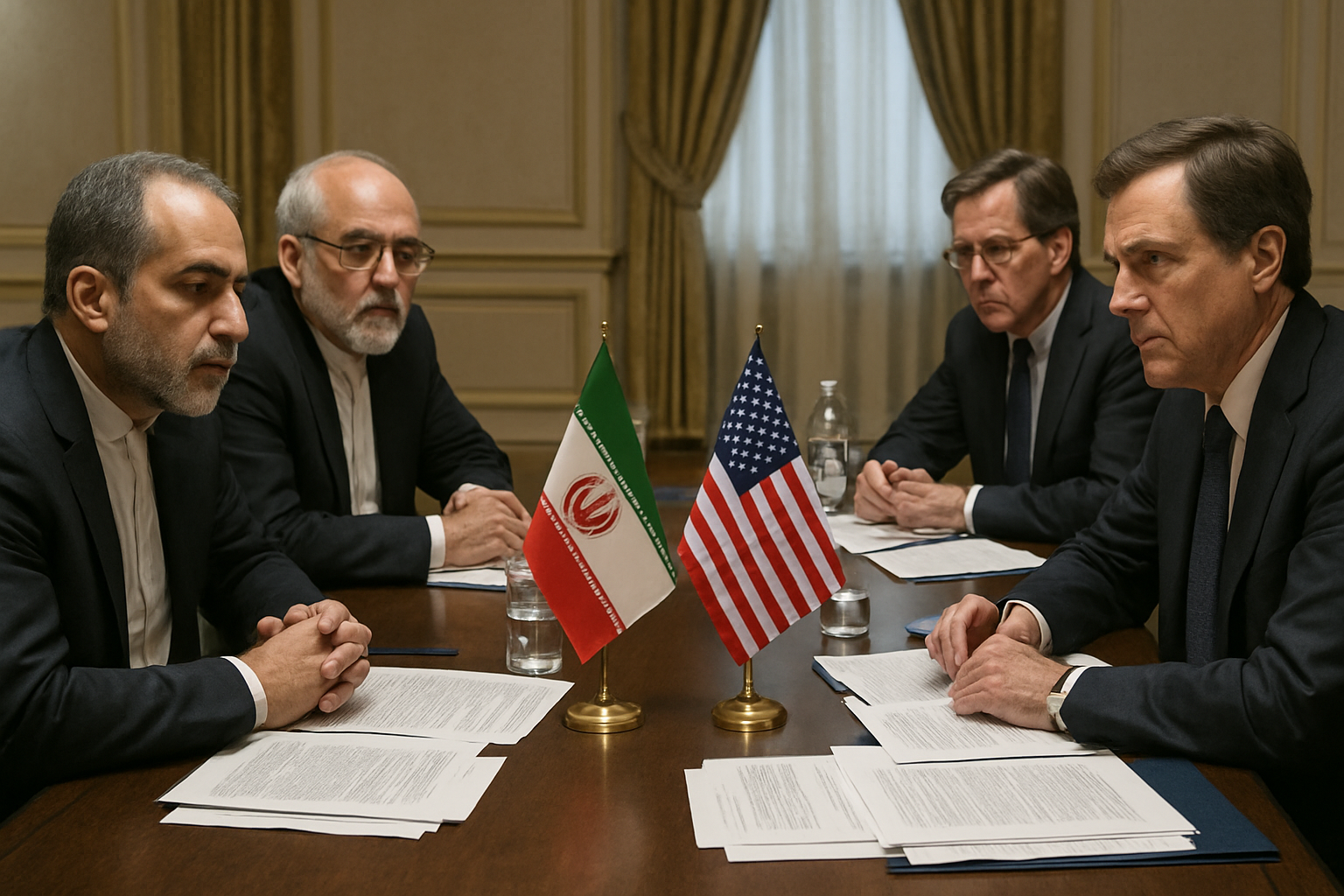
International negotiations over Iran's nuclear program have reached a critical juncture, with diplomatic sources warning that the window for a peaceful resolution is rapidly closing as military tensions escalate and fundamental disagreements persist between Tehran and Washington.
Following a series of high-stakes negotiations in Geneva mediated by Switzerland and Oman, Iranian Foreign Minister Abbas Araghchi announced significant progress, claiming "broad agreement on a set of guiding principles" with the United States. However, this diplomatic breakthrough remains overshadowed by deepening military confrontation and intractable disputes over the scope of any potential agreement.
Nuclear Program at Weapons-Grade Threshold
Iran continues enriching uranium at 60% purity, significantly exceeding the 3.67% limit established under the original Joint Comprehensive Plan of Action (JCPOA) and approaching the 90% threshold considered weapons-grade. Intelligence assessments confirm Iran possesses sufficient enriched uranium for multiple nuclear weapons if weaponized, creating urgent pressure for diplomatic resolution.
The International Atomic Energy Agency (IAEA) has struggled to maintain oversight since Iran suspended cooperation in November 2025. In Geneva, IAEA Director-General Rafael Grossi held separate discussions with Araghchi on February 16, focusing on resuming nuclear inspections and restoring monitoring cameras to damaged facilities.
"Iran will never abandon uranium enrichment even if war is imposed on us."
— Abbas Araghchi, Iranian Foreign Minister
Despite claims of diplomatic progress, Iranian officials have maintained uncompromising positions. President Masoud Pezeshkian declared Iran "open to verification" to prove non-weaponization intentions, representing a potential policy shift. However, this was coupled with firm declarations that enrichment rights remain "inalienable."
Military Escalation Reaches Unprecedented Scale
The diplomatic process unfolds against a backdrop of extraordinary military tensions. President Trump has deployed a dual-carrier strike force—USS Gerald R. Ford and USS Abraham Lincoln—creating the largest U.S. naval presence in the Middle East in years, positioned approximately 800 kilometers from Iran's coast.
Recent military incidents have raised stakes dramatically. A U.S. F-35C fighter from the Abraham Lincoln shot down an Iranian Shahed-139 drone that approached the carrier group in what officials described as an "aggressive" manner. Simultaneously, Islamic Revolutionary Guard Corps (IRGC) vessels have repeatedly harassed U.S.-flagged tankers in the Strait of Hormuz, the critical waterway handling 40% of global oil transit.
These incidents have contributed to oil price volatility, with markets rising over $1 per barrel on tension spikes. Trump issued his starkest warning yet, declaring aboard Air Force One: "I don't think they want the consequences of not making a deal."
Fundamental Scope Disagreement Threatens Progress
The core obstacle to breakthrough remains a fundamental disagreement over negotiation scope. Iran maintains that ballistic missiles and regional proxy activities represent "red lines" that must be excluded from nuclear-focused talks. Tehran demands compartmentalized negotiations addressing only atomic program elements.
Conversely, the United States insists on comprehensive agreements addressing Iran's entire threat matrix. Secretary of State Marco Rubio has repeatedly stated that any accord must include limitations on ballistic missiles, support for armed groups, and human rights improvements.
This structural disagreement has prevented diplomatic breakthroughs for over a decade since the original JCPOA's collapse in 2018. The fundamental question remains whether innovative compromise solutions can bridge positions that have remained unchanged through multiple negotiating rounds.
Regional Coalition Provides Unprecedented Support
One remarkable development has been the emergence of unprecedented regional consensus supporting diplomatic engagement. Saudi Arabia, United Arab Emirates, Qatar, and Egypt have all backed the negotiation process—an extraordinary alignment of typically competing Middle Eastern powers.
Oman has leveraged its historical neutral mediation role from the 2015 JCPOA negotiations, proving essential for maintaining structured dialogue despite trust deficits. The Sultanate's facilitation has enabled continued engagement even as military tensions escalate.
This regional coalition reflects shared concerns about potential military confrontation consequences. The Persian Gulf's energy security implications—with 40% of global oil transit vulnerable to disruption—create strong incentives for conflict prevention among neighboring states.
Domestic Pressures Complicate Diplomacy
Internal pressures on both sides significantly complicate negotiation dynamics. Iran faces severe domestic challenges, with over 42,000 protest arrests since 2022 and continued civil society suppression. The regime's harsh response to dissent has drawn international condemnation, including additional prison sentences for Nobel Peace Prize laureate Narges Mohammadi.
Economic sanctions have created regime survival pressures, but Iranian leadership appears to prioritize nuclear capabilities over sanctions relief. This calculation affects willingness to make substantive compromises on enrichment programs.
The Trump administration faces different but equally significant pressures. Republican hawks view engagement as appeasement, preferring maximum pressure approaches. However, the administration also seeks foreign policy victories while managing Israeli security concerns about incomplete agreements addressing missile and proxy threats.
Israeli Coordination Shapes U.S. Position
Israeli-U.S. coordination has proven crucial in shaping American negotiating positions. Multiple Trump-Netanyahu meetings have established Israeli red lines requiring comprehensive agreements that address "limiting ballistic missiles and ending Iranian axis support."
Israel views nuclear-only frameworks as insufficient for addressing existential security threats from Iran's integrated missile and proxy network, including Hezbollah, Hamas, and Houthi forces. This coordination ensures that any potential agreement must address broader regional security architecture rather than atomic programs alone.
International Nuclear Governance Crisis
The Iran crisis unfolds within a broader nuclear governance breakdown. The New START treaty between the United States and Russia expired on February 5, 2026—marking the first time in over 50 years without bilateral nuclear constraints between the superpowers. China's nuclear expansion further complicates multilateral frameworks.
UN Secretary-General António Guterres has warned that nuclear risks are at their "highest level in decades." Success in Iran negotiations could provide a template for 21st-century nuclear crisis resolution, while failure might encourage proliferation elsewhere and undermine diplomatic credibility globally.
Verification Challenges Exceed Previous Frameworks
Any potential agreement faces unprecedented verification challenges. Iran's nuclear infrastructure has expanded significantly since 2018, incorporating advanced centrifuge technology, sophisticated facilities, and dispersed capabilities that exceed original JCPOA complexity.
Technical monitoring mechanisms would require innovation addressing 60% enrichment capability, advanced centrifuge operations, and expanded nuclear infrastructure not existing during previous frameworks. Years of implementation would be needed for rebuilding trust between historically antagonistic parties.
Intelligence sources suggest Iran might consider a three-year enrichment halt and stockpile transfer to Russia as confidence-building measures, but hardline official statements cast doubt on such compromises without corresponding U.S. concessions.
Coming Weeks Prove Decisive
The diplomatic process enters its most critical phase as both sides have demonstrated structured dialogue willingness despite fundamental disagreements. Framework establishment represents genuine progress in creating negotiation architecture, but substantive positions on uranium enrichment, missile capabilities, and sanctions relief remain unchanged from decade-old challenges.
Success requires innovative diplomatic solutions bridging longstanding disagreements that have prevented breakthrough attempts since the original JCPOA's collapse. The alternative—military confrontation acceleration—could reshape Middle Eastern geopolitics for decades while destabilizing global energy markets.
U.S. officials expect Iranian representatives to return with concrete proposals within two weeks, suggesting sustained engagement frameworks despite disagreements. This timeline will test whether diplomatic innovation can produce breakthrough agreements or whether fundamental positions prove unbridgeable.
Maximum Stakes for Regional Stability
The negotiations' outcome carries implications extending far beyond bilateral U.S.-Iran relations. Success could prevent regional warfare, provide diplomatic templates for nuclear crisis resolution, and strengthen global non-proliferation norms. Regional war prevention stakes include Persian Gulf energy market stability affecting worldwide supply chains.
Failure might accelerate military solutions with consequences reshaping Middle Eastern geopolitics for generations. Such escalation could encourage nuclear proliferation elsewhere, undermine diplomatic credibility for territorial and security dispute resolution, and destabilize international law enforcement mechanisms in an increasingly multipolar world.
As diplomatic windows narrow and military preparations intensify, the coming weeks represent a template-setting moment for 21st-century conflict resolution—determining whether innovative diplomacy can prevail over military confrontation in addressing existential security challenges that define modern international relations.