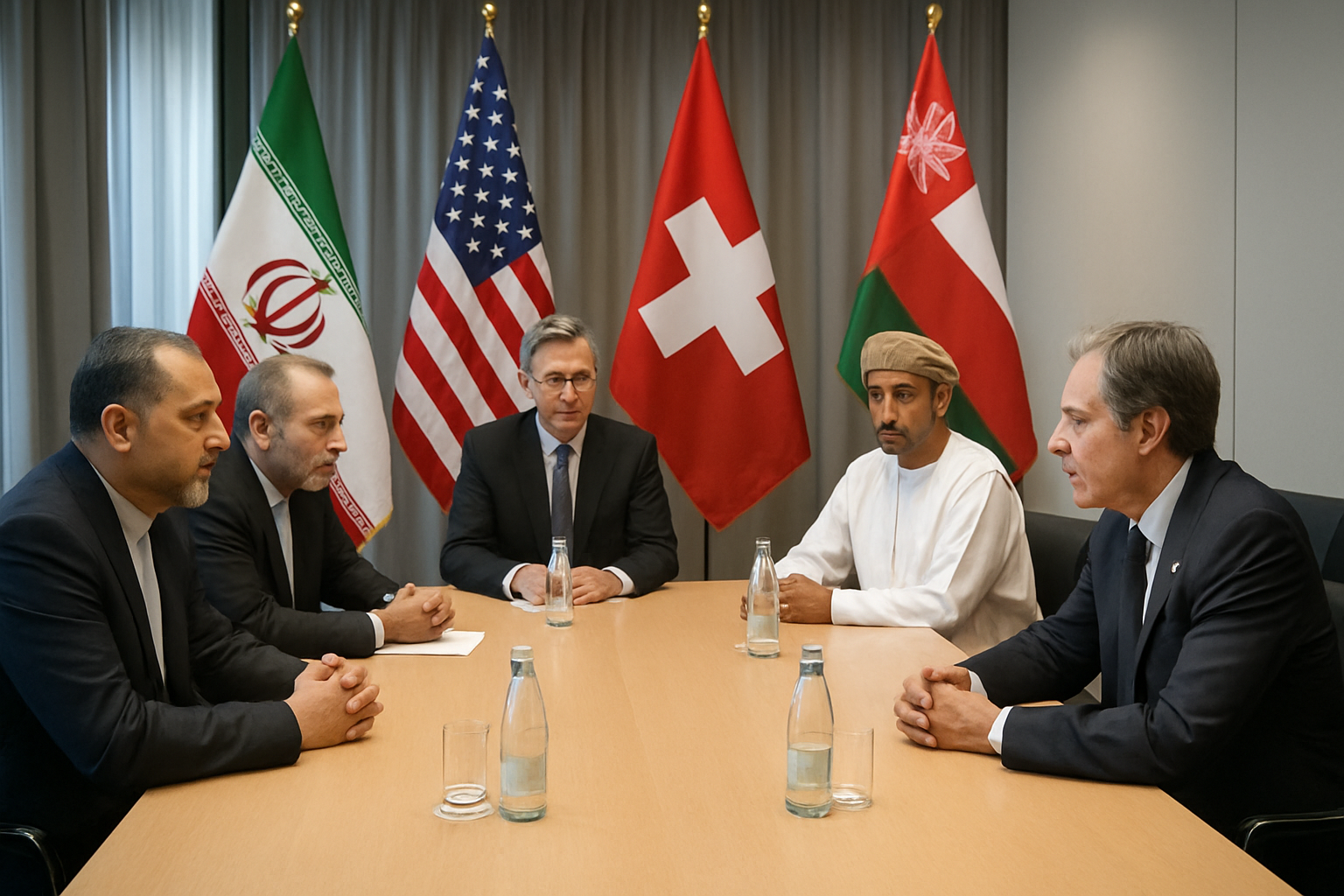
Iranian Foreign Minister Abbas Araghchi has arrived in Geneva for a crucial third round of nuclear negotiations with US officials, even as President Trump maintains an unprecedented military buildup in the Persian Gulf and threatens "bad things will happen" if Iran fails to reach a comprehensive nuclear agreement within days.
The talks, scheduled for Thursday February 26, come at a pivotal moment in the decade-long nuclear crisis, with Iran enriching uranium at 60% purity—dangerously close to the 90% weapons-grade threshold—while the largest US naval deployment since the 2003 Iraq invasion sits just 800 kilometers from Iran's coastline.
Diplomatic Framework Emerges Despite Military Tensions
Despite the military posturing, significant diplomatic progress has emerged from previous rounds. In February, Araghchi announced a "broad agreement on guiding principles" during Geneva talks—the most substantial breakthrough since the Joint Comprehensive Plan of Action (JCPOA) collapsed in 2018.
"We will move forward and begin working on the text of a potential agreement," Araghchi declared following talks mediated by Oman and supported by Switzerland. The venue evolution from Muscat to Geneva signals growing international investment in a diplomatic solution.
"I don't think they want the consequences of not making a deal."
— President Donald Trump, delivering his starkest warning to Iran
However, fundamental disagreements persist that have plagued negotiations for over a decade. Iran maintains that ballistic missiles and regional proxy activities are "red lines" that cannot be included in nuclear-only discussions, while US Secretary of State Marco Rubio insists any comprehensive agreement must address Iran's missile capabilities, support for armed groups, and human rights violations.
Unprecedented Military Buildup Raises Stakes
The diplomatic efforts unfold against the backdrop of the most significant US military deployment to the Middle East in years. Trump has positioned the USS Gerald R. Ford and USS Abraham Lincoln—representing approximately one-third of America's active aircraft carrier fleet—in striking distance of Iranian territory.
Pentagon sources confirm preparation for "potentially weeks-long operations against Iran," with strike scenarios ranging from nuclear facilities to Revolutionary Guard infrastructure. The military buildup follows a series of escalating incidents, including a US F-35C fighter jet shooting down an Iranian Shahed-139 drone and Iranian Revolutionary Guard Corps vessels harassing American-flagged tankers in the strategically vital Strait of Hormuz.
The strait handles roughly 40% of global oil transit, and ongoing tensions have already pushed oil prices up by more than $1 per barrel, demonstrating the global economic implications of the crisis.
Nuclear Program Advances Toward Weapons Capability
Iran's nuclear program has advanced significantly since the JCPOA's collapse. Current uranium enrichment at 60% purity far exceeds the agreement's 3.67% limit and approaches the 90% threshold needed for nuclear weapons. Intelligence assessments confirm Iran possesses sufficient enriched uranium for multiple weapons if the decision is made to weaponize.
Iranian President Masoud Pezeshkian has declared Iran "open to verification" to prove peaceful intentions—a notable policy shift that suggests potential for compromise. Reports indicate Iran may consider a three-year uranium enrichment halt and transfer of existing stockpiles to Russia as confidence-building measures.
Yet hardline positions persist. Araghchi has consistently maintained Iran will "never abandon uranium enrichment even if war is imposed," framing nuclear technology as an "inalienable right" regardless of international pressure.
Regional Coalition Backs Diplomatic Solution
In a remarkable development, traditional regional rivals have united behind the diplomatic process. Saudi Arabia, the United Arab Emirates, Qatar, and Egypt all support continued negotiations—an unprecedented Middle Eastern consensus aimed at preventing military confrontation.
Oman's Sultan Haitham bin Tariq has emerged as a crucial mediator, leveraging the sultanate's historical neutrality and successful role in facilitating the original 2015 JCPOA negotiations. The Persian Gulf states' energy security concerns create shared investment in regional stability.
Israeli coordination adds another critical dimension. Prime Minister Benjamin Netanyahu's meetings with Trump have established Israeli red lines requiring any agreement to include "limiting ballistic missiles and ending Iranian axis support." Israel views nuclear-only frameworks as insufficient to address existential security threats from Iran's integrated missile and proxy network, including Hezbollah, Hamas, and the Houthis.
Domestic Pressures Complicate Negotiations
Both governments face significant domestic constraints that complicate compromise. Iran has arrested over 42,000 protesters since 2022, with Nobel Peace Prize laureate Narges Mohammadi sentenced to an additional 7.5 years during the current talks. The regime appears to prioritize nuclear capabilities over economic relief despite severe sanctions pressure.
Trump faces his own political pressures, balancing Republican hawks who view any engagement as appeasement against the need for a foreign policy victory. The administration maintains its "maximum pressure" campaign, threatening 25% tariffs on countries conducting business with Iran even while engaging diplomatically.
Global Nuclear Governance Crisis
The Iran crisis unfolds against a broader breakdown of international nuclear governance. The New START treaty between the US and Russia expired on February 5—marking the first time in over 50 years without nuclear arms control constraints between the superpowers. China's nuclear arsenal expansion and UN Secretary-General António Guterres' warning that nuclear risks are at their "highest in decades" add urgency to resolving the Iranian standoff.
Success in Geneva could provide a template for 21st-century nuclear crisis resolution. Failure may accelerate military solutions that reshape Middle Eastern geopolitics for decades while encouraging nuclear proliferation globally.
Technical and Verification Challenges
Any eventual agreement faces unprecedented technical hurdles. Iran's nuclear infrastructure has expanded dramatically since 2018, featuring advanced centrifuge technology and sophisticated facilities that would require monitoring mechanisms far exceeding the original JCPOA's complexity.
The International Atomic Energy Agency suspended inspections in November 2025, adding another layer of verification challenges. Rebuilding trust and establishing effective oversight would require years of implementation between historically antagonistic parties.
Economic and Strategic Implications
The stakes extend far beyond the immediate region. Natural gas prices have risen 24% in Europe and 78% in the United States amid geopolitical tensions. A closure of the Strait of Hormuz would disrupt worldwide supply chains and potentially destabilize the global economy.
Iran has positioned potential economic cooperation in energy and mining sectors as incentives for American engagement, framing commercial opportunities as part of any comprehensive settlement. However, the continuation of maximum pressure tactics alongside diplomacy tests whether economic coercion enhances or undermines trust-building necessary for breakthrough.
Template-Setting Moment for International Relations
The coming days represent a template-setting moment for diplomacy versus military confrontation in the multipolar era. The outcome will influence international approaches to nuclear crisis resolution, territorial sovereignty enforcement, and the credibility of diplomatic mechanisms for decades.
Framework progress despite substantive deadlock offers hope for innovative compromise solutions. Yet fundamental positions on uranium enrichment, missile capabilities, and sanctions relief remain unchanged from challenges that have persisted since the JCPOA's collapse.
"This is a historic moment that will determine whether diplomatic innovation can bridge longstanding disagreements or whether we face an inevitable military confrontation."
— Senior diplomatic analyst following the negotiations
Window for Resolution Narrowing
Trump's increasingly explicit warnings and Iran's advancing nuclear capabilities create a narrowing window for diplomatic resolution. The president's suggestion that Iranian regime change would be "the best thing that could happen" signals potential policy expansion beyond nuclear talks to comprehensive political transformation objectives.
Vice President JD Vance confirmed Trump "still hopes for a diplomatic solution" while acknowledging the administration has "a lot of tools" to prevent Iranian nuclear weapons development. The delicate balance between engagement and deterrence will likely determine whether Thursday's talks produce breakthrough or breakdown.
The international community watches Geneva closely as negotiators attempt to bridge decade-old challenges through diplomatic innovation. Success would prevent regional war, strengthen global non-proliferation norms, and provide a diplomatic template for nuclear crisis resolution. Failure could accelerate military solutions, encourage nuclear proliferation elsewhere, and undermine diplomatic credibility for addressing international disputes worldwide.
As Araghchi and his American counterparts prepare for what may be decisive talks, the stakes could not be higher: regional war prevention, global energy stability, nuclear governance credibility, and the future architecture of Middle Eastern security all hang in the balance. The next few days will determine whether diplomacy can prevail over the gravitational pull toward military confrontation in one of the world's most volatile regions.