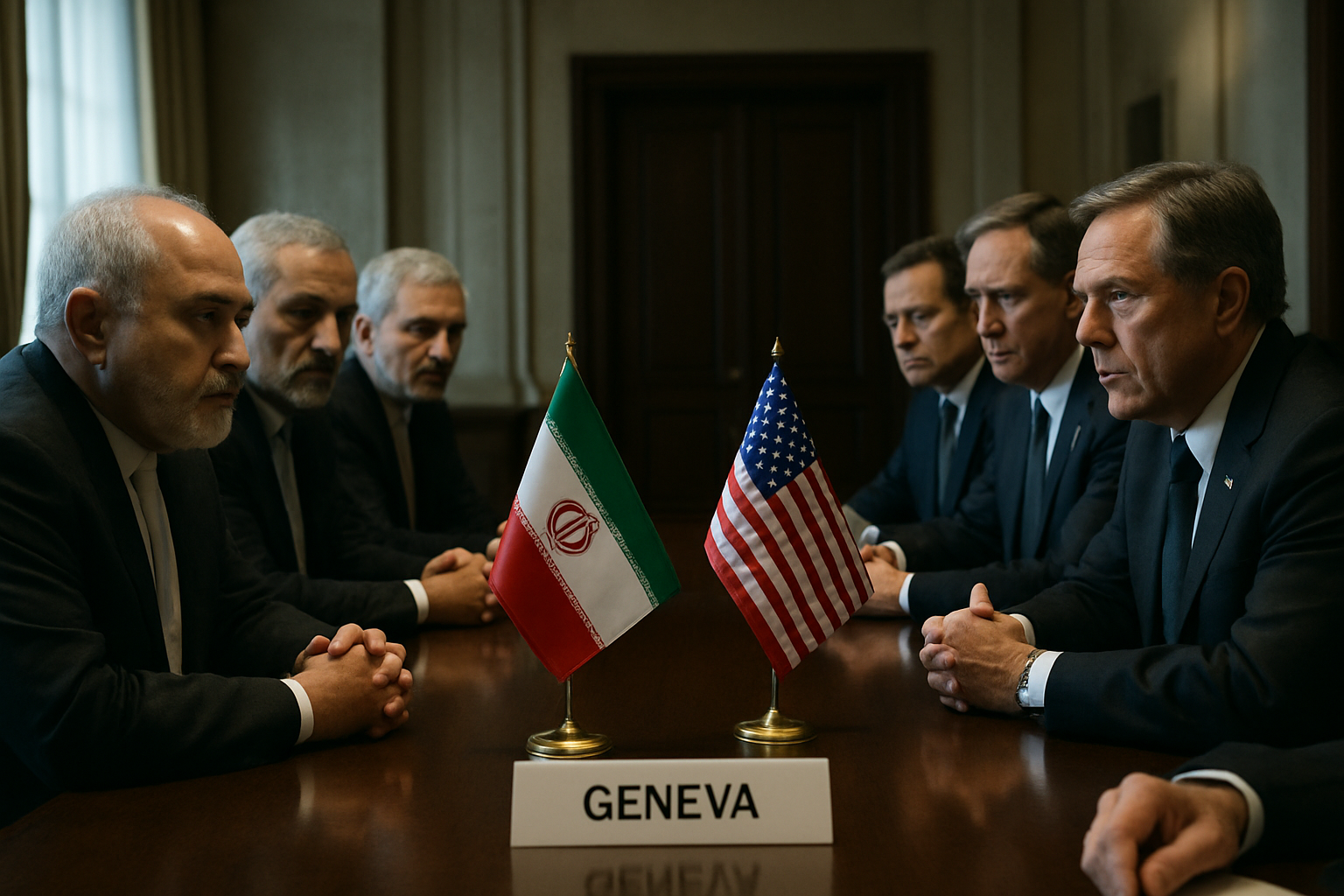
Iran is set to resume high-stakes nuclear negotiations with the United States in Geneva on Thursday, as the Trump administration deploys an unprecedented dual-carrier naval force to the Middle East and issues explicit military ultimatums, creating one of the most dangerous diplomatic crises in decades.
The third round of talks, confirmed by Oman Foreign Minister Badr Al-Busaidi, will take place with Switzerland and Oman mediating as both sides attempt to salvage diplomatic progress amid escalating military tensions. Iranian Foreign Minister Abbas Araghchi recently declared the negotiations have achieved "broad agreement on guiding principles" - the most significant diplomatic breakthrough since the collapse of the Joint Comprehensive Plan of Action (JCPOA) in 2018.
Unprecedented Military Buildup
President Trump has deployed both the USS Gerald R. Ford and USS Abraham Lincoln carrier strike groups to the Arabian Sea, approximately 800 kilometers from Iran's coast. This represents the largest U.S. naval presence in the Middle East since the 2003 Iraq invasion, with approximately one-third of the active U.S. Navy fleet concentrated in the region.
The military escalation intensified after an F-35C fighter jet from the USS Abraham Lincoln shot down an Iranian Shahed-139 drone that had approached the carrier. Subsequently, Iranian Revolutionary Guard Corps (IRGC) vessels have been harassing U.S. tankers in the Strait of Hormuz, a critical waterway through which 40% of global oil transit passes, causing oil prices to rise by more than $1 per barrel.
"I don't think they want the consequences of not making a deal."
— Donald Trump, U.S. President
Trump has issued some of his most explicit military warnings yet, suggesting that "bad things will happen" if Iran fails to reach an agreement within his stated timeline. Pentagon sources confirm that U.S. military forces could be ready for strikes by the weekend, with scenarios prepared ranging from nuclear facility targets to broader Revolutionary Guard infrastructure campaigns.
Nuclear Crisis at Critical Juncture
Iran currently enriches uranium at 60% purity, far exceeding the 3.67% limit established under the JCPOA and approaching the 90% threshold considered weapons-grade. Former IAEA inspector Dr. Yusri Abu Shadi confirms that Iran possesses over 400 kilograms of uranium enriched to 60%, making nuclear weapons capability "easily achievable."
Despite diplomatic engagement, Iranian officials maintain their hardline positions. Foreign Minister Araghchi has declared that Iran will "never abandon enrichment even if war imposed," while Iran's parliament speaker has accused the U.S. and Israel of using "Goebbels-like propaganda" tactics.
Fundamental Scope Disagreements
The central obstacle remains a fundamental disagreement over negotiation scope. Iran insists on limiting talks exclusively to nuclear issues, designating ballistic missiles and support for regional proxy groups as "red lines" that cannot be discussed. However, U.S. Secretary of State Marco Rubio demands a comprehensive agreement that must address Iran's missile program, support for armed groups, and human rights violations.
This structural disagreement has prevented breakthrough attempts for over a decade since the original JCPOA collapsed, representing the same obstacle that has stymied previous diplomatic efforts.
Regional Coalition Support
In an unprecedented development, Saudi Arabia, the UAE, Qatar, and Egypt have all publicly backed the diplomatic process, creating an extraordinary Middle Eastern consensus aimed at preventing military confrontation. This regional coalition recognizes that Persian Gulf instability could devastate global energy markets and trigger a broader regional conflict.
Oman continues to play its historical mediation role, leveraging the same neutral position that proved essential during the 2015 JCPOA negotiations. Switzerland's official support for hosting the Geneva venue represents an evolution from previous Gulf-based talks to European neutral territory, signaling growing international investment in diplomatic resolution.
Domestic Pressures and Human Rights
Iran faces severe domestic pressure with over 42,000 protest arrests since 2022, including the additional sentencing of Nobel laureate Narges Mohammadi to 7.5 years in prison during the current negotiations. The regime appears to prioritize maintaining nuclear capabilities over economic relief through sanctions removal, despite the country facing a survival-level economic crisis.
Meanwhile, Trump administration officials balance pressure from Republican hawks who view engagement as appeasement against the potential for a significant foreign policy victory that could prevent regional war.
Israeli Security Concerns
Israeli Prime Minister Benjamin Netanyahu has conducted multiple coordination meetings with Trump, emphasizing that any agreement must include "limiting ballistic missiles and ending Iranian axis support." Israel views nuclear-only frameworks as insufficient for addressing existential security threats from Iran's integrated missile and proxy network, including Hezbollah, Hamas, and the Houthis.
Israeli coordination with the U.S. has been comprehensive, with reports suggesting contingency planning for potential strikes on Iranian ballistic missile facilities if diplomatic negotiations fail to address the broader threat matrix.
International Nuclear Governance Crisis
The Iran crisis unfolds against the backdrop of a broader nuclear governance breakdown. The New START treaty between the U.S. and Russia expired on February 5, marking the first time in over 50 years that the superpowers operate without nuclear constraints. China's nuclear expansion and the UN Secretary-General's warnings about nuclear risks being at their "highest in decades" add urgency to finding diplomatic solutions.
Success in Geneva could provide a template for 21st-century nuclear crisis resolution, while failure may accelerate military solutions that could reshape Middle Eastern geopolitics for decades while encouraging nuclear proliferation elsewhere.
Verification and Technical Challenges
Any potential agreement faces unprecedented verification challenges due to Iran's advanced centrifuge technology, sophisticated nuclear infrastructure, and the suspension of IAEA inspections since November 2025. The technical complexity far exceeds the original JCPOA requirements, as Iran has significantly expanded its nuclear capabilities since 2018.
Intelligence reports suggest Iran might consider a three-year uranium enrichment halt and transferring existing stockpiles to Russia as confidence-building measures, but Iranian officials' hardline public statements cast doubt on such compromises.
Economic and Energy Security Stakes
The economic implications extend far beyond the Middle East, with oil prices already affected by military tensions and natural gas prices increasing 24% in Europe and 78% in the United States. A Strait of Hormuz closure could disrupt 40% of global oil transit, triggering worldwide supply chain disruptions and energy market destabilization.
Iran has positioned potential agreements as offering "trillion-dollar opportunities" in energy and mining sectors for American firms, framing economic cooperation as a critical component of any sustainable resolution.
The Road Ahead
The Geneva talks represent a critical test of whether innovative diplomatic solutions can bridge decade-old fundamental disagreements or whether the world is witnessing preparation for military confrontation. Framework progress has been achieved despite substantial disagreements, demonstrating that structured dialogue remains possible despite deep mistrust and parallel military escalation.
The stakes could not be higher: success could prevent a regional war that would destabilize global energy markets and provide a diplomatic template for nuclear crisis resolution in the 21st century. Failure may accelerate military solutions that could reshape Middle Eastern geopolitics, encourage nuclear proliferation globally, and undermine diplomatic credibility for international crisis resolution.
As the world watches the Geneva negotiations unfold, the coming days may prove decisive for determining whether diplomacy or military confrontation will define the template for international crisis resolution in an increasingly multipolar world order. The outcome will likely influence global approaches to nuclear governance, territorial sovereignty enforcement, and international law credibility for decades to come.