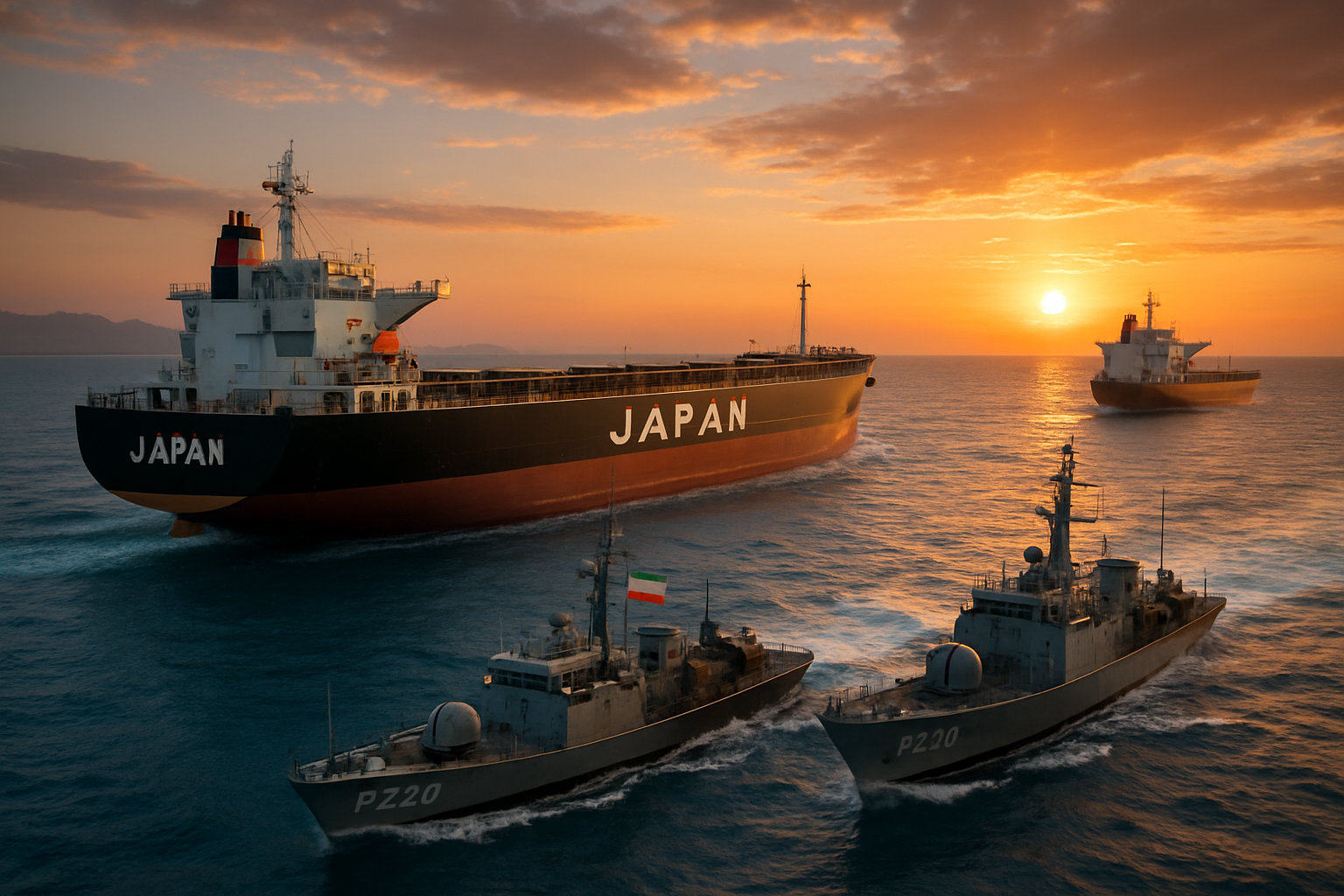
Iran has signaled willingness to provide safe passage for Japanese ships through the Strait of Hormuz, marking a potential diplomatic breakthrough amid the most severe maritime crisis in decades that has stranded over 20,000 sailors and triggered unprecedented global disruption.
Iranian Foreign Minister Abbas Araghchi told Japanese media outlet Kyodo News that Tehran is "ready to help Japanese ships pass through the Strait of Hormuz," according to multiple international reports. The statement comes as President Donald Trump has renewed calls for international naval coalition support to secure the strategic waterway that handles 40% of global seaborne oil transit.
Araghchi indicated that preliminary talks have already begun on the issue, suggesting Iran may be willing to make selective exemptions to its effective blockade of the 21-mile strait. The potential accommodation for Japanese vessels represents the first sign of Iranian flexibility since the Revolutionary Guard declared the waterway "unsafe for shipping" and deployed thousands of naval mines throughout the strategic chokepoint.
Historic Maritime Crisis Context
The offer comes against the backdrop of the most dangerous international crisis since the Cold War ended, with over 3,200 vessels carrying billions in cargo stranded in the Persian Gulf. The crisis began following the complete breakdown of US-Iran nuclear negotiations despite achieving what had been described as "broad agreement on guiding principles" - the most significant diplomatic progress since the 2018 JCPOA collapse.
Japan's unique position stems from its overwhelming dependence on Middle Eastern energy supplies, with 95% of its oil imports coming from the region and approximately 70% transiting through the Hormuz Strait. This critical vulnerability has made Japan a priority case for international diplomatic efforts to maintain energy security.
"From the moment a zone is designated a warlike zone, sailors have the right not to be on a ship that will pass through it."
— Charalampos Avgousti, OMEPEGE-SEK Secretary-General
Trump's Coalition Demands
President Trump has explicitly called on China, France, Japan, South Korea, and the UK to send warships to jointly secure the Strait of Hormuz with US forces. Posting on Truth Social, Trump declared that "many countries, especially those affected by Iran's attempted closure of the Hormuz Strait, will be sending warships, in conjunction with the United States, to keep the strait open and safe."
However, international response has been mixed. France has rejected warship deployment requests, while Japan and Australia have indicated wariness about military participation. The European coalition has taken a different approach, with the UK, Spain, Italy, France, Netherlands, and Greece deploying naval vessels following Iran's unprecedented attack on European territory at RAF Akrotiri, Cyprus.
Unprecedented Global Disruption
The maritime crisis has triggered the most severe energy emergency since the 1970s oil shocks. Oil prices have surged past $119.50 for Brent crude and $108.15 for WTI, representing the largest single-day jump on record. The International Energy Agency has announced its largest strategic petroleum reserve release in 50 years - 400 million barrels from 32 countries.
Japan has already begun releasing 80 million barrels from its strategic reserves, marking the first such deployment since the 2011 Fukushima disaster. The country's heavy reliance on energy imports makes it particularly vulnerable to supply chain disruptions in the Persian Gulf region.
Aviation has been equally affected, with over 18,000 flights cancelled worldwide - the most extensive disruption since COVID-19. Eight countries have simultaneously closed their airspace, including Iran, Iraq, Israel, UAE, Qatar, Syria, Kuwait, and Bahrain. Dubai International Airport, the world's busiest with 86 million passengers annually, remains shut down due to missile damage.
Iran's Vetting System
According to Lloyd's List reports, Iran's Revolutionary Guard is implementing a comprehensive vetting system for merchant vessels seeking passage through "safe corridors" once approved by the IRGC. Nine vessels have reportedly passed through the "safe corridor" at Larak Island, with at least one tanker paying $2 million in transit rights.
Countries including India, Pakistan, Iraq, Malaysia, and China have entered negotiations with Tehran for passage arrangements, suggesting Iran may be willing to provide selective access based on diplomatic and economic considerations. Japan's potential inclusion in this system would mark a significant development given the country's close alliance with the United States.
Diplomatic Breakdown Background
The current crisis emerged following the complete collapse of US-Iran nuclear negotiations, despite what had been the most promising diplomatic progress in years. Three rounds of talks in Geneva achieved "broad agreement on guiding principles" with Switzerland-Oman mediation, representing the most substantial progress since the 2018 JCPOA collapse.
However, fundamental scope disagreements proved insurmountable. Iran excluded ballistic missiles and regional proxies as "red lines" from nuclear-only talks, while the US insisted on comprehensive agreements addressing missiles, armed groups, and human rights. The breakdown led directly to Operation Epic Fury, the largest US operation since 2003, and Iranian retaliation through Operation True Promise 4.
Regional Coalition Under Strain
The unprecedented Saudi Arabia, UAE, Qatar, and Egypt consensus supporting diplomatic processes has been severely strained by Iranian attacks on coalition member territories. The UAE reported one civilian killed in Abu Dhabi, Kuwait saw 32 injured in airport strikes, and Qatar suffered 8 wounded while intercepting 65 missiles and 12 drones with Patriot systems.
Egyptian President Abdel Fattah el-Sisi condemned attacks on "sisterly countries" while warning of "comprehensive chaos" if escalation continues. The regional coalition's previous unity in supporting diplomatic engagement has fractured under direct Iranian military pressure.
Energy Security Architecture
The crisis has exposed dangerous over-dependence on strategic chokepoints, with the 21-mile Strait of Hormuz representing a single-point failure in modern global logistics. Energy security experts, including Samuel Ciszuk, describe this as "the most severe energy security crisis in decades, with single-chokepoint vulnerabilities exposed."
Qatar Energy Minister Saad al-Kaabi has warned that Gulf states may be forced to declare force majeure "within weeks," with oil potentially reaching $150 per barrel, which could "bring down the economies of the world." Strategic petroleum reserves provide only a temporary buffer against sustained supply disruptions.
Financial Market Impact
Global financial markets have crashed under the crisis pressure. Pakistan's KSE-100 index fell 8.97% in its largest decline in history, while South Korea's KOSPI dropped 12%, triggering circuit breakers with the Korean won hitting a 17-year low. PayPal postponed its $1.1 billion IPO indefinitely due to market instability.
Central banks, including the European Central Bank and Bank of Japan, have initiated emergency liquidity coordination to prevent financial contagion from spreading beyond the immediate crisis zone.
Nuclear Governance Crisis
The maritime crisis occurs within the broader context of a global nuclear governance breakdown. The New START treaty expired on February 5, marking the first time in over 50 years without US-Russia nuclear constraints. Iran continues 60% uranium enrichment with over 400kg of weapons-grade material, sufficient for multiple nuclear weapons if weaponized.
UN Secretary-General António Guterres has described nuclear risks as at their "highest in decades," calling the current situation "the greatest test of multilateral cooperation in the modern era."
Template-Setting Significance
The current crisis represents a template-setting moment for 21st-century international relations, determining whether diplomatic or military solutions will become the precedent for future territorial and nuclear disputes worldwide. The rapid transition from framework diplomatic breakthrough to comprehensive military confrontation demonstrates the fragility of crisis management in the multipolar era.
Japan's potential safe passage arrangement with Iran could provide a model for other nations seeking to navigate the crisis while maintaining energy security. However, success depends on whether such arrangements can be sustained amid broader regional conflicts and competing alliance obligations.
Recovery Timeline Uncertain
Recovery from the current crisis remains uncertain, dependent on military operations resolution and diplomatic normalization versus continued escalation. Traditional monetary policy has limited effectiveness against structural geopolitical disruptions, requiring coordinated international responses addressing fundamental energy architecture vulnerabilities.
The International Maritime Organization has called for an emergency "safe maritime framework" enabling swift evacuation of merchant ships confined in the Persian Gulf, but implementation requires cooperation from all regional parties.
March 2026 represents a watershed moment requiring fundamental transformation of energy security planning to reduce dependence on strategic chokepoints. The crisis implications extend decades beyond current events, establishing new paradigms for international stability mechanisms in an increasingly volatile and interconnected world.