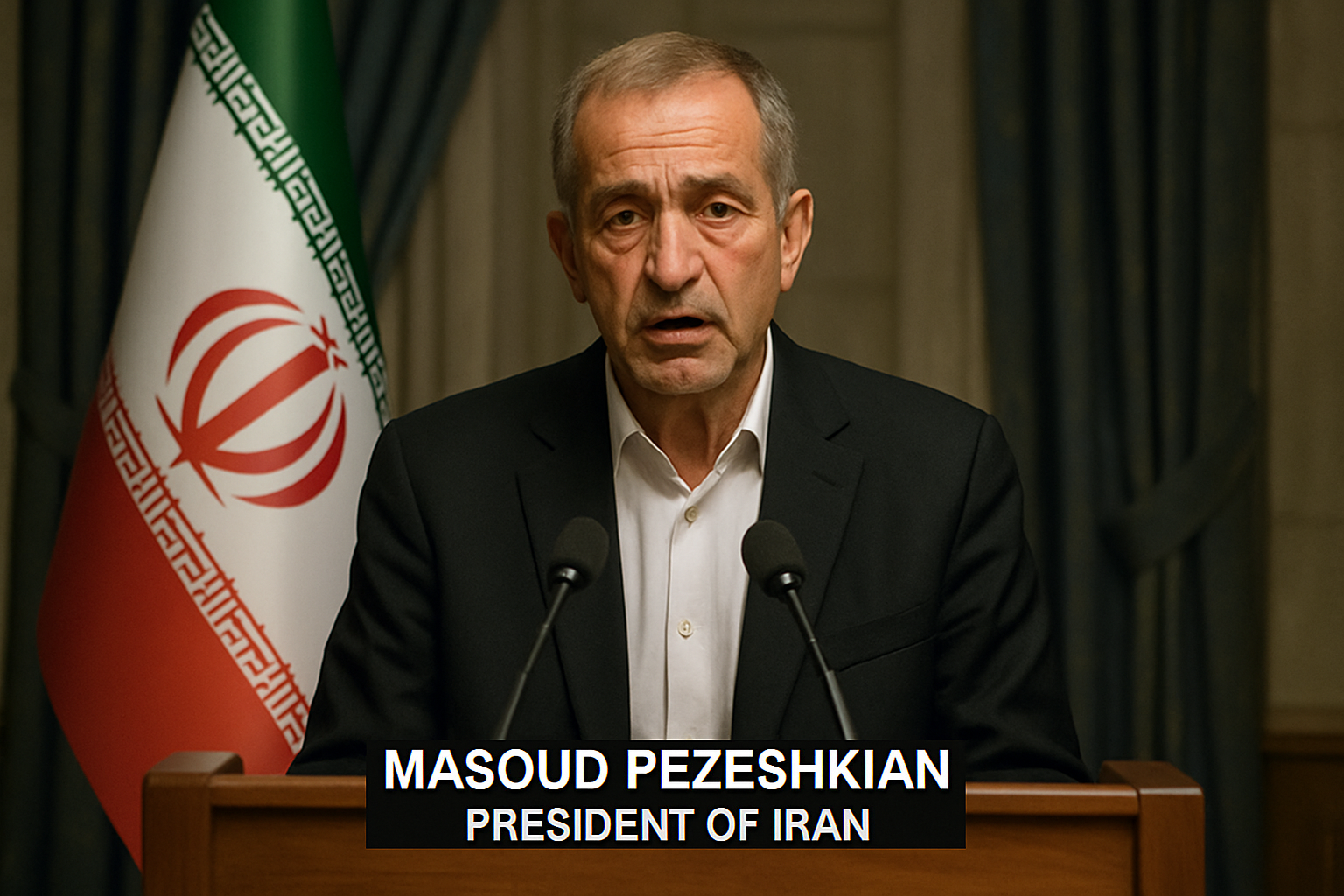
Iranian President Masoud Pezeshkian Saturday offered a rare apology to neighboring countries for missile and drone attacks during the past week while simultaneously vowing that Iran would "never surrender" to the United States and Israel as the Middle East conflict entered its most dangerous phase since the Cold War.
In a televised address broadcast by Iranian state media, Pezeshkian announced that the country's interim leadership council had approved the suspension of attacks against neighboring states unless Iran is attacked from their territory—marking a significant diplomatic shift after a week of retaliatory strikes that have injured civilians and damaged infrastructure across the Gulf region.
"I apologize to the neighboring countries and we have no hostility towards them," Pezeshkian said in the Saturday morning broadcast. "We must work with neighboring countries with the aim of ensuring and securing security and peace."
However, the Iranian president simultaneously rejected U.S. President Donald Trump's demands for "unconditional surrender," calling it "a dream that they should take to their grave."
Second Week of Unprecedented Escalation
The conflict, which began with coordinated U.S.-Israeli strikes on February 28, has now entered its eighth day with no signs of de-escalation. What started as Operation Epic Fury—targeting Iran's nuclear facilities and military infrastructure—has evolved into the most extensive Middle Eastern conflict since the 2003 Iraq invasion.
Saturday morning brought fresh waves of destruction to Tehran, with Israeli forces conducting what residents described as the most intensive bombardment since the war began. The Israeli military confirmed deploying over 80 fighter jets in strikes targeting military facilities, missile launchers, and government infrastructure in the Iranian capital and central provinces.
Iran's Revolutionary Guard Corps (IRGC) has maintained its position that "no red lines remain," systematically targeting U.S. military installations across the region and Israeli population centers in what it calls "Operation True Promise 4."
Regional Casualties Mount
Pezeshkian's apology comes after Iranian missiles and drones have struck multiple neighboring countries hosting U.S. military bases. The UAE Ministry of Defence confirmed that Afghan nationals were among over 100 people injured in Iranian attacks on the United Arab Emirates, with three fatalities reported—citizens of Pakistan, Nepal, and Bangladesh.
According to UAE officials, Iran has launched 205 ballistic missiles since the conflict began, with 190 intercepted by air defense systems, 13 falling into the sea, and two landing within UAE territory. Additionally, over 400 drones have been detected, with 387 destroyed and 11 reaching their targets.
Saudi Arabia's Defense Ministry spokesman Turki al-Maliki announced Saturday that the Kingdom's air defenses had intercepted and destroyed 21 drones heading toward the massive Shaiba oil field in the southeastern Empty Quarter, along with three ballistic missiles targeting Prince Sultan Air Base.
Dubai International Airport, the world's busiest by international passenger traffic, remains completely shut down after suffering missile damage, creating global aviation chaos with over 18,000 flights cancelled worldwide—the most extensive disruption since COVID-19.
Energy Markets in Crisis
The conflict has triggered a severe global energy crisis, with oil prices surging over 10% to breach $80 per barrel. Iran has declared the Strait of Hormuz—through which 40% of the world's seaborne oil passes—as "unsafe for shipping," effectively closing this critical waterway.
Major shipping companies Maersk and MSC have suspended operations in the Persian Gulf, leaving over 150 tankers stranded with billions of dollars worth of cargo. Natural gas prices have spiked 24% in Europe and 78% in the United States, while Qatar has halted LNG production affecting global supplies.
The economic ripple effects extend far beyond energy markets. Pakistan's KSE-100 stock index suffered its largest single-day decline in history, dropping 8.97%, while the Dow Jones futures fell 400-570 points as global markets reacted to the escalating crisis.
Trump Demands Unconditional Surrender
The diplomatic landscape shifted dramatically Friday when President Trump declared via Truth Social that there would be "no deal with Iran except UNCONDITIONAL SURRENDER!" This marked a complete reversal from earlier hints at potential negotiations and represented the most explicit regime change demand since the 1979 Iranian Revolution.
Trump has since claimed the right to be "involved in the appointment" of Iran's next Supreme Leader, rejecting the potential succession of Mojtaba Khamenei—son of the deceased Ayatollah Ali Khamenei—as a "lightweight."
The U.S. president's position has effectively eliminated any possibility of a negotiated settlement, despite the fact that Iran and the United States had achieved what officials described as "broad agreement on guiding principles" in Geneva talks just weeks before the conflict erupted.
Military Escalation Beyond Borders
The conflict has expanded far beyond the traditional Middle East theater. In an unprecedented development, the U.S. submarine USS Charlotte torpedoed and sank the Iranian frigate IRIS Dena in the Indian Ocean off Sri Lanka, killing over 80 crew members—marking the first enemy vessel sunk by a U.S. submarine since World War II.
Defense Secretary Pete Hegseth called it a "quiet death" demonstrating America's "global military reach," but the attack has raised concerns about the conflict's expansion into international waters and its potential to disrupt global maritime trade routes.
Iran has also struck European territory for the first time since World War II, with drones attacking the British RAF base at Akrotiri in Cyprus. This unprecedented assault prompted an immediate naval coalition response, with HMS Dragon, Spanish frigates, and vessels from Italy, France, the Netherlands, and Greece deploying to protect Cyprus.
Nuclear Implications
The breakdown of diplomacy has occurred against the backdrop of Iran's continued uranium enrichment at 60% purity—approaching the 90% threshold needed for weapons-grade material. Intelligence sources suggest Iran now possesses over 400 kilograms of enriched uranium, sufficient material for multiple nuclear weapons if weaponized.
The crisis comes at a particularly dangerous moment for global nuclear governance, occurring just weeks after the New START treaty between the United States and Russia expired on February 5—the first time in over 50 years that the world's two largest nuclear powers have operated without arms control constraints.
UN Secretary-General António Guterres has warned that nuclear risks are at their "highest in decades," calling the Middle East situation a "serious threat to international peace and security."
Humanitarian Crisis Deepens
The conflict has created a massive humanitarian emergency, with Iran's Red Crescent reporting over 787 civilians killed in U.S.-Israeli strikes. The most tragic incident occurred at a girls' elementary school in Minab, where between 53 and 85 students and staff were killed during regular school hours—an attack that has drawn international condemnation as a potential war crime.
The largest coordinated evacuation since the 2011 Arab Spring is underway, with Australia reporting 115,000 nationals trapped in the region and Germany attempting to evacuate 30,000 tourists and residents. Cyprus has activated its national ESTIA evacuation plan for the first time, while multiple European countries have ordered immediate evacuations from Iran citing "extremely uncertain" security conditions.
Regional Coalition Under Strain
The conflict has severely tested the unprecedented regional coalition that had backed diplomatic efforts to resolve the nuclear crisis. Saudi Arabia, the UAE, Qatar, and Egypt—which had formed an extraordinary consensus supporting negotiations—now find themselves caught between their alliance with the United States and Iranian retaliation targeting their territories.
Egyptian President Abdel Fattah el-Sisi condemned Iranian attacks on "sisterly Arab countries," warning of "comprehensive chaos" if the situation continues to deteriorate. The attacks have created a diplomatic crisis for Gulf states, forcing them to choose between their security partnerships with Washington and their need to protect their populations from Iranian retaliation.
Congressional Scrutiny Intensifies
In Washington, bipartisan lawmakers are demanding answers about the administration's strategy, costs, and the potential for ground troop deployment. Senator Richard Blumenthal said he was "more concerned than ever" about the possibility of American boots on the ground, while financial markets are emerging as what analysts call the "ultimate constraint" on further escalation.
The conflict's unpopularity is "almost unprecedented" for such an early stage of military operations, with only 25% of Americans supporting the strikes according to recent polling. Operation Epic Fury has already cost $3.7 billion in its first 100 hours—approximately $891.4 million daily—making it one of the most expensive military operations in recent history.
Historical Significance
March 1-7, 2026, may be remembered as a watershed moment in Middle Eastern geopolitics and international relations. The confirmed death of Supreme Leader Ali Khamenei on March 1 ended his 37-year rule and triggered a constitutional succession crisis in Iran, with a three-member transitional council now governing the country during wartime.
Intelligence sources suggest that Iran's next Supreme Leader will likely come from the Revolutionary Guard Corps rather than the traditional clerical establishment—a shift that could fundamentally alter the character of the Islamic Republic toward a more militarized system.
The rapid transition from diplomatic breakthrough to military confrontation demonstrates the fragility of crisis management in the multipolar era. The collapse of what many considered the most promising U.S.-Iran diplomatic opening in years raises fundamental questions about the viability of negotiated solutions to modern nuclear crises.
As the conflict enters its second week, the stakes could not be higher: regional war prevention, global energy security, nuclear governance credibility, and the enforcement of international law since World War II are all being tested simultaneously. The outcome will likely influence international approaches to conflict resolution for decades to come, potentially setting precedents for whether diplomatic or military solutions take precedence in 21st-century international disputes.
With President Pezeshkian's conditional ceasefire offer representing perhaps the last remaining diplomatic opening, the coming days will be crucial in determining whether this unprecedented crisis can be contained or will spiral into a broader Middle Eastern war with global consequences extending far beyond the current combatants.