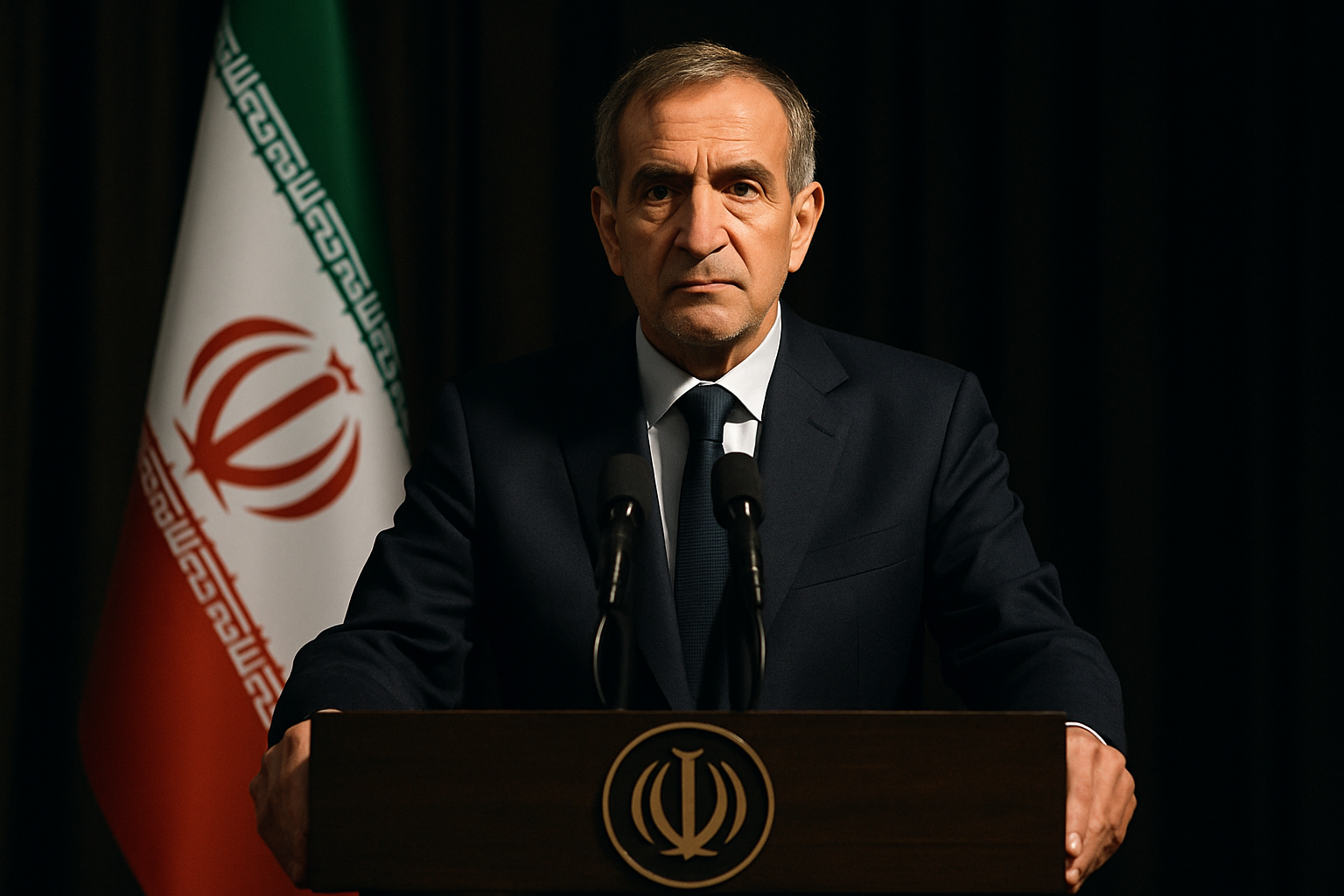
Iranian President Masoud Pezeshkian delivered a televised address Saturday apologizing to neighboring countries for Iran's attacks during the past week, while announcing that Tehran's temporary leadership council had approved a suspension of strikes against regional neighbors unless attacked from their territory.
The unprecedented diplomatic gesture comes as the Middle East conflict enters its second week following the death of Supreme Leader Ali Khamenei and the ongoing "Operation Epic Fury" - the largest coordinated US-Israeli military campaign since the 2003 Iraq invasion.
Presidential Address and Diplomatic Shift
Speaking directly to the Iranian people in a televised address, Pezeshkian made the remarkable statement: "I personally apologize to neighboring countries that were affected by Iran's actions." The apology represents a dramatic departure from the Islamic Republic's traditionally defiant stance toward regional adversaries.
The president announced that Iran's temporary leadership council - established following Khamenei's confirmed death on March 1 - had decided to halt strikes on neighboring states. "The temporary leadership council announced yesterday that there will be no more attacks on neighboring countries and no missile launches unless attacks originate from those countries against Iran," Pezeshkian stated.
However, the Iranian leader firmly rejected expectations of unconditional surrender, declaring that those hoping for complete Iranian capitulation "will take their dreams to the grave." This defiant message appeared directed at US President Donald Trump, who earlier demanded Iran's "unconditional surrender" via social media.
Trump's Response and Regime Change Claims
President Trump responded to Pezeshkian's announcement via Truth Social, claiming credit for what he characterized as Iranian capitulation. "Iran, which is being beat to HELL, has apologized and surrendered to its Middle East neighbors, and promised that it will not shoot at them anymore," Trump wrote.
Trump further claimed this marked "the first time that Iran has ever lost, in thousands of years, to surrounding Middle Eastern countries," and described Iran as no longer "the bully of the Middle East" but "the loser of the Middle East."
The US president has also made the extraordinary claim that he should be "involved in the process of choosing the person who is going to lead Iran into the future," explicitly rejecting Mojtaba Khamenei (the former Supreme Leader's son) as a "lightweight."
Regional Impact and Casualties
The Iranian apology comes after a week of devastating regional casualties from Iran's "Operation True Promise 4" retaliation campaign. The Revolutionary Guard's declaration that "no red lines remain" led to systematic targeting across the Gulf states.
Confirmed casualties include one civilian killed in Abu Dhabi from missile debris, with Dubai International Airport - the world's busiest - completely shut down from missile damage. In Kuwait, 32 people were injured in airport strikes, while Qatar intercepted 65 missiles and 12 drones using Patriot systems, though 8 people were injured by fragments.
The conflict expanded to European territory for the first time since World War II when Iranian drones struck RAF Akrotiri in Cyprus, prompting an unprecedented naval coalition response including HMS Dragon and Spanish frigates.
Global Aviation and Economic Crisis
The regional conflict has triggered the most extensive global aviation crisis since COVID-19, with over 18,000 flights cancelled worldwide as eight Middle Eastern countries simultaneously closed their airspace. Major carriers including Emirates, Air France-KLM, and Wizz Air have suspended operations indefinitely.
Energy markets have been severely disrupted, with oil prices surging 10% past $80 per barrel after Iran declared the Strait of Hormuz - through which 40% of global oil transits - "unsafe for shipping." Natural gas prices have increased 24% in Europe and 78% in the United States.
Constitutional Crisis and Succession
Iran continues to operate under a three-member transitional council consisting of President Pezeshkian, judiciary head Mohseni Ejei, and a Guardian Council representative following Khamenei's death. The Assembly of Experts is currently selecting a permanent successor under unprecedented wartime conditions.
CIA assessments suggest a Revolutionary Guards member is likely to be chosen as the next Supreme Leader, indicating a shift toward hardline military influence in Iran's governance structure - a development that could complicate future diplomatic efforts.
International Evacuations and Response
The crisis has triggered the largest coordinated international evacuation since the Arab Spring of 2011, with Australia reporting 115,000 nationals trapped in the region and Germany evacuating 30,000 tourists. The European Union activated its ESTIA evacuation plan for Cyprus for the first time.
Multiple countries have ordered immediate evacuations from Iran, with Sweden and Serbia citing "extremely uncertain" security conditions. The UN Security Council has held emergency sessions, with Secretary-General António Guterres describing the situation as posing a "serious threat to international peace and security."
Nuclear Diplomacy Collapse
The current crisis represents the complete collapse of nuclear diplomacy despite recent breakthrough progress. Geneva talks had achieved what Iranian Foreign Minister Abbas Araghchi described as "broad agreement on guiding principles" - the most significant progress since the JCPOA collapse in 2018.
However, fundamental disagreements proved insurmountable, with Iran maintaining that ballistic missiles and regional proxies were "red lines" to be excluded from nuclear-only talks, while the US insisted on comprehensive agreements addressing missiles, armed groups, and human rights issues.
Historical Significance and Future Implications
The events of March 1-7, 2026, mark a watershed moment in Middle Eastern geopolitics, representing the most dangerous international crisis since the end of the Cold War. The rapid transition from diplomatic framework to military confrontation demonstrates the fragility of crisis management in the multipolar era.
The conflict has already resulted in the first US submarine attack on an enemy vessel since World War II, when USS Charlotte sank the Iranian frigate IRIS Dena off Sri Lanka, expanding the conflict beyond the Middle East into the Indian Ocean.
Pezeshkian's apology, while significant, comes against the backdrop of continued military operations and Trump's explicit rejection of any negotiated settlement short of complete Iranian capitulation. The success or failure of containing this crisis will likely set precedents for 21st-century conflict resolution and international diplomatic approaches for decades to come.
As the world watches this unprecedented diplomatic gesture unfold against the backdrop of ongoing military operations, the fundamental question remains whether regional diplomacy can halt the escalation toward a broader Middle Eastern war with global implications extending far beyond the current crisis.