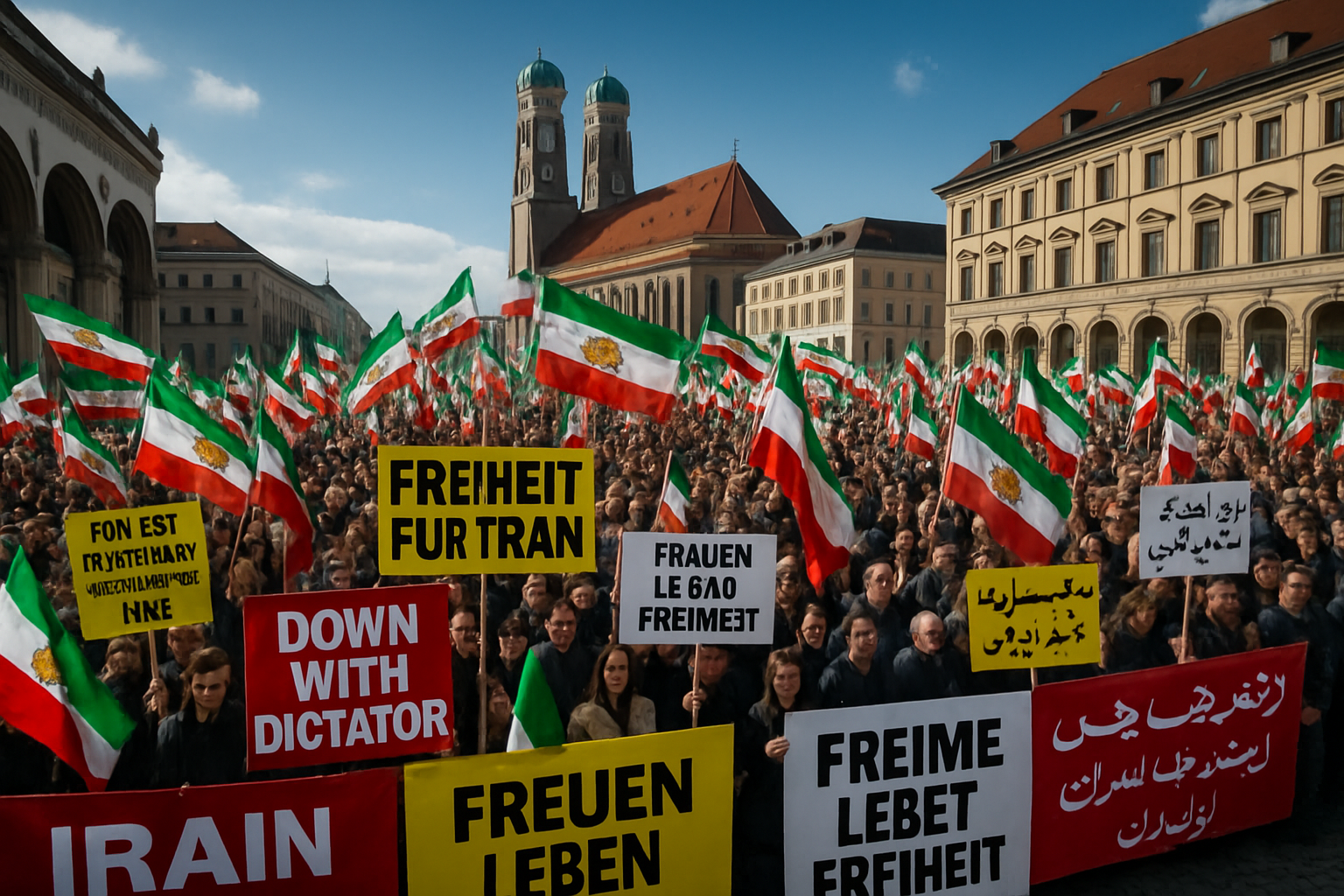
Over 200,000 demonstrators gathered in Munich on Saturday in one of the largest international protests against Iran's government, coinciding with similar rallies in Toronto, Lisbon, and other cities as part of what exiled Iranian crown prince Reza Pahlavi declared a "Global Day of Action."
The Munich demonstration, occurring on the sidelines of the city's annual Security Conference, saw massive crowds waving pre-revolutionary Iranian flags and chanting "Long live the shah" as they called for the overthrow of Iran's Islamic Republic. Police estimates ranged from 200,000 to 250,000 participants, making it one of the most significant Iran-related protests in European history.
Pahlavi's Call for Transition Leadership
Speaking to the Munich crowd, Reza Pahlavi, son of Iran's last shah, made his most explicit leadership declaration yet, stating: "I am here to ensure the transition towards a democratic and secular future. I pledge to be the leader of the transitional phase for you, so that one day we get the chance to determine the fate of our country through a democratic and transparent path to the ballot box."
The 63-year-old heir to the Pahlavi dynasty, who has lived in exile since the 1979 Islamic Revolution, has increasingly positioned himself as a potential leader for Iran's opposition movement. His Munich appearance represents a significant diplomatic moment, as he called directly on U.S. President Donald Trump to "help the Iranian people."
"Trump, act now and end the theocracy of the ayatollahs"
— Protest chant heard in Munich
International Solidarity Movement
The Munich demonstration was part of a coordinated international effort, with simultaneous protests occurring across multiple continents. In Toronto, Canadian police expected over 200,000 participants in what organizers called the largest Iran solidarity rally in North America.
The Toronto demonstration saw protesters march down Yonge Street carrying symbolic body bags and flowers to represent victims of Iran's crackdowns. Police closed major roads including portions of Yonge Street and North York Boulevard to accommodate the massive crowds.
In Lisbon, approximately 100 protesters gathered to demand an end to what they called the "massacre of Iranians," calling for international military intervention. Similar, smaller demonstrations took place in Dublin, where the Iranian diaspora expressed support for Pahlavi as their "best hope" for change.
Context of Escalating Crisis
The global protests occur against a backdrop of intensifying tensions between Iran and the West. Iran currently enriches uranium at 60% purity, approaching the 90% threshold needed for weapons-grade material, while simultaneously excluding ballistic missiles and regional proxy activities from nuclear negotiations with the United States.
The Iranian government faces severe domestic pressure, with over 42,000 protesters arrested since the 2022 uprising that began following the death of Mahsa Amini in police custody. The regime's violent crackdowns have claimed thousands of lives, according to opposition groups.
Nobel Peace Prize laureate Narges Mohammadi, currently imprisoned in Iran, was recently sentenced to an additional 7.5 years for "gathering and collusion" activities. Finnish human rights lawyer Shirin Ebadi, speaking to international media, declared her belief that Iran's Islamic government has "reached the end of its path" as "the people no longer retreat even in the face of violence."
Diplomatic and Security Implications
The Munich demonstration's timing during the Security Conference was strategically significant, occurring as world leaders gathered to discuss global security challenges. The massive turnout sent a clear message to international policymakers about the scale of opposition to Iran's current government.
U.S. officials have noted the protests while maintaining focus on nuclear negotiations. President Trump recently declared that "a change in power in Iran would be the best thing that could happen," representing his most explicit regime change comment since taking office.
The protests also coincide with unprecedented regional diplomatic activity, with Saudi Arabia, UAE, Qatar, and Egypt all supporting diplomatic processes to prevent military confrontation. This unusual Middle Eastern consensus reflects growing regional concern about Iran's destabilizing activities.
Opposition Movement Challenges
Despite the impressive turnout at international demonstrations, the Iranian opposition faces significant organizational challenges. The 2022 protest movement, while widespread, lacked centralized leadership and was eventually suppressed through massive arrests and violence.
Pahlavi's emergence as a potential leader represents both an opportunity and a challenge for the opposition. While his royal lineage provides symbolic weight and international recognition, it also ties the movement to Iran's pre-revolutionary past, which many younger Iranians view with skepticism.
The opposition must also navigate complex international dynamics, as major powers remain focused on nuclear negotiations rather than regime change. European officials, while supporting the protests morally, have emphasized diplomatic solutions over military intervention.
Economic and Social Pressures
Iran's government faces mounting economic pressure from international sanctions, with the country experiencing severe inflation and currency devaluation. These economic challenges have fueled public discontent, particularly among younger Iranians who make up a majority of the population.
The regime's prioritization of nuclear capabilities over economic relief has created what analysts describe as a "survival pressure" dynamic, where the government believes nuclear weapons are essential for regime survival despite the economic costs.
Oil market analysts noted that tensions surrounding Iran have contributed to price volatility, with oil rising over $1 per barrel on recent incidents in the Strait of Hormuz, through which 40% of global oil transit occurs.
International Response and Future Prospects
The scale of Saturday's demonstrations has prompted renewed international attention to Iran's internal situation. German officials described the Munich protest as "unprecedented" in its size and organization, while maintaining their support for diplomatic solutions.
The protests also highlight the diaspora's role in maintaining pressure on the Iranian government. Organizers indicated that additional demonstrations are planned, with the goal of maintaining international focus on Iran's human rights situation.
As nuclear negotiations continue in Oman with uncertain prospects, the opposition movement represents an alternative vision for Iran's future. However, the path from international protests to meaningful change inside Iran remains fraught with challenges, requiring sustained international support and effective domestic organization.
The coming weeks will be critical in determining whether the diplomatic momentum from these protests can translate into concrete political pressure on Tehran, or whether the demonstrations will remain primarily symbolic expressions of diaspora frustration with the Islamic Republic's continued rule.