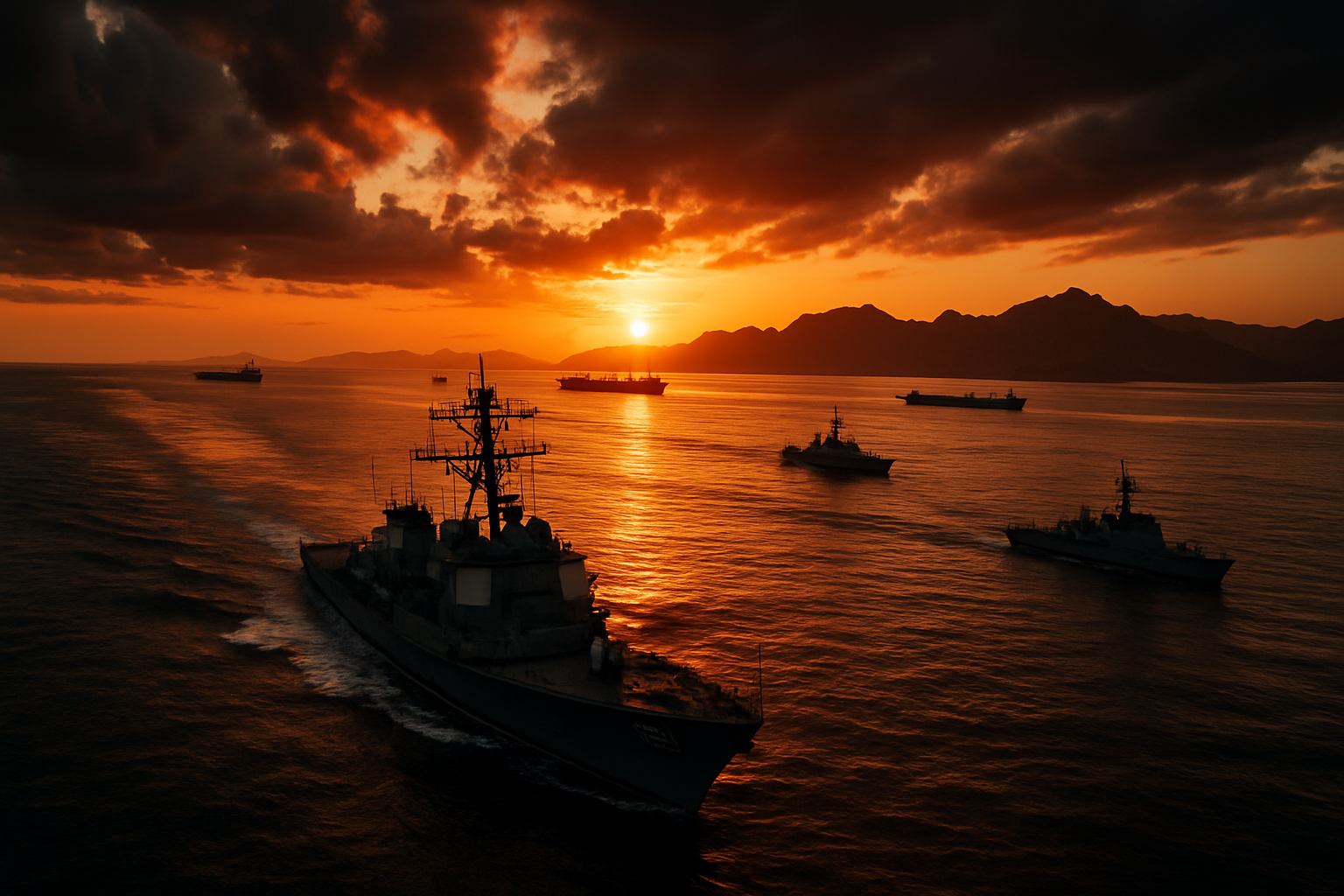
Iran's Revolutionary Guard has reimposed strict military control over the Strait of Hormuz, effectively closing the strategic waterway that handles 40% of global oil transit after briefly reopening it during a temporary ceasefire with Israel-Lebanon.
The closure, announced Saturday by Iranian military commanders, represents a dramatic escalation in tensions with the United States and threatens to plunge global energy markets back into crisis. The narrow 21-mile waterway serves as the world's most critical oil chokepoint, with no viable alternatives for the massive volumes of crude oil and liquefied natural gas that flow through it daily.
Immediate Triggers and Military Response
Iran's decision to re-close the strait came within hours of Friday's announcement by Foreign Minister Abbas Araghchi that the waterway was "completely open" during the Lebanon ceasefire. Multiple international sources confirm that at least two merchant vessels were struck by gunfire from Islamic Revolutionary Guard Corps (IRGC) gunboats without radio warning about 20 nautical miles northeast of Oman.
According to the UK Maritime Trade Operations (UKMTO), maritime trackers had recorded a convoy of eight oil tankers successfully transiting the strait—the first significant movement since the US-Israeli military campaign against Iran began seven weeks ago. However, subsequent vessels were forced to retreat after encountering Iranian naval forces.
"The strait has returned to strict management and control of the armed forces," announced IRGC commanders, citing continued US violations and "piracy" through the naval blockade of Iranian ports.
— IRGC Official Statement
Iran's military leadership demands that the United States lift its blockade of Iranian ports before allowing normal commercial transit, with armed forces maintaining the waterway under military supervision until "full freedom of movement" is restored.
Diplomatic Collapse and Nuclear Deadlock
The latest closure follows the spectacular failure of Pakistan-mediated peace talks in Islamabad, where Vice President JD Vance led 21-hour marathon negotiations that ultimately collapsed over Iran's nuclear program. The primary sticking point remains Iran's refusal to suspend uranium enrichment at 60% purity—just short of weapons-grade levels—and abandon its stockpile of over 400 kilograms of weapons-grade material.
"Iran will never abandon enrichment even if war is imposed," declared Foreign Minister Araghchi during the collapsed talks, highlighting the fundamental impasse that has prevented any lasting diplomatic resolution.
The Lebanon factor proved equally problematic. Israel's exclusion of Lebanon from broader ceasefire arrangements created what Iranian officials called an "unbridgeable gap." Israeli strikes killed over 254 people in a single day during the Islamabad talks—the deadliest bombardment since the conflict began—while 1.2 million people were displaced. Iran demanded comprehensive enforcement across all fronts, which the United States never agreed to include.
Economic Shockwaves and Market Volatility
Oil markets responded immediately to news of the re-closure, with Brent crude surging above $106 per barrel and West Texas Intermediate reaching $104.29—marking the second time this year that prices have breached the psychologically important $100 threshold. This price surge threatens to reverse the consumer relief that had begun to emerge during the brief diplomatic opening.
The International Energy Agency maintains its record-breaking strategic petroleum reserve release of 400 million barrels from 32 countries—the largest intervention in the agency's 50-year history. However, energy analysts warn that these emergency reserves cannot indefinitely offset the loss of roughly 21 million barrels per day that normally flow through the Strait of Hormuz.

Major shipping companies Maersk and MSC have suspended their Persian Gulf operations indefinitely, leaving more than 150 tankers stranded with billions of dollars worth of cargo. The aviation industry faces renewed disruption, with the prospect of 18,000+ flight cancellations returning to levels not seen since the COVID-19 pandemic. Dubai International Airport remains closed due to missile damage, creating a massive gap in Asia-Europe flight corridors.
Regional Coalition Under Maximum Strain
The crisis has severely tested the unprecedented unity among Gulf Arab states. Saudi Arabia, the UAE, Qatar, and Egypt had formed an unusual consensus supporting diplomatic solutions, but Iran's "Operation True Promise 4" retaliation campaign has directly targeted coalition member territories.
The UAE suffered one civilian death in Abu Dhabi, Kuwait experienced 32 injuries from airport strikes, and Qatar recorded 8 wounded despite successfully intercepting 65 missiles and 12 drones with Patriot defense systems. Egyptian President Abdel Fattah el-Sisi's warnings about "comprehensive chaos" affecting "sisterly countries" have proved prescient as diplomatic solutions continue to elude international negotiators.
European Security Implications
The conflict's geographical scope expanded dramatically when Iranian drones struck RAF Akrotiri in Cyprus—marking the first attack on European territory since World War II. This unprecedented escalation prompted the European Union to activate its ESTIA crisis mechanism for the first time in the bloc's history.
A multinational naval coalition featuring HMS Dragon and Spanish, Italian, French, Dutch, and Greek vessels has deployed to the Eastern Mediterranean. However, UK Prime Minister Keir Starmer has declared that Britain "will not be dragged into Iran war," while France and Germany have distanced themselves from US military approaches, emphasizing diplomatic solutions instead.
Nuclear Governance in Crisis
The current crisis unfolds against the backdrop of a broader nuclear governance breakdown. The New START treaty between the United States and Russia expired in February 2026, creating the first gap in US-Russian nuclear constraints in over 50 years. Simultaneously, China continues expanding its nuclear arsenal from 350 to over 500 warheads, while Iran maintains sufficient enriched uranium for multiple weapons if it chooses to weaponize its program.
UN Secretary-General António Guterres has characterized nuclear risks as being at their "highest level in decades," calling the situation the "greatest test of multilateral cooperation in the modern era." The failure of direct US-Iran engagement represents a significant blow to diplomatic solutions in an increasingly volatile international environment.
Congressional Opposition and Military Costs
Domestic political pressure continues mounting against the military approach. American public support has fallen to just 25%—historically low levels for early-stage military operations. Senator Richard Blumenthal has expressed being "more concerned than ever" about potential ground troop deployments, while Operation Epic Fury has already cost $11.3 billion in its first week alone, running at approximately $1 billion daily.
Pentagon operations are now planned through September 2026, far exceeding initial 4-6 week projections. The dual-carrier deployment in the Arabian Sea, featuring the USS Gerald Ford and Abraham Lincoln, represents roughly one-third of the US Navy's fleet concentrated in a single region.
Humanitarian Toll and International Response
The humanitarian consequences continue escalating, with the Iranian Red Crescent reporting over 787 civilian casualties. The Pentagon has acknowledged responsibility for elementary school strikes that killed between 165-185 students due to "outdated targeting data," prompting war crimes investigations under the Geneva Conventions.
International evacuations have reached levels not seen since the Arab Spring of 2011, with Australia reporting 115,000 nationals trapped in the region and Germany evacuating 30,000 people. The scale of the humanitarian crisis underscores the conflict's far-reaching impact beyond military and economic considerations.
Strategic Analysis and Future Implications
Iran's repeated opening and closing of the strait demonstrates sophisticated leverage tactics designed to strengthen its negotiating position in potential future talks. Chinese analysts suggest Tehran is systematically enhancing its strategic position while new Supreme Leader Mojtaba Khamenei—the first hereditary successor in the Islamic Republic's 47-year history—warns the navy is ready to deliver "new bitter defeats" to enemies.
The crisis serves as a template-setting moment for 21st-century international relations, testing whether innovative diplomatic compromise can bridge decades-old disagreements over nuclear issues, regional conflicts, and sanctions relief, or whether military confrontation will reshape global governance mechanisms for decades to come.
"This is the greatest test of multilateral cooperation and crisis management in the modern era," said UN Secretary-General António Guterres, emphasizing the global stakes involved.
— UN Secretary-General António Guterres
Looking Ahead: Critical Decisions
The re-closure of the Strait of Hormuz represents a critical juncture in what has become the most dangerous international crisis since the end of the Cold War. The failure of Pakistan's innovative "message relay system" diplomacy—despite achieving a temporary ceasefire just 88 minutes before President Trump's "whole civilization will die" deadline on April 8—highlights both the potential for diplomatic innovation and the persistence of fundamental disagreements.
The stakes extend far beyond bilateral US-Iran disputes, affecting global energy architecture, nuclear proliferation prevention, international law enforcement, and the credibility of post-WWII international order principles. Success in containing the crisis could provide a framework for 21st-century nuclear crisis resolution, while failure may accelerate military solutions as the preferred template for international disputes, encouraging proliferation globally and undermining diplomatic credibility worldwide.
As oil prices surge and global supply chains face renewed disruption, the international community confronts a stark choice between innovative diplomatic solutions and military confrontation, with implications that will reshape international relations for decades to come.