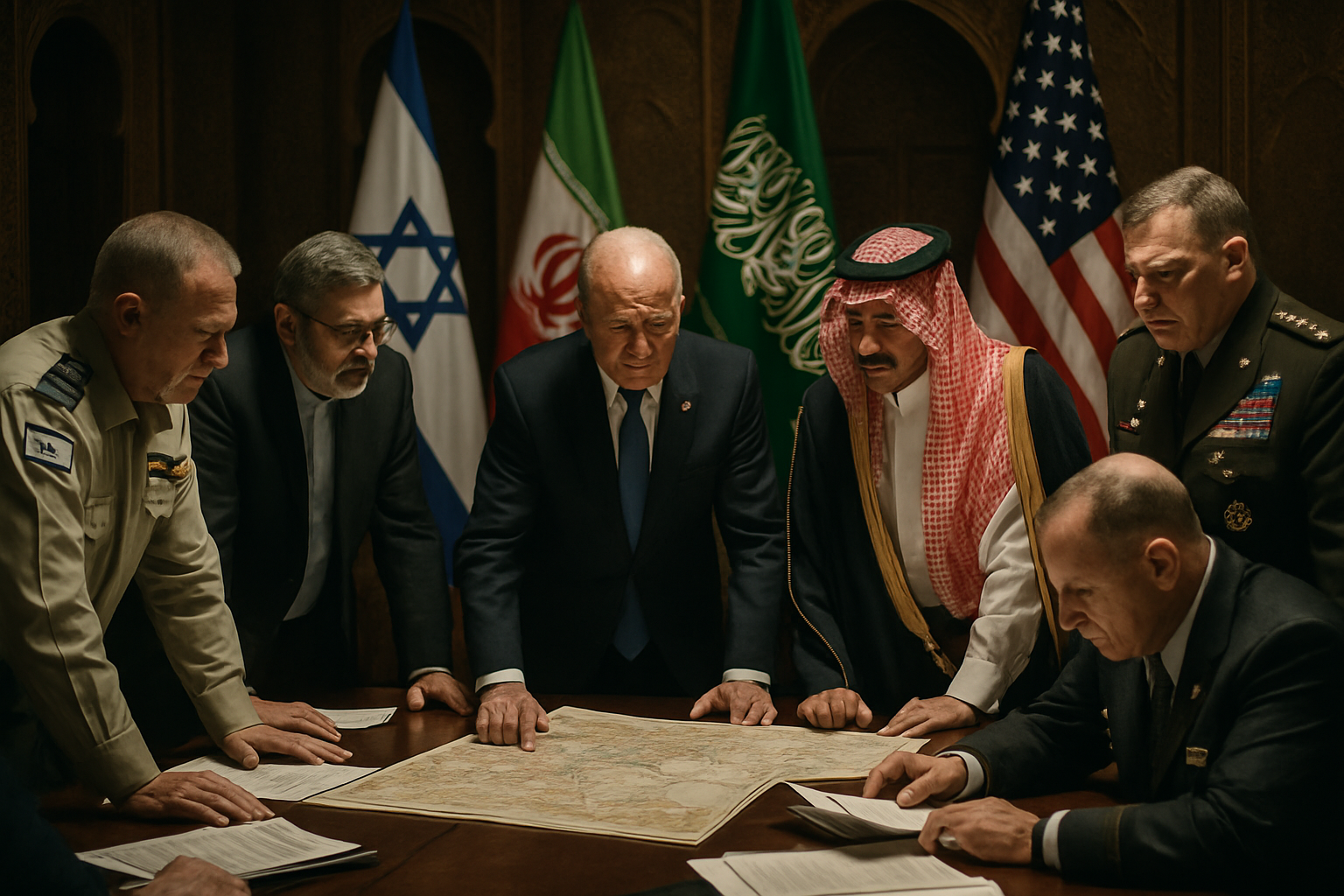
A complex web of military preparations, diplomatic initiatives, and international pressure has engulfed the Middle East as Iran faces unprecedented challenges on multiple fronts, with Israel and regional allies coordinating responses to potential Iranian threats while nuclear negotiations continue against a backdrop of escalating tensions.
The crisis has reached a critical inflection point as the Trump administration deploys dual aircraft carriers to the Persian Gulf while simultaneously maintaining nuclear negotiations with Iran through Omani mediation. This dual-track approach of maximum military pressure combined with selective diplomatic engagement represents the most significant test of Middle Eastern stability in decades.
Military Escalation Reaches Unprecedented Levels
The deployment of the USS Gerald R. Ford, the world's largest aircraft carrier, to join the USS Abraham Lincoln has created an unprecedented naval presence approximately 800 kilometers from Iran's coast. This dual-carrier strike force represents the largest U.S. military buildup in the Middle East in recent years, providing multiple strike capabilities and enhanced defensive coverage for sustained operations.
Recent military incidents underscore the volatility of the situation. An F-35C fighter jet from the USS Abraham Lincoln shot down an Iranian Shahed-139 drone that aggressively approached the carrier group in the Arabian Sea. Simultaneously, Islamic Revolutionary Guard Corps (IRGC) vessels have been harassing U.S.-flagged tankers in the Strait of Hormuz, a critical waterway that handles 40% of global oil transit.
"If we need it, we'll have it ready. In case we don't make a deal, we'll need it."
— President Trump, explaining the dual-carrier deployment
Taliban spokesperson Zabihullah Mujahid has indicated that Afghanistan would show "sympathy and possible cooperation" with Iran if the United States launches military action, adding another dimension to regional calculations. This statement reflects the broader regional dynamics at play as various actors position themselves in anticipation of potential conflict.
Nuclear Diplomacy at Critical Crossroads
Despite military tensions, nuclear negotiations between Iran and the United States continue through Omani mediation, representing the most significant diplomatic engagement since the JCPOA collapse in 2018. Iranian Foreign Minister Abbas Araghchi has maintained that talks achieve a "positive atmosphere," while President Trump declared negotiations "very good" with Iran "very eager to make a deal."
However, fundamental disagreements persist over the scope of any potential agreement. Iran maintains uranium enrichment at 60% purity - significantly above the 3.67% limit established in the original JCPOA and approaching the 90% threshold for weapons-grade material. Iranian officials have declared they will "never abandon uranium enrichment even if war is imposed," while establishing "red lines" that exclude ballistic missiles and regional proxy activities from nuclear-only discussions.
The U.S. position, articulated by Secretary of State Marco Rubio, demands a comprehensive agreement that addresses not only nuclear capabilities but also Iran's ballistic missile program, support for armed groups, and human rights violations. This scope disagreement represents the same structural obstacle that has prevented agreements for over a decade.
Israeli Strategic Coordination Intensifies
Israeli Prime Minister Benjamin Netanyahu has emphasized that any future agreement must "fully dismantle Iran's nuclear infrastructure" rather than merely limiting uranium enrichment activities. In coordination meetings with President Trump, Netanyahu has stressed that enriched uranium stockpiles should be removed entirely and Tehran's ability to resume enrichment must be permanently ended.
According to reports from Albanian media, Israel received what appears to be a positive signal for potential strikes against Iran's ballistic missile program and rocket installations during a December meeting between Netanyahu and Trump at Mar-a-Lago. CBS News reported that Trump agreed to support Israeli strikes against Iran's ballistic program if negotiations between Washington and Tehran fail to produce results.
American officials have confirmed military preparations for "potentially weeks-long operations against Iran," with scenarios ranging from targeted nuclear facilities to broader Revolutionary Guard infrastructure campaigns. The administration expects Iranian retaliation that could create "back-and-forth attacks" cycles, representing a significant escalation from previous confrontation models.
Unprecedented Regional Coalition Forms
Perhaps most remarkably, an unprecedented coalition of Middle Eastern powers - including Saudi Arabia, the UAE, Qatar, and Egypt - has emerged to support diplomatic processes and prevent military confrontation. This represents an extraordinary consensus among traditionally competing regional powers, reflecting shared concerns about the potential consequences of a broader conflict.
Oman has proven crucial as a neutral mediator, leveraging its historical role in facilitating the 2015 JCPOA negotiations. The sultanate's neutral diplomatic capacity has enabled structured dialogue despite significant trust deficits between Washington and Tehran.
The regional coalition's support for diplomacy reflects practical concerns about energy market stability and maritime security. Any conflict that disrupts Persian Gulf shipping lanes would have immediate global implications, given the region's critical role in international energy supplies.
Domestic Pressures Shape Iranian Calculations
Iran faces severe domestic challenges that complicate its strategic calculations. The regime has documented over 42,000 protest arrests since 2022, while severe economic sanctions continue to create pressure for sanctions relief. However, Iranian leadership appears to prioritize nuclear capabilities and regional influence over economic considerations.
The sentencing of Nobel Peace Prize laureate Narges Mohammadi to an additional 7.5 years in prison demonstrates the regime's continued domestic repression even amid international diplomatic engagement. This juxtaposition of human rights violations with nuclear diplomacy creates additional complexity for potential agreements.
International Nuclear Governance Crisis
The Iranian nuclear crisis unfolds against a backdrop of broader nuclear governance challenges. The New START treaty between the United States and Russia expired on February 5, 2026, marking the first time in over 50 years without nuclear arms control agreements between the superpowers. Combined with China's nuclear expansion, this creates unprecedented challenges for multilateral nuclear governance frameworks.
UN Secretary-General António Guterres has warned that nuclear risks are "higher than at any time in decades," emphasizing the critical importance of diplomatic solutions to prevent further nuclear proliferation.
Economic and Energy Market Implications
The tensions have already impacted global markets, with oil prices rising over $1 per barrel on incidents in the Strait of Hormuz. Natural gas prices have surged 24% in Europe and 78% in the United States amid broader geopolitical pressures. Regional conflict risks disrupting supply chains far beyond the Middle East, creating global economic implications.
Argentina's analysis suggests that while Trump sends the aircraft carrier Gerald Ford to the Middle East, there are doubts about whether he will ultimately order an attack, as he did in Venezuela to end the Maduro regime. The assessment notes that the cost could be higher and could lead to a frontal war, reflecting international uncertainty about American intentions.
Diplomatic Innovation Under Pressure
The coming weeks represent a critical test of whether innovative diplomatic solutions can bridge decade-old challenges or whether the situation will escalate toward military confrontation. Switzerland has officially announced that Geneva will host the next round of nuclear negotiations, representing an evolution from Gulf mediation to European neutral territory.
Intelligence suggests Iran is considering potential concessions, including a three-year uranium enrichment halt and transferring existing stockpiles to Russia. However, hardline statements from Iranian officials cast doubt on the likelihood of meaningful compromises without corresponding U.S. concessions.
Strategic Stakes and Global Implications
Success in preventing military confrontation while addressing nuclear proliferation concerns could provide a template for 21st-century crisis resolution. However, failure may accelerate military solutions that could reshape Middle Eastern geopolitics for decades, encourage nuclear proliferation elsewhere, and undermine diplomatic credibility for territorial and security disputes globally.
The situation represents a convergence of multiple challenges: nuclear proliferation prevention, regional power competition, energy security, human rights enforcement, and international law credibility. How these issues are resolved will significantly influence global governance mechanisms and conflict resolution approaches for years to come.
As military preparations continue alongside diplomatic initiatives, the international community watches closely to see whether this crisis will produce innovative solutions or accelerate toward a confrontation that could destabilize one of the world's most critical regions. The next few weeks may determine whether the Middle East moves toward stability through negotiated settlements or faces the prospect of expanded military conflict with global consequences.