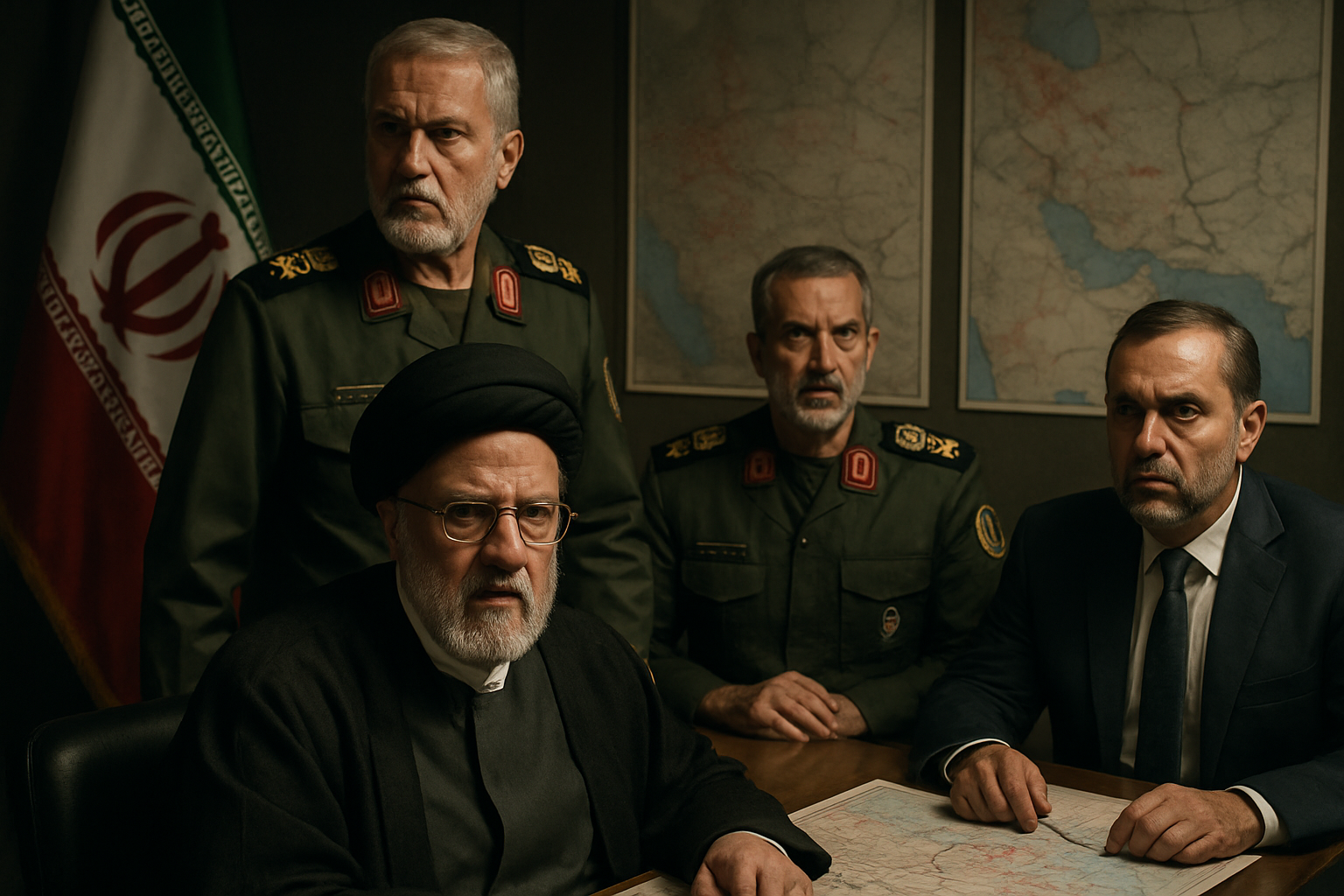
Iran's Revolutionary Guard has categorically rejected President Donald Trump's latest ultimatum, threatening to open the "gates of hell" for US and Israeli forces if military escalation continues, marking the most dangerous confrontation in the Middle East since the end of the Cold War.
The dramatic escalation comes as Iranian supreme operational command spokesman warned Saturday that the entire region would become "hell" for American and Israeli forces should they persist with their campaign against the Islamic Republic. The stark warning follows weeks of intensifying military confrontation that has already reshaped the geopolitical landscape of the Middle East.
Tehran's Defiant Response
Speaking from Tehran's command center, Iranian officials made clear that the country would not bow to what they termed Trump's "desperate ultimatum." The rejection comes amid mounting pressure from the Trump administration, which has demanded Iran's unconditional surrender and threatened massive retaliation if Tehran continues its regional operations.
"The period of American intimidation is over," declared a senior Revolutionary Guard commander, whose identity was withheld for security reasons. "If they think they can force Iran to its knees through threats and military posturing, they are gravely mistaken. We are prepared to turn this region into hell for our enemies."
The Iranian response represents a significant hardening of Tehran's position following weeks of diplomatic breakdown and military escalation that began in late February 2026 with the collapse of nuclear negotiations in Geneva.
Historical Context: From Diplomacy to Military Confrontation
The current crisis emerged from the dramatic failure of nuclear negotiations that had shown unprecedented promise. In February 2026, Iranian Foreign Minister Abbas Araghchi announced achieving "broad agreement on guiding principles" - the most significant diplomatic progress since the JCPOA collapse in 2018.
However, fundamental disagreements proved insurmountable. Iran excluded ballistic missiles and regional proxy activities as "red lines" from nuclear-only talks, while US Secretary Marco Rubio insisted on comprehensive agreements addressing missiles, armed groups, and human rights.
The diplomatic breakdown coincided with Iran's uranium enrichment reaching 60% purity, approaching the 90% threshold needed for weapons-grade material. Dr. Yusri Abu Shadi, a former IAEA inspector, confirmed Iran possessed over 400 kilograms of enriched uranium, making weapons development "easily achievable."
Operation Epic Fury: Unprecedented Military Campaign
The current military confrontation, dubbed "Operation Epic Fury," represents the largest coordinated US-Israeli campaign since the 2003 Iraq invasion. The operation involves a dual-carrier deployment of the USS Gerald R. Ford and USS Abraham Lincoln, representing approximately one-third of the active US Navy fleet positioned 800 kilometers from Iran's coast.
"This is not merely a regional conflict anymore. The implications extend far beyond the Middle East to global energy security, nuclear proliferation, and international law enforcement."
— UN Secretary-General António Guterres
The military escalation has already claimed significant casualties on multiple sides. Confirmed Iranian leadership targets have included Defense Minister Aziz Nasirzadeh and IRGC Chief Mohammad Pakpour, alongside over 40 high-ranking officials. The most significant development came with the confirmed death of Supreme Leader Ali Khamenei on March 1, 2026, ending his 37-year rule and creating a constitutional succession crisis.
Regional Consequences and Global Impact
The conflict has triggered unprecedented global disruptions. Over 18,000 flights worldwide have been cancelled - the most extensive aviation crisis since COVID-19 - as eight Middle Eastern countries simultaneously closed their airspace. Dubai International Airport, the world's busiest, remains shuttered due to missile damage.
Energy markets have been severely impacted, with oil prices surging past $100 per barrel as Iran declared the Strait of Hormuz "unsafe," affecting 40% of global seaborne oil transit. More than 150 tankers worth billions in cargo remain stranded in the Persian Gulf, while major shipping companies Maersk and MSC have suspended operations.
The crisis has also prompted the largest international evacuation since the Arab Spring of 2011, with Australia reporting 115,000 nationals trapped in the region and Germany confirming 30,000 stranded tourists.
Iranian Retaliation: Operation True Promise 4
Iran's response, designated "Operation True Promise 4," has involved systematic targeting of US military installations and allied nations across the Gulf region. The Revolutionary Guard declared "no red lines remain," extending attacks to coalition partners including the UAE, Kuwait, Qatar, and Bahrain.
Most significantly, Iranian forces conducted their first attack on European territory since World War II, striking RAF Akrotiri in Cyprus with drones. This unprecedented escalation prompted a massive NATO naval response, with HMS Dragon and frigates from Spain, Italy, France, the Netherlands, and Greece deploying to protect European interests.
Succession Crisis and Internal Dynamics
Following Khamenei's death, Iran activated its constitutional succession mechanism with a three-member transitional council comprising President Masoud Pezeshkian, judiciary head Gholam-Hossein Mohseni-Ejei, and a Guardian Council representative. The Assembly of Experts is now selecting a permanent successor under wartime conditions.
CIA assessments suggest a Revolutionary Guard member is likely to become the next Supreme Leader, marking a historic shift from clerical to military governance in the Islamic Republic's 47-year history. This development has raised concerns about further militarization of Iranian policy.
Trump's Escalating Demands
President Trump has dramatically escalated his demands, moving from nuclear-focused objectives to explicit regime change goals. Via Truth Social, Trump demanded Iran's "unconditional surrender" and claimed the right to personally choose Iran's next Supreme Leader, representing the most direct assertion of American control over Iranian affairs since the 1979 revolution.
The administration has prepared scenarios for "potentially weeks-long operations" extending from nuclear facilities to comprehensive regime targeting. Pentagon sources indicate operations could continue through September, far beyond the initial 4-6 week timeline communicated to Congress.
Congressional Scrutiny and Domestic Opposition
Congressional opposition to the military campaign has intensified, with bipartisan lawmakers demanding clarity on strategy, costs, and potential ground troop deployment. Senator Richard Blumenthal expressed being "more concerned than ever" about the possibility of boots on the ground.
The conflict's unpopularity is "almost unprecedented" for early-stage military operations, with only 25% of Americans supporting the strikes according to recent polling. Financial markets have emerged as what experts term the "ultimate constraint" on further escalation, with Pakistan's stock exchange suffering its largest single-day decline in history at -8.97%.
Nuclear Governance Crisis
The current crisis unfolds against a broader backdrop of nuclear governance breakdown. The New START treaty expired on February 5, 2026, marking the first time in over 50 years without US-Russia nuclear constraints. Combined with China's nuclear expansion and UN warnings of nuclear risks being at their "highest in decades," the Iranian crisis represents a template-setting moment for 21st-century conflict resolution.
International Response and Mediation Efforts
Multiple countries have attempted mediation, with Pakistan, Turkey, and Egypt conducting "active back-channel diplomacy." Pakistan's army chief, General Asim Munir, has leveraged relationships with both Tehran and Trump for potential de-escalation, though Iranian officials categorically deny any direct diplomatic contact with the US administration.
The European Union has activated its ESTIA evacuation plan for Cyprus for the first time in the bloc's history, while NATO allies have coordinated unprecedented defensive measures in response to Iranian attacks on European territory.
Humanitarian Crisis
The conflict has generated a mounting humanitarian crisis, with Iran's Red Crescent reporting over 787 civilian casualties from US-Israeli strikes. The most tragic incident occurred at an elementary school in Minab, where 53-85 students and staff were killed in what Iranian officials condemned as a "barbaric crime."
International human rights organizations have demanded Geneva Convention investigations, while images of children's backpacks and schoolbooks amid the rubble have become symbols of the diplomatic failure's human cost.
Looking Ahead: Template-Setting Implications
UN Secretary-General António Guterres has characterized the crisis as the "greatest test of multilateral cooperation and crisis management in the modern era." The rapid transition from diplomatic breakthrough to military escalation demonstrates the fragility of crisis management mechanisms in the multipolar era.
The outcome will establish precedents for international dispute resolution, nuclear proliferation prevention, and territorial sovereignty enforcement that will influence 21st-century conflict approaches for decades. Success in containing the crisis could provide a diplomatic framework for future interventions, while failure might accelerate military solutions and undermine diplomatic credibility worldwide.
As Iran threatens to unleash the "gates of hell" and Trump demands unconditional surrender, the Middle East faces its most dangerous moment since the Cold War's end. The stakes extend far beyond regional boundaries, encompassing global energy security, nuclear governance credibility, and the fundamental principles of post-World War II international order.