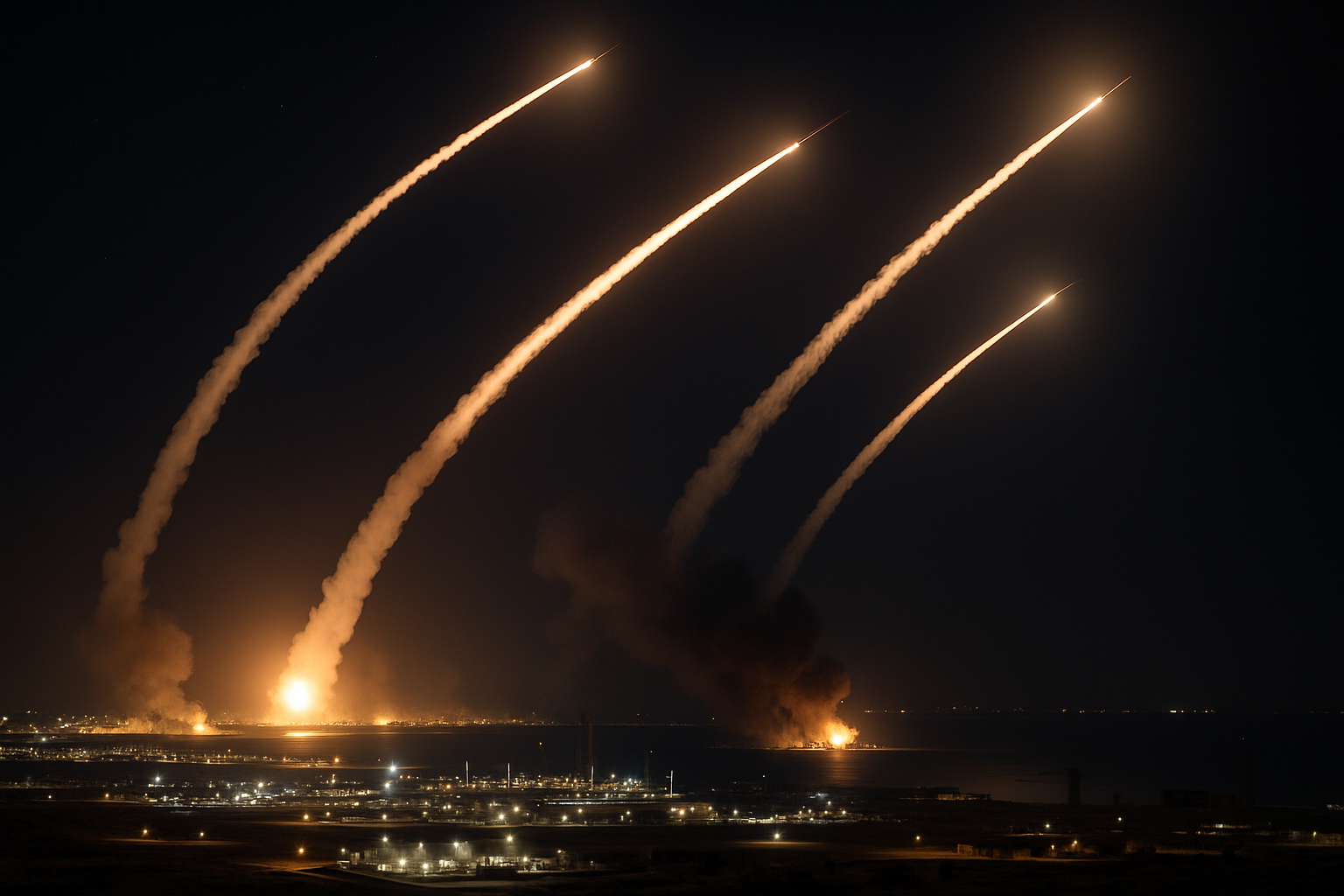
Iran launched a coordinated wave of retaliatory missile and drone strikes against multiple countries across the Gulf region on Saturday, targeting US military installations and regional infrastructure in Kuwait, UAE, Bahrain, and Qatar in response to earlier US-Israeli attacks on Iranian territory.
The Islamic Revolutionary Guard Corps (IRGC) confirmed the launch of what Iranian officials described as the "first wave" of retaliation, with Foreign Minister Abbas Araghchi declaring that "no red lines remain" following the collapse of nuclear negotiations. The strikes represent the most significant regional military escalation since the devastating 12-day Iran-Israel war in June 2025.
Coordinated Regional Strike Campaign
Iranian forces targeted multiple countries simultaneously in an unprecedented display of regional reach. In Kuwait, drone attacks struck Kuwait International Airport, causing minor injuries to several employees and limited material damage. The Ministry of Public Works confirmed that drones also targeted the new Kuwait Airport project (T2), forcing site evacuations.
The United Arab Emirates experienced some of the most serious consequences, with shrapnel from an Iranian missile attack on Abu Dhabi killing at least one civilian. Explosions were reported in Dubai, with witnesses describing a large cloud of smoke rising over the city. A fire broke out near the luxury Fairmont The Palm hotel, reportedly caused by falling debris from intercepted missiles.
In Bahrain, Iranian missiles targeted the US Navy's Fifth Fleet headquarters at Juffair, with videos circulating online showing people scrambling for safety. Qatar successfully intercepted all incoming projectiles using its Patriot missile defense systems, though explosions were heard throughout Doha.
US Military Installations Under Fire
The IRGC specifically targeted American military facilities across the region, representing a dramatic escalation from previous conflicts. US bases in Bahrain, Kuwait, and Qatar all reported incoming missile strikes, with the Pentagon confirming that "situations are still active" at multiple installations.
Iran's Islamic Revolutionary Guard Corps claimed that at least 200 American soldiers have been killed or wounded in the retaliatory strikes, though this figure could not be independently verified. The attacks focused on key US strategic assets, including the massive Al Udeid Air Base in Qatar, which houses over 10,000 American personnel and serves as the largest US military facility in the Middle East.
"As a result of missile strikes on American bases, at least 200 American soldiers have been killed or wounded across the region. This is the beginning of our response to the criminal aggression."
— IRGC Statement via Telegram
Regional Coalition Disrupted
The attacks severely disrupted the unprecedented Arab coalition that had been supporting diplomatic efforts between Iran and the United States. Saudi Arabia, UAE, Qatar, and Egypt had formed an extraordinary consensus backing the nuclear negotiations, but now find themselves dealing with direct attacks on their territories or airspace.
Egypt condemned Iran's targeting of "several sisterly Arab countries" in the strongest terms, warning that the military escalation could slide the entire region into "comprehensive chaos" with catastrophic consequences for international peace and security. Saudi Arabia expressed strong condemnation of what it called "blatant and cowardly Iranian attacks" on the Riyadh region and Eastern Province, which were successfully intercepted by the Kingdom's defenses.
Collapse of Nuclear Diplomacy
The retaliatory strikes followed the dramatic breakdown of US-Iran nuclear negotiations in Geneva, despite achieving what Iranian Foreign Minister Araghchi had described as "broad agreement on guiding principles" - the most significant diplomatic progress since the JCPOA collapse in 2018.
The talks foundered on the same structural disagreement that has prevented breakthroughs for over a decade: Iran maintained that ballistic missiles and regional proxy activities were "red lines" excluded from nuclear-only discussions, while US Secretary Marco Rubio insisted on a comprehensive agreement addressing missiles, armed groups, and human rights.
Iran continues enriching uranium at 60% purity, approaching the 90% weapons-grade threshold, with former IAEA inspector Dr. Yusri Abu Shadi confirming that Iran possesses over 400kg of enriched uranium, making nuclear weapons capability "easily achievable."
Unprecedented Military Escalation
The Iranian response came hours after coordinated US-Israeli military operations that President Trump dubbed "Operation Epic Fury." The strikes followed Trump's historic 10-day ultimatum to Iran, warning that "bad things will happen" if no meaningful nuclear agreement was reached.
The United States had deployed an unprecedented dual-carrier strike force, with the USS Gerald R. Ford and USS Abraham Lincoln representing approximately one-third of the active US Navy fleet concentrated just 800 kilometers from Iran's coast - the largest American naval presence in the Middle East since the 2003 Iraq invasion.
Israeli Defense Minister Israel Katz announced "preemptive strikes to eliminate threats" against Iranian facilities, while Trump made his most explicit regime change comments yet, calling Iranian government overthrow "the best thing that could happen."
Global Aviation Crisis
The regional strikes triggered an immediate aviation crisis as Iran, Iraq, Israel, UAE, and Qatar all closed their airspace to civilian traffic. Flight tracking showed Iranian and Iraqi airspace completely empty, affecting hundreds of thousands of passengers worldwide.
Major carriers including Emirates, Air France-KLM, Wizz Air, and Bulgarian Air suspended Middle East operations. The Middle East serves as a critical connecting hub between Europe and Asia, and the airspace closures created significant challenges for maintaining global connectivity.
International Response and Energy Markets
The UN Security Council scheduled an emergency session requested by France, Bahrain, China, Russia, and Colombia. Russia condemned what it called "reckless actions by Washington and West Jerusalem against a sovereign UN member state" as a direct violation of international law.
Oil prices rose immediately on news of the strikes, with the Strait of Hormuz - through which 40% of global oil transit passes - potentially threatened by the escalating conflict. The regional instability raised immediate concerns about global energy security and supply chain disruptions.
Broader Regional Implications
The strikes extended beyond direct participants to affect neighboring countries. Four people were killed in Syria when an Iranian missile struck a building in the southern city of Sweida, with additional missile debris falling in Quneitra and the Yarmouk Basin in Daraa province.
The attacks also demonstrated Iran's expanding regional reach, with the Taliban in Afghanistan pledging "sympathy and cooperation" with Iran if US attacks continued, showing how the conflict risks drawing in additional regional actors.
"The current military escalation could slide the entire region into a state of comprehensive chaos with catastrophic consequences for international peace and security."
— Egyptian Ministry of Foreign Affairs Statement
Nuclear Governance Crisis Context
The escalation occurs against the backdrop of a broader nuclear governance crisis, with the New START treaty between the US and Russia having expired on February 5 - the first time in over 50 years without US-Russian nuclear constraints. UN Secretary-General António Guterres has warned that nuclear risks are at their "highest in decades."
The collapse of Iran diplomacy raises fundamental questions about the viability of diplomatic solutions for modern nuclear crises, potentially setting a dangerous precedent for how the international community addresses proliferation challenges in the 21st century.
Strategic Stakes and Future Implications
The Iranian retaliation represents a template-setting moment for international conflict resolution in the multipolar era. The breakdown from intensive diplomatic negotiations to military escalation within days demonstrates the fragility of modern crisis management mechanisms.
With Iran declaring that "no red lines remain," the international community faces the prospect of a broader regional conflict that could reshape Middle Eastern geopolitics for decades. The attacks threaten not only regional stability but also global energy security, nuclear non-proliferation efforts, and the credibility of diplomatic solutions to international crises.
As emergency diplomatic efforts begin to contain the escalation, the world watches to see whether this represents the beginning of a prolonged regional conflict or whether cooler heads can prevail in pulling the region back from the brink of all-out war.