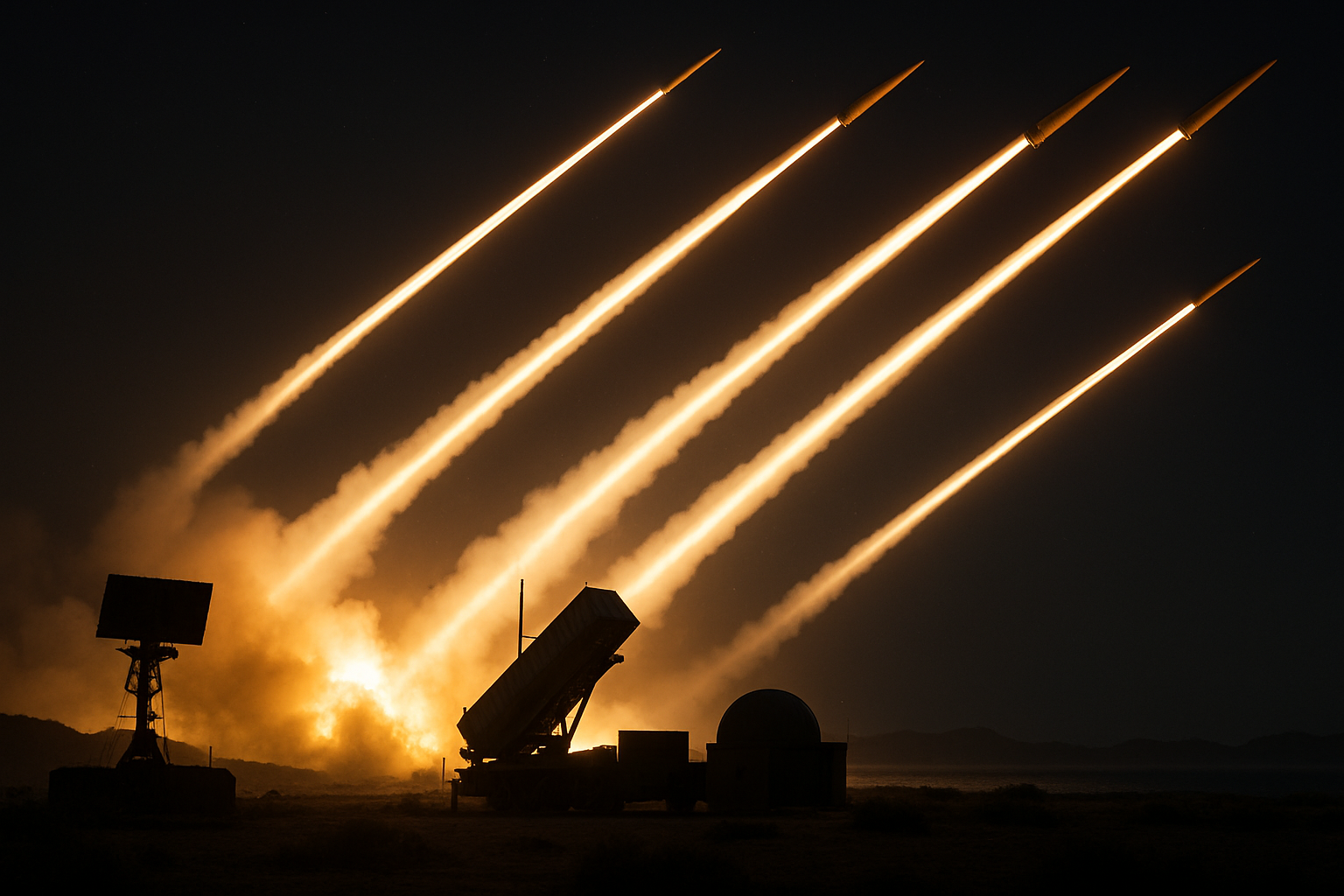
Iran has launched a coordinated wave of missile and drone attacks against American military bases across the Gulf region, marking the most significant escalation in the months-long crisis that has brought the Middle East to the brink of regional war.
Iranian state-affiliated media confirmed that the Islamic Revolutionary Guard Corps (IRGC) targeted multiple strategic US facilities on Saturday, February 28, 2026, including the Al Udeid Air Base in Qatar, Al-Salem Air Base in Kuwait, Al Dhafra Air Base in the UAE, and the US Navy's Fifth Fleet headquarters in Bahrain.
The strikes represent a dramatic escalation from the diplomatic efforts that had shown signs of progress just days earlier, when Iranian Foreign Minister Abbas Araghchi declared a nuclear deal was "within reach" during Geneva negotiations. The attacks came hours after coordinated US-Israeli military operations against Iranian facilities, which Israeli Defense Minister Israel Katz described as "preemptive strikes" to eliminate threats.
Widespread Strikes Across the Gulf
Multiple sources confirmed explosions across the region, with Fars News Agency reporting direct hits on US installations. The coordinated assault triggered air defense systems across Qatar, Bahrain, Kuwait, and the UAE, with reports of successful missile interceptions alongside confirmed impacts.
In Bahrain, smoke was seen rising from the Juffair area, home to the US Navy's Fifth Fleet headquarters, which serves as the central command for American naval operations in the Persian Gulf. The facility, housing thousands of US personnel, has been central to American military strategy in the region for decades.
The UAE's defense ministry reported successfully intercepting several Iranian ballistic missiles but confirmed one fatality when missile debris fell on a residential area in Abu Dhabi. The victim was described as an individual of Asian nationality, highlighting how the conflict has begun affecting civilian populations across the region.
Qatar's defense ministry acknowledged coming under missile attack but reported successful interception using Patriot missile systems. Authorities urged residents to remain indoors and avoid military installations as air raid sirens sounded across the capital, Doha.
Context of Escalating Crisis
The missile strikes represent the explosive conclusion of weeks of unprecedented diplomatic and military tension. For months, the Trump administration had pursued a dual-track approach, combining the largest US military buildup in the Middle East since 2003 with intensive nuclear negotiations mediated by Switzerland and Oman.
The crisis began escalating dramatically in February when President Trump issued a historic 10-day ultimatum to Iran, warning that "bad things will happen" if no nuclear deal was reached. This was accompanied by the deployment of a dual-carrier strike force—USS Gerald R. Ford and USS Abraham Lincoln—representing approximately one-third of the active US Navy fleet positioned 800 kilometers from Iran's coast.
Despite achieving what Iranian officials called a "broad agreement on guiding principles" in Geneva talks, fundamental disagreements persisted. Iran maintained that ballistic missiles and regional proxy activities were "red lines" that must be excluded from any nuclear agreement, while the US insisted on a comprehensive deal addressing Iran's entire security apparatus.
Diplomatic Collapse and Military Action
The breakdown of negotiations came despite what appeared to be the most promising diplomatic opening in years. Iranian Foreign Minister Abbas Araghchi had declared on February 26 that a nuclear deal was "within reach," describing a "historic opportunity to strike an unprecedented agreement addressing mutual concerns and mutual interests."
However, Iran continued enriching uranium to 60% purity—approaching the 90% threshold needed for weapons-grade material. Former IAEA inspector Dr. Yusri Abu Shadi confirmed that Iran possessed over 400 kilograms of enriched uranium, making nuclear weapons "easily achievable" if the decision were made to weaponize.
The diplomatic process ultimately collapsed when the fundamental scope disagreement proved insurmountable. Iran's insistence on limiting talks to nuclear issues only, while excluding ballistic missiles and regional activities, conflicted with US demands for a comprehensive agreement that would address the full spectrum of Iranian capabilities.
"The situation is still active and developing. We're monitoring multiple impact sites across our regional facilities."
— Senior US Military Official
Regional and International Response
The missile strikes have disrupted what had been an unprecedented regional coalition supporting diplomatic engagement. Saudi Arabia, the UAE, Qatar, and Egypt had all backed the negotiation process, representing extraordinary Middle Eastern consensus for preventing military confrontation.
This regional unity, which had been crucial in maintaining diplomatic momentum despite escalating tensions, now faces severe strain as member nations deal with attacks on their territory. The strikes have particularly complicated relationships with Gulf partners who host US military facilities while maintaining complex diplomatic ties with Iran.
Israeli officials had coordinated closely with the Trump administration, with Prime Minister Netanyahu emphasizing that any agreement must include "limiting ballistic missiles and ending support for the Iranian axis." The failure of negotiations to address these Israeli red lines contributed to the decision to launch preemptive military action.
Multiple international evacuation orders had been issued in the days leading up to the strikes. The US had authorized departure of non-essential embassy personnel from Israel, while several European nations issued urgent travel warnings for the region.
Economic and Energy Security Implications
The attacks have immediate implications for global energy markets, with the Strait of Hormuz—through which 40% of global oil transit occurs—now a potential flashpoint. Oil prices rose sharply following initial reports of the strikes, with markets pricing in the risk of broader regional conflict.
The targeting of US bases across multiple Gulf nations threatens the security architecture that has underpinned energy market stability for decades. The UAE, Qatar, Kuwait, and Bahrain are all crucial players in global energy markets, and sustained military operations could disrupt production and shipping routes.
Iran had positioned potential economic cooperation as a "trillion-dollar opportunity" for US energy and mining companies during the diplomatic phase, but those prospects now appear remote as military confrontation takes precedence.
Nuclear Governance Crisis Context
The escalation occurs against the backdrop of what UN Secretary-General António Guterres has described as nuclear risks at their "highest level in decades." The New START treaty between the US and Russia expired on February 5, 2026, leaving the world without nuclear arms control constraints between major powers for the first time in over 50 years.
The failure of the Iran nuclear negotiations represents a critical test case for 21st-century diplomatic crisis resolution. The breakdown from framework agreement to military action within days illustrates the challenges of managing nuclear proliferation concerns in an increasingly multipolar world order.
Intelligence assessments suggest Iran possesses sufficient enriched uranium for multiple weapons if the decision is made to weaponize, creating urgent timelines that complicated the diplomatic process. The advanced centrifuge technology and sophisticated infrastructure developed since 2018 would have required verification mechanisms far exceeding the complexity of the original JCPOA.
Immediate Military Response
US forces across the region have been placed on highest alert, with defensive systems activated and preliminary damage assessments underway. The targeting of the Fifth Fleet headquarters in Bahrain represents a direct challenge to US naval supremacy in the Persian Gulf, while strikes on air bases threaten America's ability to project power across the region.
Iran's capability to simultaneously target multiple facilities across four different countries demonstrates the sophisticated planning and coordination that went into the operation. The use of both missiles and drones suggests a complex, multi-layered attack designed to overwhelm defensive systems.
Senior Iranian officials have indicated that "no red lines remain" following the US-Israeli strikes on Iranian territory, suggesting that the current missile barrage may be only the beginning of a broader retaliatory campaign.
Looking Forward
The missile strikes represent a fundamental breakdown of the diplomatic process that had consumed months of intensive international mediation. The failure of negotiations despite achieving "broad agreement on guiding principles" raises serious questions about the viability of diplomatic solutions to modern nuclear crises.
The escalation affects far more than Middle Eastern regional security. The precedent set by the transition from framework diplomatic agreement to military confrontation within days may influence how similar crises are approached globally, potentially accelerating military solutions over diplomatic engagement in future territorial and nuclear disputes.
With both sides now engaged in active military operations, the window for diplomatic resolution appears to have closed dramatically. The international community now faces the challenge of preventing a localized conflict from expanding into the broader regional war that diplomatic efforts had sought to avoid.
The coming hours and days will be critical in determining whether the current exchange of strikes can be contained or whether the Middle East is entering a period of sustained military confrontation with global implications for energy security, nuclear governance, and international law enforcement mechanisms.