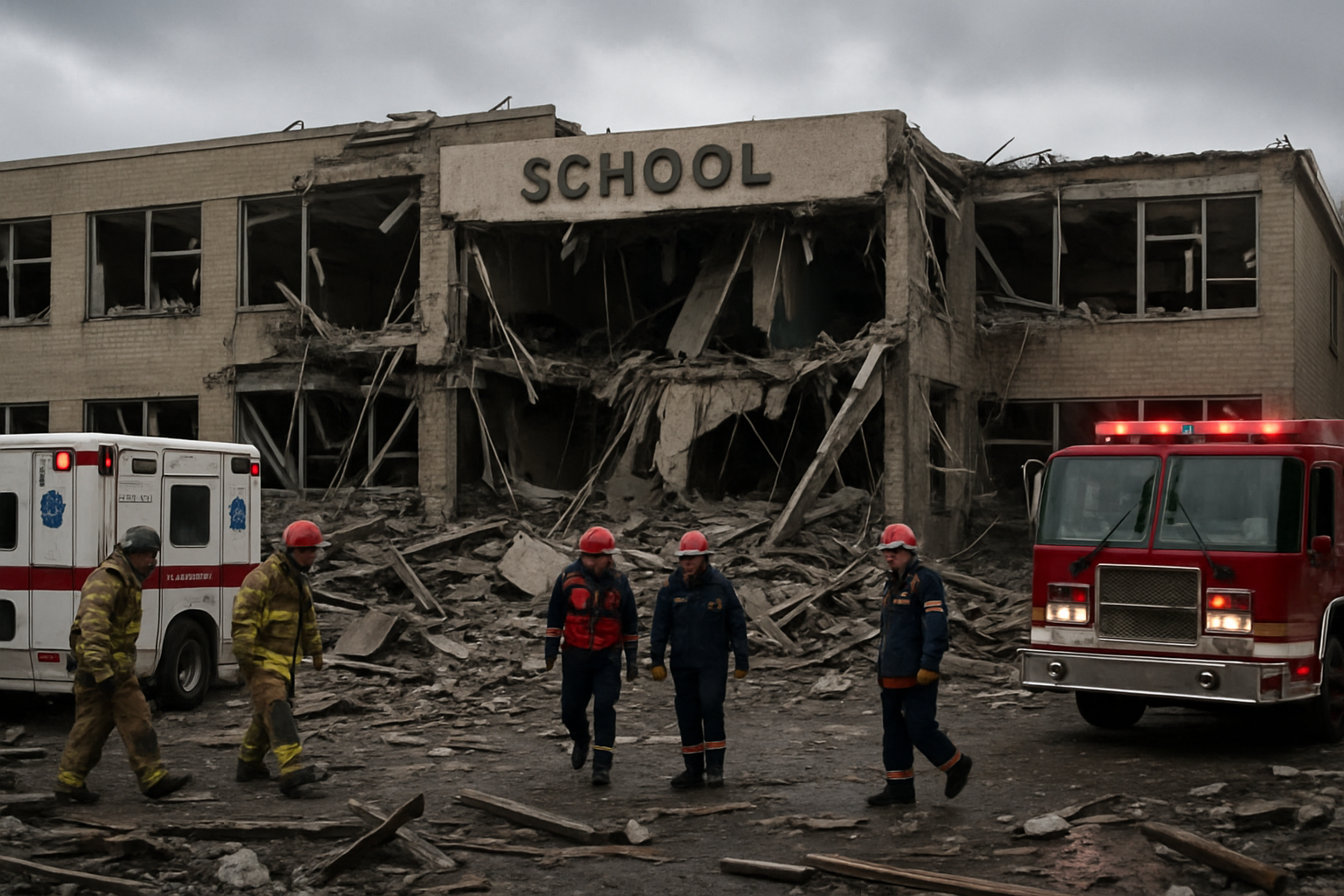
The death toll from a devastating attack on a girls' elementary school in Iran's Hormozgan province has risen to 148, with most victims being young schoolchildren, according to Iranian media reports citing local prosecutors.
The deadly strike on the educational facility in Minab district occurred during regular school hours when the building was filled with students and staff. Iranian state news agency IRNA, citing the local prosecutor, confirmed that at least 95 people were also wounded in what officials are calling a "barbaric crime" targeting innocent children.
The attack comes amid the most serious escalation in Middle East tensions since the Cold War, following the collapse of nuclear diplomacy between Iran and the United States despite achieving what negotiators called "broad agreement on guiding principles" - the most significant progress since the 2018 JCPOA breakdown.
Tragic Toll on Children and Families
According to multiple sources familiar with the incident, the strike occurred when the girls' elementary school was at full capacity during regular academic hours. The facility served students aged 6-12, making the casualties particularly devastating for the local community.
Iranian President Ebrahim Raisi condemned the attack as a "barbaric crime," while Foreign Minister Hossein Amir-Abdollahian described the targeting of schoolchildren as evidence that "no red lines remain" in the current crisis. Local officials report that rescue operations continued through the night as emergency responders worked to reach survivors trapped in the damaged building.
"They bombed it in broad daylight when it was full of young schoolgirls. This represents the complete breakdown of any moral constraints."
— Abbas Araghchi, Iranian Foreign Minister
Context of Escalating Regional Crisis
The school attack occurred against the backdrop of "Operation Epic Fury," the largest coordinated US-Israeli military operation in the Middle East since the 2003 Iraq invasion. The operation involved an unprecedented dual-carrier deployment of the USS Gerald R. Ford and USS Abraham Lincoln, representing approximately one-third of the active US Navy fleet positioned within 800 kilometers of Iran's coast.
The military escalation followed the complete breakdown of intensive nuclear negotiations in Geneva, despite diplomatic sources confirming that talks had achieved the most significant progress since the Joint Comprehensive Plan of Action (JCPOA) collapsed in 2018. The fundamental disagreement centered on scope: Iran maintained that ballistic missiles and regional proxy relationships were "red lines" to be excluded from nuclear-only discussions, while US Secretary of State Marco Rubio demanded a comprehensive agreement including missiles, armed groups, and human rights issues.
International Response and Condemnation
The targeting of the educational facility has drawn widespread international condemnation, with human rights organizations demanding investigations into potential Geneva Conventions violations. Images of children's backpacks and schoolbooks scattered among the rubble have become powerful symbols of the human cost of diplomatic failure.
The United Nations Security Council has scheduled an emergency session following requests from France, China, Russia, Colombia, and Bahrain. UN Secretary-General António Guterres warned that the actions represent "serious threats to international peace and security" and could "trigger a chain of events no one can control in the world's most unstable region."
European Union leaders issued a rare joint statement demanding "maximum restraint" and compliance with international law. However, they clarified their non-participation in the military strikes while condemning Iranian retaliatory actions across the Gulf region.
Regional Implications and Retaliation
Iran's Islamic Revolutionary Guard Corps (IRGC) launched what it termed "first wave" missile and drone strikes against Israeli and US installations across the Gulf states in response to the attacks. The retaliation caused casualties across multiple countries: one civilian was killed in Abu Dhabi from missile debris, Kuwait's international airport was struck by drones causing employee injuries, and Qatar intercepted 65 missiles and 12 drones using Patriot defense systems, resulting in eight injuries from fragments.
The strikes have severely strained the unprecedented regional coalition of Saudi Arabia, UAE, Qatar, and Egypt that had backed the diplomatic process. Egyptian President Abdel Fattah al-Sisi condemned attacks on "sisterly Arab countries," warning of "comprehensive chaos" spreading across the region.
Aviation and Economic Disruption
The crisis has triggered the most extensive aviation disruption since COVID-19, with Iran, Iraq, Israel, UAE, and Qatar closing their airspace to civilian traffic. Flight tracking data shows these regions now appear empty of commercial aviation. Over 18,000 flights have been cancelled worldwide, with major carriers including Emirates, Air France-KLM, Wizz Air, and Bulgaria Air suspending Middle East operations affecting hundreds of thousands of passengers globally.
Oil prices have risen immediately on concerns about the Strait of Hormuz, through which 40% of global oil transit passes. Natural gas prices have surged 24% in Europe and 78% in the United States, reflecting fears that regional conflict could disrupt worldwide energy supplies and supply chains.
Nuclear Governance Crisis
The breakdown of Iran diplomacy occurs within a broader nuclear governance crisis. The New START treaty between the United States and Russia expired on February 5, marking the first time in over 50 years without US-Russia nuclear constraints. Combined with China's nuclear expansion and what UN Secretary-General Guterres called nuclear risks at their "highest in decades," the collapse of the most promising US-Iran diplomatic opening in years raises fundamental questions about the viability of diplomatic solutions to modern nuclear crises.
Intelligence assessments suggest Iran has been enriching uranium to 60% purity with over 400 kilograms of material, making weapons development "easily achievable" according to nuclear expert Dr. Yusri Abu Shadi. This technical capability, combined with the breakdown of diplomatic constraints, represents what analysts describe as a template-setting moment for 21st-century nuclear crisis management.
Historical Significance and Future Implications
The attack on the Minab school represents more than a tragic loss of young lives; it symbolizes the human cost when diplomatic solutions give way to military confrontation. The rapid transition from what negotiators described as a diplomatic "breakthrough" to active military operations demonstrates what experts call the fragility of modern crisis management in a multipolar era.
Success or failure in containing this escalation will likely influence how future territorial and nuclear disputes are resolved globally, potentially setting precedents for whether military or diplomatic solutions become the default approach to international crises. The stakes extend beyond the Middle East to include regional war prevention, global energy security, nuclear governance credibility, and the enforcement mechanisms of international law in the 21st century.
As rescue operations continue in Minab and diplomatic efforts attempt to prevent further escalation, the images of destroyed classrooms and young victims serve as a stark reminder of what is lost when the international community fails to maintain pathways for peaceful conflict resolution. The coming days will be critical in determining whether this tragedy becomes a catalyst for renewed diplomatic engagement or marks a further descent into regional warfare with global implications.