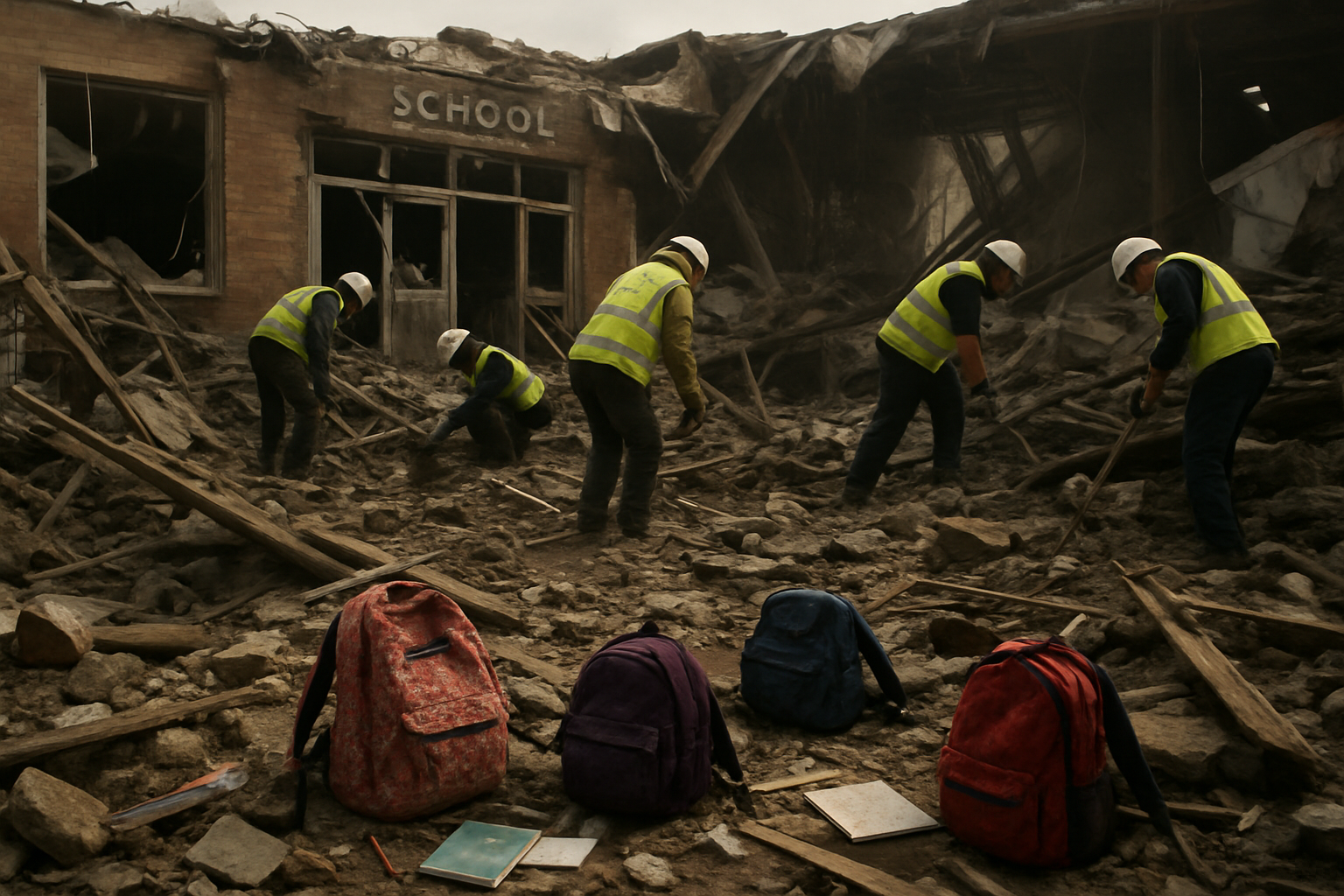
A catastrophic strike on a girls' elementary school in the southern Iranian city of Minab has killed between 53 and 85 students and staff, according to varying reports from Iranian authorities, marking one of the deadliest single incidents since the escalation of military operations in the region.
The attack on the school in Hormozgan province occurred during coordinated US-Israeli military strikes against Iranian facilities on February 28, 2026, as part of what President Trump has termed "Operation Epic Fury." Iranian authorities report that three missiles struck the school building while it was filled with young students during regular school hours.
Conflicting Casualty Reports Emerge
Death tolls from various sources present a tragic picture of the scale of casualties. Iran's Ministry of Education initially reported 53 killed and 63 wounded, while the country's judiciary later stated that at least 85 students had died in what they described as "US-Israeli strikes." French media sources confirmed the higher figure, while other international outlets reported death tolls ranging from 40 to 70 victims.
Iranian Foreign Minister Abbas Araghchi condemned the attack in a post on social media, writing: "The destroyed building is a girls' primary school in southern Iran. It was bombed in broad daylight, when it was full of young schoolgirls." President Masoud Pezeshkian called the strike "a barbaric crime" and expressed condolences to the families of victims.
Context of Broader Military Operations
The school attack occurred during the most significant US-Israeli military escalation against Iran since the 1979 revolution. The coordinated strikes, dubbed "Operation Epic Fury," were launched after the complete breakdown of nuclear negotiations despite recent diplomatic progress that had achieved what Iranian officials called "broad agreement on guiding principles."
The military operations followed Trump's explicit 10-day ultimatum warning that "bad things will happen" if no nuclear deal was reached. The US had deployed an unprecedented dual-carrier strike force, including the USS Gerald R. Ford and USS Abraham Lincoln, representing the largest American naval presence in the Middle East since the 2003 Iraq invasion.
"This is a historic moment that will have profound implications for the entire region and beyond."
— Regional Security Analyst
International Reactions and Diplomatic Fallout
The attack has drawn widespread international condemnation and has severely strained the unprecedented regional coalition of Saudi Arabia, UAE, Qatar, and Egypt that had been supporting diplomatic efforts. Multiple countries have issued travel warnings and begun evacuating embassy staff from the region.
The incident has also triggered a massive aviation crisis, with Iran, Iraq, Israel, UAE, and Qatar all closing their airspace to civilian traffic. Major international carriers including Emirates, Air France-KLM, Wizz Air, and Bulgaria Air have suspended flights to Middle Eastern destinations, affecting hundreds of thousands of passengers worldwide.
Iranian Retaliation and Regional Escalation
In response to the broader military operations, Iran launched what officials described as "first wave" retaliatory strikes against US military installations across the Gulf region. Iranian Revolutionary Guard Corps (IRGC) officials declared that "no red lines remain" and that all US and Israeli assets in the region were now "legitimate targets."
The retaliation included coordinated missile and drone attacks on multiple US bases, including Al Udeid Air Base in Qatar, facilities in Kuwait and the UAE, and the Fifth Fleet headquarters in Bahrain. At least one civilian was confirmed killed in Abu Dhabi from missile debris, while Kuwait Airport sustained damage from drone strikes.
Nuclear Diplomacy Collapse
The school attack and broader military escalation represent the complete breakdown of months-long nuclear negotiations that had shown unprecedented promise. Despite achieving what Iranian Foreign Minister Araghchi had described as "broad agreement on guiding principles" - the most significant progress since the 2018 JCPOA collapse - talks foundered on fundamental scope disagreements.
Iran had maintained that ballistic missiles and regional proxy activities were "red lines" excluded from nuclear-only negotiations, while US Secretary Marco Rubio insisted on a comprehensive agreement addressing missiles, armed groups, and human rights issues. The same structural disagreement that had prevented breakthrough attempts for over a decade ultimately proved insurmountable.
Global Energy and Economic Impact
The escalation has immediate implications for global energy markets, with oil prices rising sharply on concerns about potential disruption to the Strait of Hormuz, through which 40% of the world's oil transit passes. The broader Middle East serves as a critical connection hub between Europe and Asia, and the aviation disruptions are affecting global transportation networks.
The attacks also occur against the backdrop of what UN Secretary-General António Guterres has called the "highest" nuclear risks in decades, following the expiration of the New START treaty between the US and Russia on February 5, 2026 - the first time in over 50 years without nuclear constraints between the superpowers.
Humanitarian Crisis and International Law
International human rights organizations have called for immediate investigations into potential violations of international humanitarian law, particularly regarding the targeting of civilian infrastructure including schools. The Geneva Conventions strictly prohibit attacks on educational facilities and other civilian targets.
The school attack has been particularly devastating for the local community in Minab, where rescue workers have been seen searching through rubble containing children's backpacks, school books, and other educational materials - stark reminders of the young lives lost in the violence.
Looking Forward: Regional and Global Implications
The attack represents a template-setting moment for 21st-century conflict resolution, demonstrating how quickly intensive diplomatic efforts can collapse into military confrontation. The failure of months of negotiations despite achieving significant framework agreements raises questions about the viability of diplomatic solutions for modern nuclear crises.
An emergency session of the UN Security Council has been scheduled to address the escalation, as the international community grapples with the implications of this breakdown in diplomacy. The events may influence approaches to nuclear crisis resolution far beyond the Middle East, affecting global governance mechanisms and international law enforcement for decades to come.
As rescue operations continue at the destroyed school in Minab, the tragedy serves as a stark reminder of the human cost when diplomatic efforts fail and military solutions become the default response to international disputes. The images of children's belongings scattered among the debris will likely become enduring symbols of this latest chapter in Middle Eastern conflict.