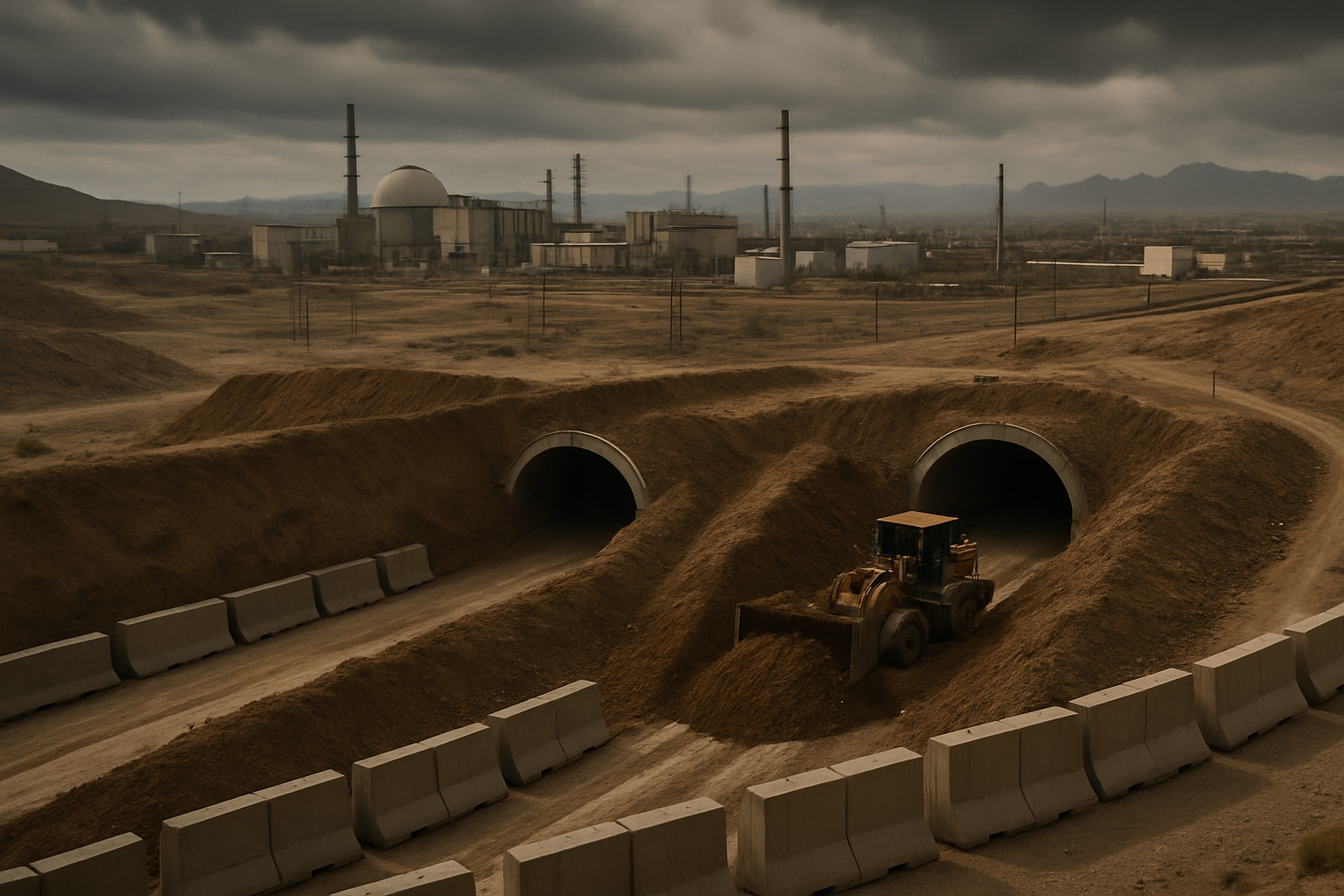
Satellite imagery reveals Iran has sealed all entrances to its Isfahan nuclear facility with earth and concrete, according to U.S.-based monitoring organizations, as diplomatic tensions escalate between Tehran and Washington despite ongoing nuclear negotiations.
The Washington-based Institute for Science and International Security (ISIS) published satellite images Tuesday showing all access points to Iran's Isfahan nuclear site have been buried under earthworks, a defensive measure the think tank says demonstrates Tehran is "seriously concerned" about potential U.S. or Israeli military strikes.
The defensive preparations come as Israeli Prime Minister Benjamin Netanyahu travels to Washington this week for high-stakes meetings with President Trump, with Iran strategy expected to dominate their discussions. The timing underscores the complex diplomatic and military calculations at play as multiple international actors navigate nuclear negotiations alongside military posturing.
Defensive Preparations Echo Previous Patterns
According to ISIS analysts, Iran implemented similar protective measures before the unprecedented U.S.-Israeli joint strikes on Iranian nuclear facilities in June 2025, which marked the first direct American military action against Iran's nuclear infrastructure. The facility hardening suggests Iranian leadership believes another round of military action may be imminent.
The Isfahan facility, located approximately 340 kilometers south of Tehran, houses uranium conversion capabilities and has been a centerpiece of Iran's nuclear program for decades. The site's strategic importance has made it a frequent target of international monitoring and diplomatic pressure.
Italian media reports indicated Iran has also transformed subway stations in major cities into improvised bunker systems, demonstrating the breadth of defensive preparations extending beyond nuclear facilities to civilian infrastructure protection.
Netanyahu-Trump Coordination Meeting
Israeli Prime Minister Netanyahu's Washington visit, confirmed by multiple international sources, represents a critical juncture in U.S.-Israeli coordination on Iran policy. The meeting occurs as nuclear negotiations between Iran and the United States continue in Oman, mediated by Sultan Haitham bin Tariq's government.
Netanyahu's office emphasized that discussions will prioritize ensuring "all negotiations must include limiting ballistic missiles, ending support for Iranian axis" — referring to Iran's regional proxy networks including Hezbollah, Hamas, and Houthi forces. This represents Israel's key red line for any comprehensive nuclear agreement.
The Israeli position creates potential friction with ongoing U.S.-Iran talks, where Iranian Foreign Minister Abbas Araghchi has maintained that ballistic missiles and regional activities are explicit "red lines" excluded from nuclear-only discussions.
Diplomatic Momentum Amid Military Tensions
Despite the defensive preparations, diplomatic engagement continues between Iran and the United States. Following talks in Muscat, Oman, both sides described a "positive atmosphere" and agreed to continue negotiations, marking the most significant diplomatic engagement since the 2018 JCPOA collapse.
Iranian officials have described the talks as having potential for "reassuring agreements" while maintaining their position that uranium enrichment remains an "inalienable right." Iran currently enriches uranium at 60% purity, significantly above the 3.67% limit established in the original nuclear agreement and approaching the 90% threshold required for weapons-grade material.
However, U.S. Secretary of State Marco Rubio has maintained that any comprehensive agreement must address Iran's ballistic missile capabilities, support for regional armed groups, and human rights violations — creating a fundamental scope disagreement that has historically prevented breakthrough agreements.
Regional Coalition Supports Diplomatic Process
An unprecedented coalition of Middle Eastern powers — including Saudi Arabia, the United Arab Emirates, Qatar, and Egypt — has endorsed the diplomatic process, representing remarkable consensus among traditionally competing regional actors. This support reflects shared concerns about potential military escalation affecting energy markets and maritime security.
The Persian Gulf handles approximately 40% of global oil transit, making regional stability crucial for international energy security. Oil prices have fluctuated in response to both military incidents and diplomatic developments, rising over $1 per barrel during recent tensions.
Oman's role as mediator has proven essential, leveraging its historical neutrality and successful facilitation of the 2015 JCPOA negotiations. The sultanate's diplomatic capital has enabled structured dialogue despite deep mistrust between Iran and the United States.
Military Incidents Complicate Diplomacy
The diplomatic engagement occurs against a backdrop of continued military tensions. Recent incidents include a U.S. F-35C fighter jet shooting down an Iranian Shahed-139 drone near the USS Abraham Lincoln aircraft carrier in the Arabian Sea, and Iranian Revolutionary Guard Corps vessels harassing U.S.-flagged tankers in the Strait of Hormuz.
These confrontations demonstrate the challenges of maintaining military deterrence while pursuing diplomatic solutions. Both sides have maintained readiness for potential conflict while exploring negotiated outcomes.
Admiral Brad Cooper, CENTCOM commander, visited the USS Abraham Lincoln alongside U.S. Special Envoy Steve Witkoff and Jared Kushner, demonstrating military-diplomatic coordination. The high-profile naval visit emphasized American resolve while supporting ongoing negotiations.
International Context and Stakes
The Iran nuclear crisis occurs within a broader international context that includes the expiration of the New START treaty between the United States and Russia, ongoing Ukraine-Russia peace negotiations, and China's nuclear expansion. This represents the first time in over 50 years without nuclear arms control constraints between superpowers, adding urgency to preventing Iranian weapons development.
U.N. Secretary-General António Guterres has warned that nuclear weapon use risks are "higher than at any time in decades," emphasizing the global implications of nuclear crisis resolution efforts.
European allies have expressed cautious support for renewed U.S.-Iran dialogue while emphasizing the need for robust verification mechanisms. The international community recognizes that success could provide a template for diplomatic resolution of nuclear crises, while failure might accelerate military solutions with far-reaching consequences.
Domestic Pressures Shape Negotiations
Iran faces severe domestic pressure with over 42,000 protest arrests since the 2022 uprising and continued economic sanctions creating regime survival imperatives. The Iranian government appears to be prioritizing nuclear capabilities over immediate sanctions relief, as evidenced by Foreign Minister Araghchi's recent declarations that Iran will "never abandon uranium enrichment even if war is imposed."
Meanwhile, the Trump administration balances Republican pressure viewing engagement as potential appeasement against the need for foreign policy achievements. The dual-track approach of maintaining maximum economic pressure while pursuing diplomatic engagement reflects these competing political considerations.
Future Trajectory Uncertain
The coming weeks will prove decisive for determining whether innovative diplomatic solutions can bridge decade-old challenges or whether the current engagement represents another false start in nuclear crisis resolution. The fundamental disagreement over negotiation scope — Iran's nuclear-only approach versus U.S. demands for comprehensive agreements addressing missiles and regional activities — remains the core obstacle to progress.
Intelligence reports suggest Iran may consider significant concessions, including a three-year uranium enrichment halt and transfer of existing stockpiles to Russia. However, recent hardline statements from Iranian leadership suggest such compromises may be increasingly unlikely without corresponding U.S. concessions.
Success would prevent potential regional military confrontation and provide international precedent for nuclear diplomacy. Failure could accelerate toward military solutions, fundamentally reshaping Middle Eastern geopolitics with global implications for energy security, nuclear governance, and international law enforcement.
The intersection of Iran's defensive preparations, Netanyahu's Washington meetings, and ongoing diplomatic negotiations represents a critical test of whether 21st-century nuclear crises can be resolved through sustained engagement or whether military solutions remain the default outcome for intractable international disputes.