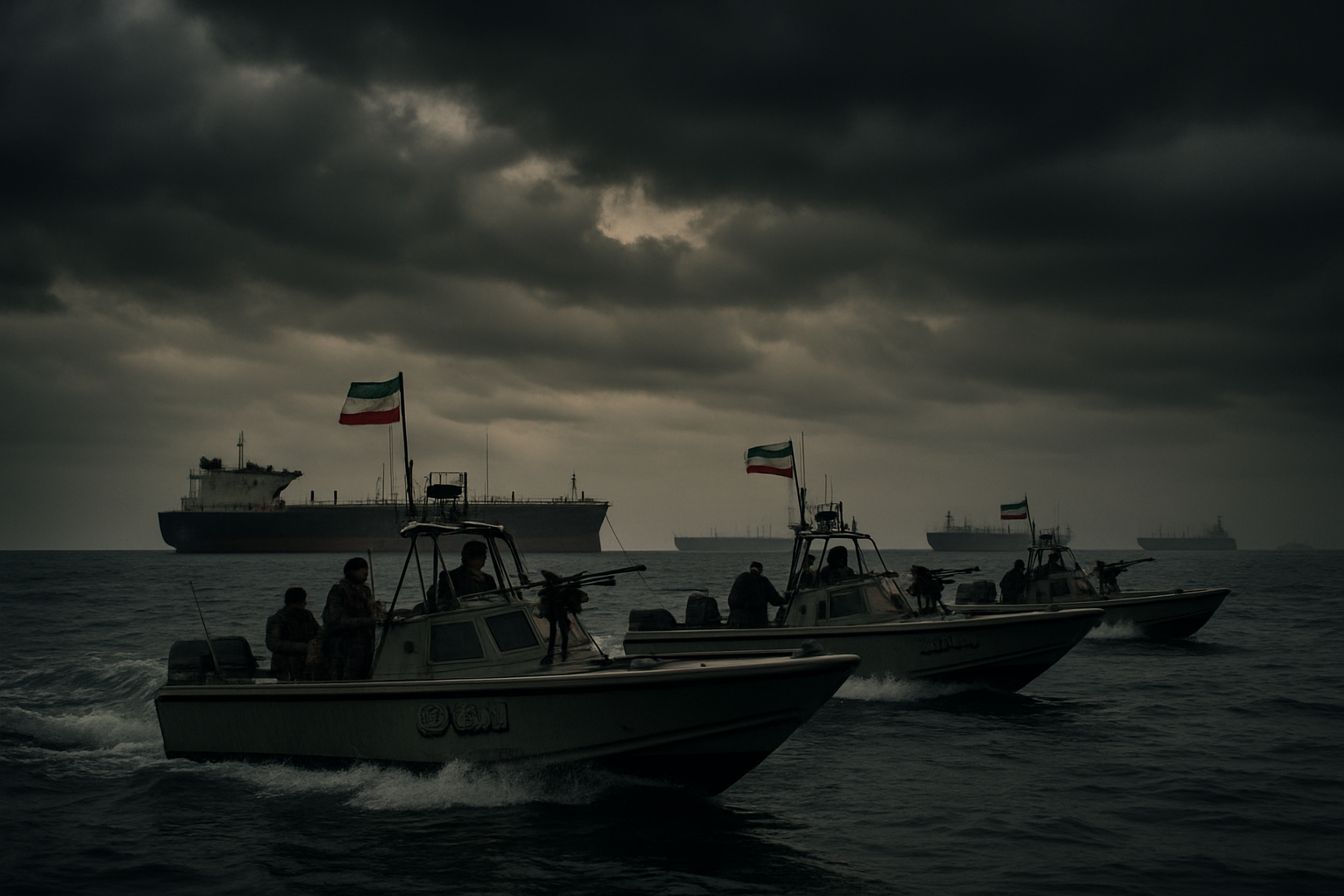
Iran's Revolutionary Guard Corps (IRGC) intercepted and seized multiple commercial vessels in the Strait of Hormuz on Wednesday, marking a dangerous escalation in the ongoing Middle East crisis that threatens global oil supplies through the world's most strategic waterway.
The IRGC confirmed that its naval forces captured two vessels—the MSC Francesca, described by Iran as "linked to Israel," and the Epaminondas—for alleged violations including operating without authorization and tampering with navigation systems. The ships were attempting to exit the strait "covertly" when intercepted based on intelligence monitoring, according to an IRGC statement.
The seizures occurred just hours after President Trump announced an indefinite extension of the Iran ceasefire, creating a dangerous contradiction as Tehran categorically rejected further negotiations while demonstrating its continued control over the vital shipping lane that handles 40% of global seaborne oil transit.
Strategic Chokepoint Under Iranian Control
The UK Maritime Trade Operations, which serves as a naval liaison with the shipping industry, reported on social media that both a cargo ship and container ship came under fire in the 21-mile waterway. Iranian gunboats fired on the vessels without warning, forcing them into Iranian territorial waters where they remain under Revolutionary Guard custody.
According to multiple international sources, Iran's state television later confirmed that the ships were in Revolutionary Guard custody and being taken to Iranian ports. The seizures represent Iran's assertion of "complete control" over the strategic waterway, which the IRGC has declared "unsafe for shipping" during the ongoing conflict.
The Strait of Hormuz has become a focal point of the crisis, with Iran deploying an estimated 2,000-6,000 naval mines throughout the waterway. The US has destroyed 28 Iranian mine-laying vessels in response, but the strategic chokepoint remains effectively under Iranian control.
Global Energy Markets React
Oil prices surged following the ship seizures, with Brent crude reaching $106.04 and West Texas Intermediate hitting $104.29—marking the second time in 2026 that oil has breached the $100 per barrel threshold. The crisis has triggered the largest strategic petroleum reserve release in the International Energy Agency's 50-year history, with 400 million barrels deployed from 32 countries.
Major shipping companies Maersk and MSC have suspended operations in the Persian Gulf indefinitely, leaving more than 150 oil and LNG tankers stranded with cargo worth billions of dollars. The disruption affects critical supply chains far beyond energy, impacting consumer goods and industrial materials worldwide.
"The situation is far worse than initially thought, and financial markets are becoming the ultimate constraint on prolonged conflict."
— Damien Boey, Financial Analyst
Diplomatic Breakdown Amid Ceasefire Extension
The ship seizures occurred against the backdrop of collapsed peace negotiations. VP JD Vance's 21-hour marathon talks in Islamabad ended in failure over Iran's nuclear program, with the US demanding Iran suspend 60% uranium enrichment and abandon its 400kg+ stockpile of weapons-grade material. Iran's lead negotiator Abbas Araghchi maintained that Iran would "never abandon enrichment even if war imposed."
A critical factor in the diplomatic breakdown was the "Lebanon loophole"—Netanyahu's explicit exclusion of Lebanon from the ceasefire framework. Israeli strikes killed more than 254 people in a single day during the talks, with 1.2 million Lebanese displaced, representing 25% of the country's population.
Iran's Foreign Ministry spokesman Esmaeil Baghaei announced Tehran has "no plans for further negotiations with the US," citing excessive demands and the ongoing US naval blockade of Iranian ports—an action generally considered an act of war under international law.
Regional Coalition Under Maximum Strain
The unprecedented diplomatic consensus among Saudi Arabia, the UAE, Qatar, and Egypt faces severe testing following Iran's systematic regional targeting. The IRGC's "Operation True Promise 4" resulted in casualties across the coalition: one civilian killed in Abu Dhabi, 32 injured in Kuwait airport strikes, and eight wounded in Qatar despite Patriot missile intercepts of 65 missiles and 12 drones.
Egyptian President Abdel Fattah el-Sisi's warnings about "comprehensive chaos" affecting "sisterly countries" have proven increasingly prophetic as diplomatic failures mount. The regional coalition's ability to maintain unity while under direct attack represents one of the crisis's most significant diplomatic achievements, though it remains under maximum strain.
International Response Fractures
NATO allies have delivered historic rejections of US military escalation demands. UK Prime Minister Keir Starmer declared Britain "will not be dragged into Iran's war," while France and Germany have emphasized diplomatic approaches over military solutions. Australia and Japan's refusal to provide naval support represents the most significant rejection of American military leadership since the 2003 Iraq War.
Only Israeli Prime Minister Benjamin Netanyahu has offered "full support and close coordination" with US operations, highlighting growing divisions within the traditional Western alliance structure during this crisis.
Congressional Opposition Reaches Historic Levels
US domestic opposition to military operations has reached unprecedented levels, with only 25% of Americans supporting "Operation Epic Fury"—historically low approval for early-stage military operations. Senator Richard Blumenthal expressed being "more concerned than ever" about potential ground troop deployments, as Pentagon operations are projected to continue through September, far beyond initial 4-6 week timelines.
The operation has already cost $11.3 billion in its first week alone, with daily expenses of approximately $1 billion creating what analysts describe as the "ultimate constraint" forcing diplomatic solutions over prolonged military confrontation.
Humanitarian Crisis Mounting
The Iranian Red Crescent reports more than 787 civilian casualties, including a Pentagon elementary school strike that killed 165-185 students using what officials called "outdated targeting data." War crimes investigations are underway under the Geneva Conventions.
International evacuations have reached Arab Spring-scale proportions, with Australia reporting 115,000 nationals trapped and Germany evacuating 30,000 citizens. The EU activated its ESTIA crisis mechanism for the first time following Iranian drone attacks on RAF Akrotiri in Cyprus—the first attack on European territory since World War II.
Nuclear Governance in Crisis
The crisis unfolds against the backdrop of collapsed nuclear governance mechanisms. The New START treaty expired in February 2026, creating the first gap in US-Russia nuclear constraints in over 50 years. Iran continues uranium enrichment at 60% purity, approaching the 90% threshold required for weapons-grade material, with sufficient stockpiles for multiple nuclear weapons if weaponized.
UN Secretary-General António Guterres has described the situation as the "greatest test of multilateral cooperation in the modern era," while warning that nuclear risks are at their "highest levels in decades."
Economic Impact Spreads Globally
The crisis has triggered severe economic disruptions worldwide. Bangladesh has implemented fuel rationing for 170 million people, while Pakistan has adopted wartime austerity measures including four-day work weeks. European energy costs are surging, with natural gas prices up 24% in Europe and 78% in the United States.
Financial markets have experienced historic crashes, with Pakistan's KSE-100 suffering its largest single-day decline in history at -8.97%, and South Korea's KOSPI falling 12% to trigger circuit breakers. The Korean won has hit 17-year lows as investors flee to safe havens.
Aviation Industry Paralyzed
The aviation crisis continues with more than 18,000 flights cancelled worldwide—the most extensive disruption since COVID-19. Eight countries maintain simultaneous airspace closures, creating what experts describe as an "aviation black hole" across Europe-Asia corridors.
Dubai International Airport, the world's busiest with 86 million annual passengers, remains shut following missile damage. Major carriers including Emirates, Air France-KLM, and Wizz Air have suspended Middle East operations indefinitely, affecting hundreds of thousands of passengers globally.
Template-Setting Crisis for the 21st Century
Energy security expert Samuel Ciszuk has described this as "the most severe energy security crisis in decades," exposing dangerous vulnerabilities in the global economy's dependence on strategic chokepoints. The 21-mile Strait of Hormuz represents a single point of failure for modern logistics with no realistic alternatives for the volume of energy and goods that transit the waterway.
The crisis represents a watershed moment for 21st-century international relations, testing whether diplomatic innovation can ultimately triumph over military confrontation in resolving complex geopolitical disputes. The stakes extend far beyond the immediate Middle East conflict, affecting energy architecture transformation, nuclear proliferation mechanisms, and international cooperation credibility for decades to come.
Path Forward Uncertain
As Iran maintains its seizure of commercial vessels while rejecting negotiations, and the US continues its naval blockade despite ceasefire extensions, the world faces a dangerous impasse. Pakistan's innovative mediation framework—which achieved a historic ceasefire just 88 minutes before President Trump's "whole civilization" deadline—demonstrated that middle-power diplomacy can bridge even the most bitter adversaries when traditional mechanisms fail.
However, fundamental disagreements over Iran's nuclear program, regional proxy conflicts, and territorial sovereignty remain unresolved. The coming days will determine whether the international community can restore diplomatic momentum or face a return to maximum crisis conditions with potentially civilizational consequences.
The seizure of ships in the Strait of Hormuz represents more than a regional conflict—it is a defining moment that will shape how the world handles energy security, nuclear governance, and international law enforcement for generations to come.