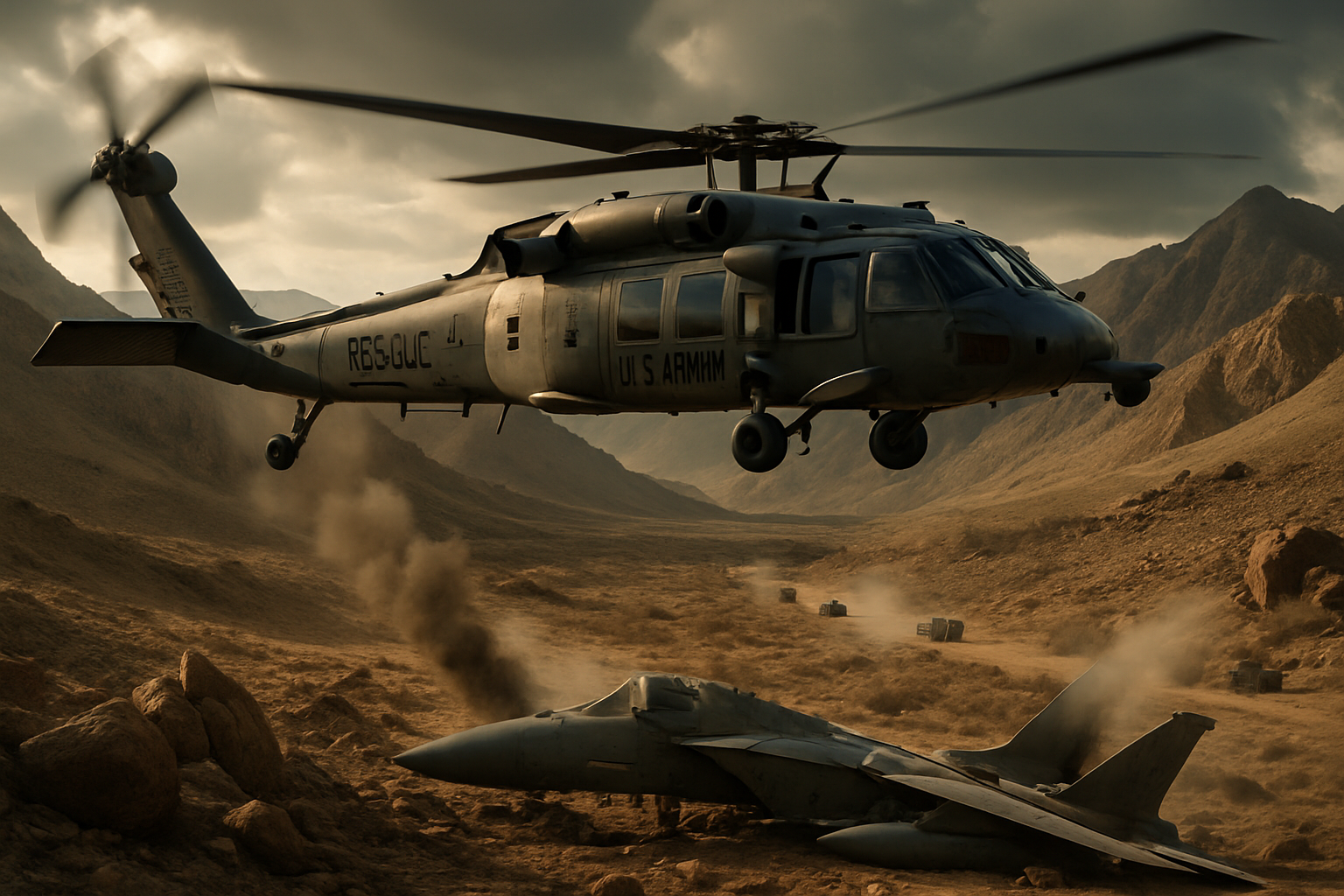
Iran's Islamic Revolutionary Guards Corps (IRGC) claimed Friday that it shot down a US F-35 fighter jet over central Iranian territory, marking a dramatic escalation in the ongoing military confrontation between Tehran and Washington that has dominated headlines since late February.
Iranian state media reported that the fate of the American pilot remains unknown following the downing of the aircraft, with the semi-official Tasnim News Agency citing an IRGC statement claiming the plane was "completely destroyed." This represents the second time in recent weeks that Iran has claimed to have downed a US F-35, though the previous March 19 claim was rejected by Washington.
US officials confirmed to multiple international news outlets that an American fighter aircraft had indeed been shot down over Iran, with search and rescue operations currently underway. A US official speaking to Reuters confirmed the incident and added that efforts to locate the crew were in progress, representing the first confirmed loss of a US military aircraft to enemy fire since the current crisis began on February 28.
Race Against Time for Missing Pilots
Iranian ground forces have reportedly launched extensive search operations across the crash site area, with IRGC ground units conducting "comprehensive field operations" to locate and potentially capture the American pilot, according to Iranian media reports.
In a disturbing escalation, Iranian state television has begun offering rewards for civilians who capture the downed pilot, with local broadcasts urging citizens to "shoot them if you see them." The Iranian Red Crescent has also been mobilized to assist in search operations across the mountainous terrain of central Iran.
European intelligence sources suggest that Iran has deliberately released footage of what appears to be an ejection seat from the downed aircraft, allegedly to disrupt US rescue operations by providing false location indicators. This psychological warfare tactic underscores the high stakes involved in recovering the American airman.
Escalation Following Massive US-Israeli Campaign
The aircraft downing comes amid the most intensive military confrontation between the United States and Iran since 1979, following the launch of "Operation Epic Fury" - a massive US-Israeli campaign targeting Iranian military infrastructure that began after the collapse of nuclear negotiations in Geneva.
President Donald Trump has taken an increasingly hardline stance, demanding Iran's "unconditional surrender" and claiming the right to personally select Iran's next Supreme Leader. This represents the most explicit regime change policy since the Islamic Revolution, moving far beyond the nuclear-focused disputes that initially triggered the crisis.
"This is clearly an F-15 based on the debris patterns we've analyzed"
— Peter Layton, Griffith Asia Institute
Military analysts examining Iranian state media footage suggest the downed aircraft may actually be an F-15 rather than the claimed F-35, based on visible wreckage characteristics. However, the strategic significance remains unchanged - this marks the first confirmed US aircraft loss in what has become the largest American military operation in the Middle East since the 2003 Iraq invasion.
Global Energy Crisis Deepens
The military escalation has triggered unprecedented global economic disruption, with Iran's closure of the Strait of Hormuz effectively blocking 40% of the world's seaborne oil transit. Over 150 oil and LNG tankers worth billions remain stranded in the Persian Gulf as major shipping companies suspend operations indefinitely.
Oil prices have surged past $80 per barrel, while natural gas prices have increased by 24% in Europe and 78% in the United States. The aviation industry faces its worst crisis since COVID-19, with over 18,000 flights cancelled worldwide as eight countries simultaneously closed their airspace.
Qatar's massive LNG production facilities have been forced offline following Iranian missile strikes, threatening European energy supplies just as winter demand peaks. The economic ripple effects extend far beyond the Middle East, with supply chains for automotive, electronics, and textile manufacturing severely disrupted.
European Territory Attacked for First Time Since WWII
In an unprecedented expansion of the conflict, Iranian drones successfully struck the British Royal Air Force base at Akrotiri in Cyprus - marking the first attack on European territory since World War II. This has prompted an extraordinary naval coalition response, with HMS Dragon, Spanish frigates, and vessels from Italy, France, the Netherlands, and Greece deploying to protect Cyprus.
The attack on European soil fundamentally alters the scope of the conflict, with EU officials activating the ESTIA crisis response mechanism for the first time in the bloc's history. French President Emmanuel Macron made an emergency visit to Cyprus, emphasizing the gravity of the situation for European security.
Regional Casualties Mount
Iran's "Operation True Promise 4" has systematically targeted US facilities and allies across the region, resulting in significant casualties. In the United Arab Emirates, at least one civilian has been killed in Abu Dhabi, while Dubai International Airport - the world's busiest - remains closed due to missile damage.
Kuwait reported 32 people injured in airport strikes, while Qatar managed to intercept 65 missiles and 12 drones using Patriot defense systems, though 8 people were still injured. The scale of Iran's retaliation has strained the unprecedented regional coalition that had supported diplomatic efforts just weeks ago.
Nuclear Diplomacy's Complete Collapse
The current military escalation follows the complete breakdown of what initially appeared to be promising nuclear negotiations. Three rounds of talks in Geneva had achieved what Iranian Foreign Minister Abbas Araghchi called "broad agreement on guiding principles" - the most significant diplomatic progress since the 2018 collapse of the Joint Comprehensive Plan of Action (JCPOA).
However, fundamental disagreements proved insurmountable. Iran insisted on limiting talks to nuclear issues only, treating ballistic missiles and regional proxy relationships as "red lines." The United States, coordinating closely with Israel, demanded a comprehensive agreement addressing Iran's entire military and regional activities.
Iran continues uranium enrichment at 60% purity - approaching the 90% threshold needed for weapons-grade material. Intelligence assessments suggest Iran now possesses over 400 kilograms of enriched uranium, sufficient for multiple nuclear weapons if weaponized.
Constitutional Crisis in Tehran
The military confrontation has coincided with a constitutional succession crisis in Iran following Supreme Leader Ali Khamenei's death on March 1, ending his 37-year rule. A three-member transitional council currently governs the country during active warfare - an unprecedented situation in the Islamic Republic's history.
The Assembly of Experts is tasked with selecting a permanent successor under combat conditions, with CIA assessments suggesting a Revolutionary Guards member is likely to assume power. This would represent a significant shift from clerical to military governance, potentially hardening Iran's confrontational approach.
Congressional Opposition Mounts
In Washington, bipartisan opposition to the military campaign is intensifying, with lawmakers demanding comprehensive briefings on strategy, costs, and the potential deployment of ground troops. Senator Richard Blumenthal expressed being "more concerned than ever" about the possibility of American boots on the ground.
The conflict's unpopularity is "almost unprecedented" for such an early stage, with only 25% of Americans supporting the strikes according to recent polling. Financial markets have emerged as what analysts call the "ultimate constraint," with Pakistan's stock exchange suffering its largest single-day decline in history.
Operation Epic Fury has already cost $3.7 billion in its first 100 hours, at a rate of $891.4 million daily. Pentagon officials confirm the first US casualties of the operation: 3 service members killed and 5 wounded, marking the first American deaths in the largest Middle East military operation since 2003.
International Community Responds
The crisis has triggered the largest coordinated international evacuation since the Arab Spring in 2011, with Australia reporting 115,000 citizens trapped in the region and Germany struggling to extract 30,000 stranded tourists. Multiple countries have issued immediate evacuation orders for Iran, citing "extremely uncertain security situations."
UN Secretary-General António Guterres has called this "the greatest test of multilateral cooperation in crisis management in the modern era." The rapid transition from diplomatic breakthrough to military escalation demonstrates what experts term the "fragility of crisis management in the multipolar era."
Template-Setting Implications
The current crisis represents far more than a regional military confrontation - it serves as a template-setting moment for 21st-century international relations. The breakdown of the New START treaty between the US and Russia in February, combined with China's nuclear expansion, has created a broader nuclear governance crisis.
Success in containing the conflict could provide a framework for future nuclear crisis resolution through diplomatic channels. However, failure may accelerate military solutions to international disputes for decades to come, encouraging nuclear proliferation elsewhere and fundamentally undermining diplomatic credibility worldwide.
The stakes extend beyond the immediate participants to encompass global energy security, nuclear governance credibility, and the effectiveness of international law enforcement mechanisms in the post-World War II order. As the world watches American search and rescue operations unfold over Iranian territory, the outcome may well determine whether diplomatic solutions or military confrontation become the primary tool for resolving 21st-century international disputes.