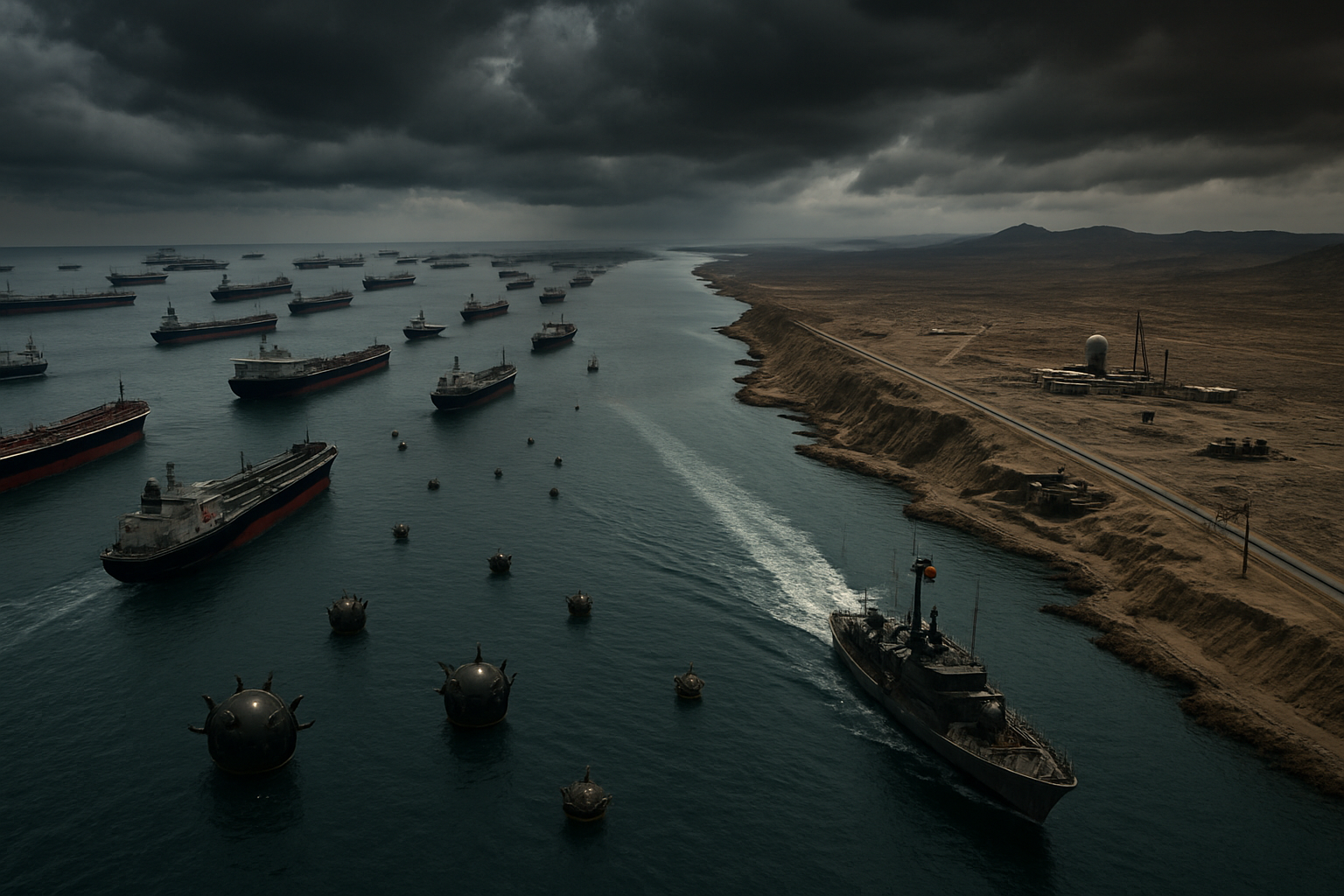
Iran's Revolutionary Guard maintains its blockade of the Strait of Hormuz as oil tankers continue to turn back from the critical waterway, with reports indicating ships are being forced to reverse course despite recent diplomatic efforts to resolve the crisis affecting 40% of global oil transit.
According to multiple international sources, Iran has effectively closed the strategic 21-mile waterway while implementing a selective passage system that requires coordination with Iranian authorities. The Italian tanker Auroura was observed making a complete 180-degree turn back into the Persian Gulf, highlighting the ongoing challenges facing international shipping.
Current Crisis Status
The blockade stems from the breakdown of ceasefire negotiations between the United States and Iran, with the opening of the Strait of Hormuz being a central component of any potential agreement. However, Israel's continued military operations in Lebanon have complicated diplomatic efforts, according to German reports indicating Iran maintains the waterway closure in response to regional hostilities.
Japanese sources confirm that 42 Japan-linked vessels remain stranded in the Persian Gulf, including crude oil tankers, chemical carriers, vehicle transporters, liquefied natural gas ships, and petroleum product carriers. This represents one of the most significant maritime crises in decades, affecting global supply chains beyond energy sectors.
"The Strait of Hormuz is not simply a military chokepoint; it is a living marine corridor through which roughly a quarter of global seaborne oil trade, major LNG volumes and around one-third of global seaborne fertilizer normally pass."
— Dr. Mureed Kazim, Energy Security Expert
Alternative Route Implementation
Russian sources indicate that Iran's Islamic Revolutionary Guard Corps Navy has issued directives specifying two alternative routes for vessel passage, both requiring transit through waters near Larak Island under Iranian supervision. This represents a significant departure from traditional international maritime law governing free navigation through international waters.
Sweden's diplomatic sources report that Iran's naval forces have distributed maps showing "safe routes" through the Strait of Hormuz, suggesting a systematic approach to controlling maritime traffic rather than a complete closure. However, these routes require explicit Iranian authorization and coordination.
Toll Collection Controversy
Reports from Trinidad and Tobago reveal that Iran is demanding the right to collect tolls in the Strait of Hormuz as a precondition for reopening the waterway to normal traffic. This proposal has drawn international criticism as a violation of basic maritime trade principles.
According to legal experts cited in Caribbean sources, collecting tolls in the strait would violate the fundamental principle of freedom of peaceful navigation, which was codified by the United Nations Convention on the Law of the Sea that took effect in 1994. This ancient principle has been a cornerstone of international maritime commerce for centuries.

Environmental and Economic Impact
Pakistani analysis highlights the ecological dimensions of the crisis, noting that recent Iranian strikes on vessels carrying millions of barrels of oil pose significant environmental risks. The reported attack on Kuwait's Al Salmi tanker near Dubai, carrying approximately two million barrels of oil, demonstrates the potential for environmental catastrophe beyond the immediate economic impacts.
The UK Maritime Trade Operations (UKMTO) has documented 24 incidents between February 28 and March 30 across the Arabian Gulf, Strait of Hormuz, and Gulf of Oman, including 16 confirmed attacks. This pattern of escalation has forced major shipping companies to indefinitely suspend operations in the region.
Global Supply Chain Disruption
The crisis has extended far beyond energy markets, affecting global supply chains for consumer goods, industrial materials, and manufacturing components. The Persian Gulf serves as a critical trade hub, and the 21-mile Strait of Hormuz represents a single-point failure for modern logistics systems with no realistic alternative routes capable of handling the diverted volume.
Manufacturing sectors dependent on Gulf trade networks, particularly automotive, electronics, and textiles, are experiencing severe disruptions. China has suspended refined fuel exports, while Singapore reports 30% increases in logistics costs, demonstrating the global reach of the crisis.
Diplomatic Background
The current blockade follows the complete breakdown of US-Iran nuclear negotiations despite what sources described as achieving "broad agreement on guiding principles" - the most progress since the 2018 JCPOA collapse. The fundamental disagreement centered on Iran's exclusion of ballistic missiles and proxy groups as "red lines" versus comprehensive US demands covering missiles, armed groups, and human rights issues.
This diplomatic failure led to Operation Epic Fury, described as the largest US-Israeli coordinated military operation since 2003, which prompted Iranian retaliation under "Operation True Promise 4" that has systematically targeted regional coalition members supporting diplomatic solutions.
Regional Coalition Under Pressure
The crisis has severely strained the Saudi Arabia-UAE-Qatar-Egypt coalition that had previously maintained consensus supporting diplomatic engagement. Iranian attacks on member territories have resulted in casualties: one civilian killed in Abu Dhabi, 32 injured in Kuwait airport strikes, and eight wounded in Qatar despite Patriot missile system interceptions of 65 missiles and 12 drones.
Egyptian President Abdel Fattah el-Sisi has condemned attacks on "sisterly Arab countries" while warning of potential "comprehensive chaos" if regional escalation continues, highlighting the delicate balance coalition members must maintain between US alliance obligations and Iranian pressure.
International Response Mechanisms
The crisis has prompted the largest strategic petroleum reserve release in International Energy Agency history - 400 million barrels from 32 countries, more than double the 2022 Ukraine crisis response. Japan is releasing 80 million barrels for the first time since the 2011 Fukushima disaster, given its 95% dependence on Middle Eastern oil with 70% transiting through Hormuz.
Aviation industries worldwide have cancelled over 18,000 flights - the most extensive disruption since COVID-19 - as eight countries maintain simultaneous airspace closures across Iran, Iraq, Israel, UAE, Qatar, Syria, Kuwait, and Bahrain. Dubai International Airport, the world's busiest with 86 million passengers annually, remains shut down due to missile damage.
"This situation is going on longer than people initially thought, and the financial markets will be the ultimate constraint in any prolonged conflict."
— Damien Boey, Financial Analyst
Long-term Implications
Security experts characterize this as the most dangerous international crisis since the Cold War's end, affecting regional war prevention, global energy security, nuclear governance credibility, and international law enforcement mechanisms simultaneously. The rapid transition from diplomatic breakthrough to military confrontation demonstrates the fragility of crisis management in the multipolar era.
The crisis exposes fundamental vulnerabilities in global energy architecture that requires years or decades to address through supply diversification and renewable energy transitions. However, the urgency of the current situation has dramatically accelerated discussions about reducing dependence on strategic chokepoints in volatile geopolitical regions.
Nuclear Governance Crisis
Compounding the maritime crisis, the New START Treaty expired February 5, marking the first time in over 50 years without US-Russia nuclear constraints. Iran continues 60% uranium enrichment with over 400 kilograms of weapons-grade material - sufficient for multiple nuclear weapons. UN Secretary-General António Guterres has warned that nuclear risks are at their "highest level in decades."
This convergence of maritime blockade, regional military escalation, and nuclear governance breakdown represents what Guterres calls "the greatest test of multilateral cooperation in the modern era," with implications extending decades beyond current events.
Economic and Consumer Impact
Oil prices peaked at Brent crude $119.50 and WTI $108.15, marking an 18.98% single-day jump - the largest on record. Natural gas prices have surged 24% in Europe and 78% in the United States, reaching €47.32/MWh, the highest since February 2025.
Consumer impacts vary globally based on energy market integration levels: Sweden faces electricity increases of 10-20 öre with gasoline rising 1-2 kronor per liter, while Bangladesh has implemented fuel rationing for 170 million people. Pakistan has instituted wartime austerity measures including four-day government work weeks.
The Qatar Energy Minister has warned that Gulf states may be forced to declare force majeure "within weeks," potentially driving oil prices to $150 per barrel, which could "bring down the economies of the world," according to official statements.
Path Forward
Recovery timeline remains uncertain as it depends on military operations resolution and diplomatic normalization rather than predictable factors like weather disruptions. Aviation industries cannot maintain long-term scheduling with multiple airspaces closed, while energy markets remain volatile with critical transit routes blocked.
The crisis represents a template-setting moment for 21st-century conflict resolution, determining whether diplomatic engagement can prevail over military solutions in addressing territorial and nuclear disputes. Success in containing the crisis could provide frameworks for future nuclear crisis resolution, while failure risks accelerating military approaches to international disputes for decades to come.
As the situation continues to unfold, the international community faces the challenge of immediate supply needs versus long-term energy security architecture transformation that could reshape global energy markets and international relations for generations.