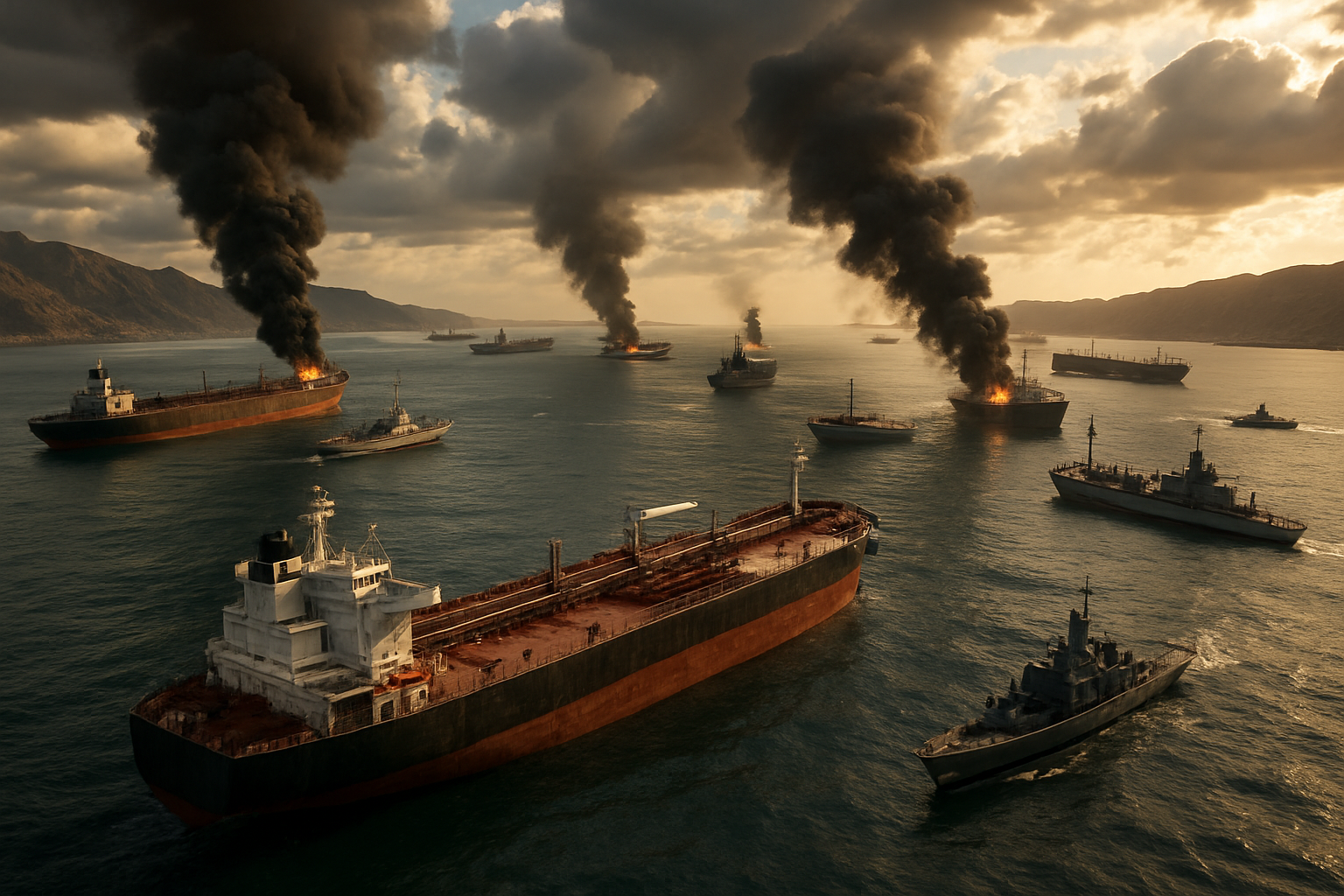
Iran's Revolutionary Guard has effectively blockaded the strategic Strait of Hormuz with naval mines and sustained attacks on commercial shipping, triggering the most severe global energy crisis in decades and prompting the International Energy Agency to announce its largest-ever emergency oil reserve release of 400 million barrels.
The 21-mile-wide waterway, through which approximately 40% of the world's seaborne oil transits daily, has become virtually impassable for commercial vessels following Iran's declaration that the strait is "unsafe for shipping." The crisis has sent oil prices soaring past $100 per barrel for the first time since 2022, with Brent crude peaking at $119.50 and West Texas Intermediate jumping a record 18.98% to $108.15.
Mining Operation Paralyzes Critical Waterway
Intelligence sources confirm Iran has deployed naval mines from its stockpile of 2,000-6,000 sea mines, using small vessels to lay the weapons across key shipping channels. U.S. forces have destroyed 16 Iranian mine-laying vessels in recent operations, but experts warn the damage is already done. Three commercial vessels were attacked on Wednesday alone, including a Thai cargo ship that caught fire, requiring the rescue of 23 crew members.
Major shipping companies Maersk and MSC have suspended all operations through the Persian Gulf, leaving more than 150 oil and LNG tankers stranded with cargo worth billions of dollars. Alternative routes around the Arabian Peninsula lack adequate capacity and add significant time and costs to shipments.
"This represents the most severe energy security crisis in decades, exposing our dangerous over-dependence on strategic chokepoints with limited alternatives."
— Samuel Ciszuk, Energy Security Analyst
Historic Strategic Reserve Deployment
In response to the unprecedented supply disruption, the International Energy Agency announced the release of 400 million barrels from strategic petroleum reserves – the largest deployment in the organization's 50-year history, surpassing the 182.7 million barrels released during the 2022 Ukraine crisis.
Japan will contribute 80 million barrels beginning March 16, marking the country's first reserve deployment since the 2011 Fukushima disaster. With 95% of Japan's oil imports originating from the Middle East and 70% transiting through Hormuz, the crisis poses an existential threat to the world's fourth-largest economy.
Germany has confirmed its participation in the coordinated release, while the United States is expected to be the largest contributor. U.S. Energy Secretary Christopher Wright is also considering lifting additional sanctions on Russian oil to help stabilize global supplies.
Aviation Industry in Crisis
The conflict has created a parallel aviation crisis, with over 18,000 flights cancelled worldwide – the most extensive disruption since the COVID-19 pandemic. Eight countries have simultaneously closed their airspace: Iran, Iraq, Israel, UAE, Qatar, Syria, Kuwait, and Bahrain.
Dubai International Airport, the world's busiest with 86 million passengers annually, remains completely shut down due to missile damage. Major carriers including Emirates, Air France-KLM, Wizz Air, and Bulgaria Air have suspended Middle East operations indefinitely, affecting hundreds of thousands of passengers globally.
Financial Markets in Turmoil
Global financial markets have crashed as investors flee to safety. Pakistan's KSE-100 index suffered its largest single-day decline in history, falling 8.97%. South Korea's KOSPI plunged 12% with circuit breakers activated, while the Korean won hit a 17-year low as foreign capital fled.
The crisis has forced PayPal to postpone its $1.1 billion IPO indefinitely due to market volatility. Central banks, led by the European Central Bank and Bank of Japan, are coordinating emergency liquidity provisions to prevent broader financial contagion.
Diplomatic Breakdown and Regional Tensions
The maritime blockade follows the complete collapse of U.S.-Iran nuclear negotiations, despite achieving what officials described as "broad agreement on guiding principles" – the most progress since the 2018 JCPOA withdrawal. Iran excluded its ballistic missile program and proxy forces as "red lines," while the U.S. demanded comprehensive agreements covering missiles, armed groups, and human rights.
The diplomatic breakdown led to Operation Epic Fury, the largest U.S.-Israeli coordinated military operation since 2003. Iran's retaliation, dubbed "Operation True Promise 4," declared "no red lines remain" and has systematically targeted U.S. and allied assets across the region.
The regional coalition of Saudi Arabia, UAE, Qatar, and Egypt – which had supported diplomatic engagement – is now severely strained as Iranian attacks target member territories. UAE reported one civilian killed in Abu Dhabi, Kuwait suffered 32 injuries from airport strikes, and Qatar intercepted 65 missiles and 12 drones, resulting in 8 wounded despite Patriot missile defenses.
Global Consumer Impact
The energy crisis is already hitting consumers worldwide. Sweden predicts electricity price increases of 10-20 öre per kilowatt-hour and gasoline price rises of 1-2 kronor per liter, with the Malmö region most exposed due to continental European market integration. Ireland has seen heating oil approach €2 per liter, while Austria reports fuel cost increases of 20%.
In Asia, Pakistan faces the highest fuel prices in South Asia at Rs321.17 per liter, while Bangladesh has implemented fuel rationing for 170 million people. Even nations with strategic reserves are feeling the pinch – Malta reports fuel prices 45% higher without government subsidies.
Supply Chain Vulnerabilities Exposed
The Persian Gulf serves as a critical global trade hub extending far beyond energy, affecting consumer goods and industrial materials worldwide. The 21-mile Strait of Hormuz represents a geographic single-point failure in modern logistics, with no realistic alternatives for handling the diverted volume.
Manufacturing sectors dependent on Gulf networks – including automotive, electronics, and textiles – face severe disruptions. China has suspended refined fuel export contracts, canceling committed shipments and adding pressure to already strained global supplies.
Nuclear Governance Crisis
The current crisis unfolds against the backdrop of a broader nuclear governance breakdown. The New START treaty between the U.S. and Russia expired on February 5, marking the first time in over 50 years without bilateral nuclear constraints. Combined with China's nuclear expansion and Iran's continued uranium enrichment at 60% purity with over 400 kilograms of near-weapons-grade material, UN Secretary-General António Guterres warns that nuclear risks are at their "highest in decades."
Template-Setting Historical Moment
Energy analysts describe the March 2026 crisis as a watershed moment that could reshape global energy security architecture for decades. Unlike weather-related disruptions with predictable timelines, recovery depends entirely on military operations resolution and diplomatic normalization.
"The situation is going on longer than initially thought, and financial markets are becoming the ultimate constraint on prolonged conflict."
— Damien Boey, Portfolio Strategist
Qatar's Energy Minister Saad Al Kaabi has warned that Gulf states may be forced to declare force majeure "within weeks" if the situation continues, potentially driving oil prices toward $150 per barrel and threatening to "bring down the economies of the world."
Long-term Implications
The crisis represents the most dangerous international situation since the end of the Cold War, affecting regional war prevention, global energy security, nuclear governance credibility, and international law enforcement simultaneously. The rapid transition from diplomatic breakthrough to military confrontation demonstrates the fragility of modern crisis management mechanisms in a multipolar era.
Success in containing the escalation could provide a framework for future nuclear crisis resolution and strengthen diplomatic precedents. However, failure may accelerate military solutions over diplomatic engagement, reshape Middle Eastern geopolitics for decades, encourage nuclear proliferation globally, and undermine diplomatic credibility worldwide.
The international community faces its greatest test of multilateral cooperation in crisis management of the modern era, with implications extending far beyond current events to determine 21st-century approaches to conflict resolution, energy market evolution, supply chain resilience, and the fundamental transformation needed to reduce dependence on strategic chokepoints that affect international stability mechanisms globally.