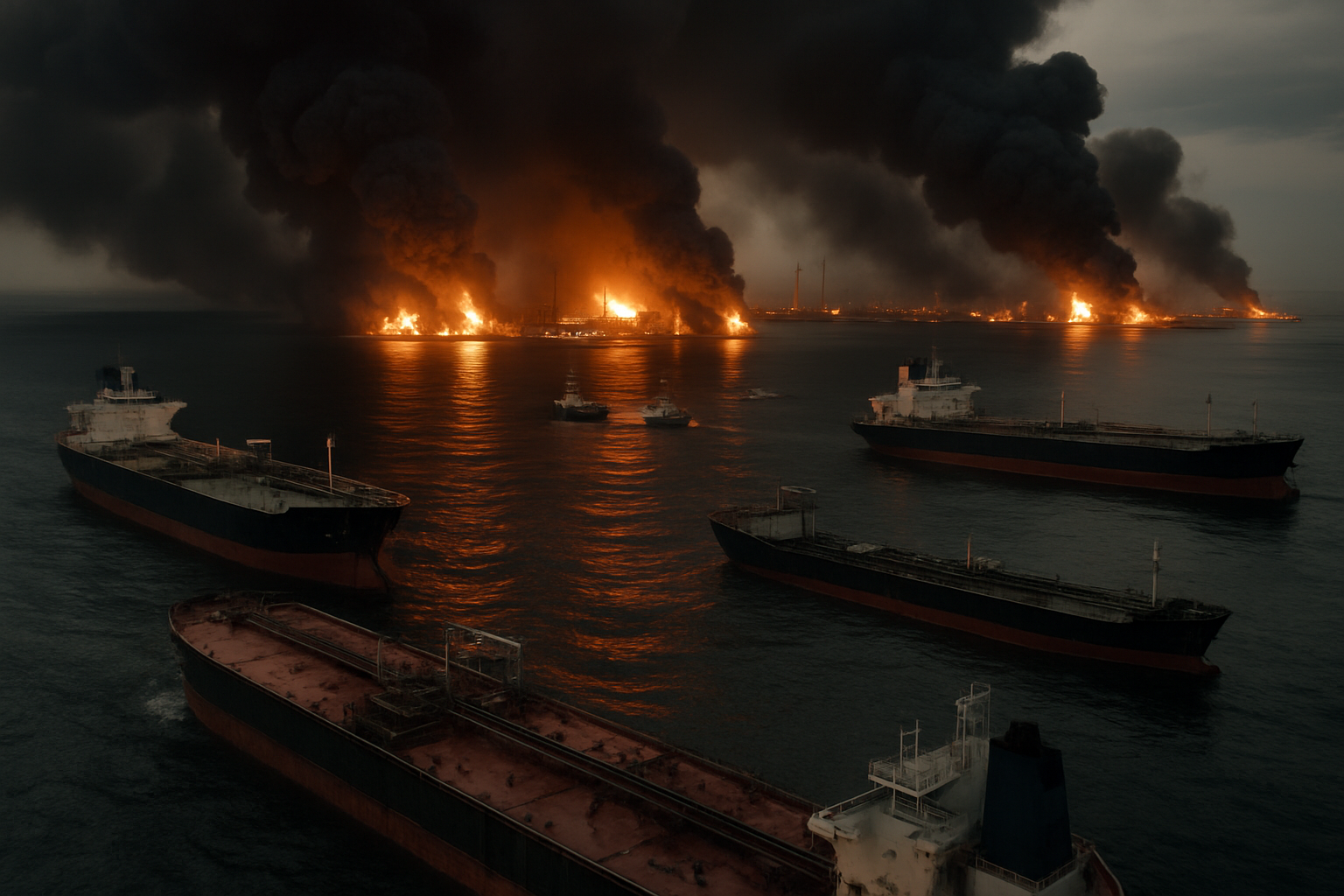
Oil prices have surged past $100 per barrel for the first time since 2022, with Brent crude peaking at $119.50 and WTI reaching a record single-day jump of 18.98% to $108.15, as Iran's Revolutionary Guard maintains its closure of the Strait of Hormuz in the most severe global energy crisis since the 1970s oil shocks.
The crisis escalated dramatically on March 18, 2026, when Iran's Revolutionary Guard declared the strategic 21-mile waterway "unsafe for shipping," effectively blocking 40% of global seaborne oil transit. Over 150 oil and LNG tankers worth billions in cargo remain stranded in the Persian Gulf, while major shipping companies Maersk and MSC have suspended all operations in the region.
Unprecedented Energy Market Disruption
The International Energy Agency (IEA) announced the largest strategic petroleum reserve release in its 50-year history, deploying 400 million barrels from 32 member countries - more than double the 182.7 million barrels released during the 2022 Ukraine crisis. Japan is contributing 80 million barrels, marking its first reserve deployment since the 2011 Fukushima disaster, highlighting the country's vulnerability with 95% Middle East oil dependence and 70% of imports transiting through Hormuz.
Natural gas prices have exploded by 24% in Europe and 78% in the United States, reaching €47.32/MWh - the highest levels since February 2025. Qatar, which accounts for approximately 20% of global LNG exports, has halted production at its Ras Laffan and Mesaid facilities following Iranian drone attacks, with Energy Minister Saad Al Kaabi warning that Gulf states may be forced to declare force majeure "within weeks" if oil approaches $150/barrel, threatening to "bring down economies of the world."
Global Transportation and Supply Chain Collapse
The aviation industry is experiencing its most comprehensive disruption since the COVID-19 pandemic, with over 18,000 flights cancelled worldwide. Eight countries - Iran, Iraq, Israel, UAE, Qatar, Syria, Kuwait, and Bahrain - have simultaneously closed their airspace. Dubai International Airport, the world's busiest with 86 million passengers annually, remains completely shut down due to missile damage, while Emirates, Air France-KLM, Wizz Air, and Bulgaria Air have suspended operations indefinitely.
Jet fuel costs have soared from $85-90 to $150-200 per barrel, representing increases of up to 122%. Airlines globally are implementing emergency fare surcharges, with Air France-KLM adding 50 euros to economy class and 200 euros to business class tickets on long-haul routes.
The Persian Gulf, serving as a critical global trade hub beyond energy, has seen manufacturing supply chains severely disrupted. China has suspended refined fuel export contracts, cancelling committed shipments. Singapore retailers are experiencing 30% increases in logistics costs, while automotive, electronics, and textiles manufacturers dependent on Gulf-based logistics networks face severe operational challenges.
Immediate Consumer Impact Worldwide
European consumers are bearing the immediate brunt of the crisis. In Sweden, electricity prices have increased by 10-20 öre per kWh, with gasoline rising by 1-2 kronor per liter, particularly affecting the southern Malmö region due to its continental European market integration. Ireland is experiencing what officials describe as "brazen rip-offs," with heating oil approaching €2 per liter, while Austria has seen fuel costs surge by 20% in what authorities term "war-driven price explosions."
The crisis extends far beyond Europe. Bangladesh has implemented fuel rationing for 170 million people, while Bosnia-Herzegovina maintains only two days of gas reserves. Pakistan faces the highest fuel prices in South Asia at Rs321.17 per liter, prompting the implementation of wartime austerity measures including four-day government work weeks. Malta reports fuel prices 45% higher without government subsidies, while Montenegro has experienced panic buying with enormous queues at fuel stations.
Emergency Government Responses
Governments worldwide are implementing unprecedented emergency measures. President Trump has issued a temporary 60-day suspension of the century-old Jones Act, allowing foreign vessels to transport cargo between domestic US ports to help stabilize fuel costs. Australia's NSW Energy Minister Penny Sharpe is chairing crisis talks in Sydney as regional Queensland stations run completely dry, with Robinvale, 70 kilometers east of Mildura, depleted over the weekend.
European governments are taking coordinated action. Germany's Federal Ministry of Economics is preparing legislation to strengthen antitrust laws to prevent gas station price spikes. France has deployed 500 fuel station inspectors to prevent price manipulation, while Romania has developed five scenarios to prevent diesel from exceeding 10 lei per liter. Hungary has implemented immediate price caps on gasoline and diesel, and Slovakia has activated strategic reserves for the first time under emergency protocols.
New Zealand's Prime Minister and Finance Minister have provided morning media assurances that the country is "well positioned for fuel supply" despite petrol surpassing $3 per liter, though the government is considering "Muldoon-era" emergency measures including car-free days and petrol sale limits - interventions not seen since the 1970s oil crisis.
Financial Markets in Turmoil
Global financial markets have experienced severe disruption, with Pakistan's KSE-100 index recording its largest single-day decline in history at -8.97%. South Korea's KOSPI fell 12%, triggering circuit breakers as the Korean won hit a 17-year low. PayPal's $1.1 billion IPO has been postponed indefinitely due to market volatility, while central banks including the ECB and Bank of Japan are coordinating emergency liquidity measures to prevent financial contagion.
Traditional monetary policy tools are proving limited in effectiveness against these structural geopolitical disruptions, with analysts warning that financial markets may serve as the "ultimate constraint" on prolonged conflict escalation.
Diplomatic Breakdown and Military Escalation
The energy crisis stems from the complete collapse of US-Iran nuclear negotiations despite achieving a "broad agreement on guiding principles" breakthrough in Geneva - the most progress since the 2018 JCPOA collapse. The fundamental disagreement proved insurmountable: Iran insisted on nuclear-only discussions, excluding ballistic missiles and regional proxies as "red lines," while the United States demanded comprehensive agreements addressing missiles, armed groups, and human rights.
This diplomatic failure led to Operation Epic Fury, the largest coordinated US-Israeli military operation since 2003, which prompted Iran's massive retaliation under "Operation True Promise 4," with the Revolutionary Guard declaring that "no red lines remain." The regional coalition of Saudi Arabia, UAE, Qatar, and Egypt, which had provided unprecedented consensus supporting diplomatic resolution, is now severely strained as Iranian attacks have targeted member territories.
Nuclear Governance Crisis Context
The crisis unfolds against a broader nuclear governance breakdown. The New START treaty expired on February 5, 2026, marking the first time in over 50 years without US-Russia nuclear constraints. Iran continues uranium enrichment at 60% purity with over 400kg of weapons-grade material - sufficient for multiple nuclear weapons if weaponized. UN Secretary-General António Guterres has declared nuclear risks at their "highest level in decades," calling this the "greatest test of multilateral cooperation in crisis management in the modern era."
Single-Point Failure Vulnerabilities Exposed
Energy analysts describe the current situation as exposing dangerous vulnerabilities in global energy architecture. Samuel Ciszuk, a leading energy security expert, calls it the "most severe energy security crisis in decades," noting how "single-chokepoint vulnerabilities have been completely exposed." The 21-mile Strait of Hormuz represents a geographic single-point failure for modern logistics systems, with no realistic alternatives capable of handling the volume of transit.
Qatar's Energy Minister Saad Al Kaabi's warning about potential economic collapse if oil reaches $150 per barrel underscores the severity. Alternative Arabian Peninsula routes have inadequate capacity and involve significant time and cost penalties, while strategic petroleum reserves provide only temporary buffers for sustained disruptions.
Long-Term Energy Architecture Transformation
The crisis highlights the imperative for fundamental energy architecture transformation. Strategic petroleum reserves, while providing crucial short-term relief, cannot address sustained disruptions of this magnitude. Energy security experts emphasize that supply diversification and renewable energy transitions, while requiring years or decades to implement fully, have gained urgent new priority due to the exposed vulnerabilities of current systems.
The over-dependence on volatile geopolitical regions and strategic chokepoints requires fundamental restructuring to reduce exposure to such disruptions. Manufacturing industries dependent on Gulf-based logistics networks are reassessing their supply chain resilience, with implications extending far beyond current events.
Template-Setting Historical Significance
March 2026 represents what analysts describe as the most dangerous international crisis since the end of the Cold War, affecting regional war prevention, global energy security, nuclear governance credibility, and international law enforcement of post-WWII order principles simultaneously. The rapid transition from diplomatic breakthrough to military confrontation demonstrates the fragility of crisis management mechanisms in the multipolar era.
Recovery timelines remain uncertain, unlike weather-related disruptions, as they depend on military operations resolution and diplomatic normalization. Aviation industries cannot engage in long-term scheduling with multiple airspaces closed, while energy markets remain volatile with critical transit routes blocked. The template-setting implications of success or failure in containing this crisis will affect approaches to conflict resolution, energy market evolution, and international stability mechanisms globally for decades to come.
As governments worldwide implement emergency measures and markets struggle to adapt, the global community faces its greatest test of multilateral cooperation in modern crisis management, with the outcome likely to reshape international approaches to energy security and conflict resolution for the 21st century.