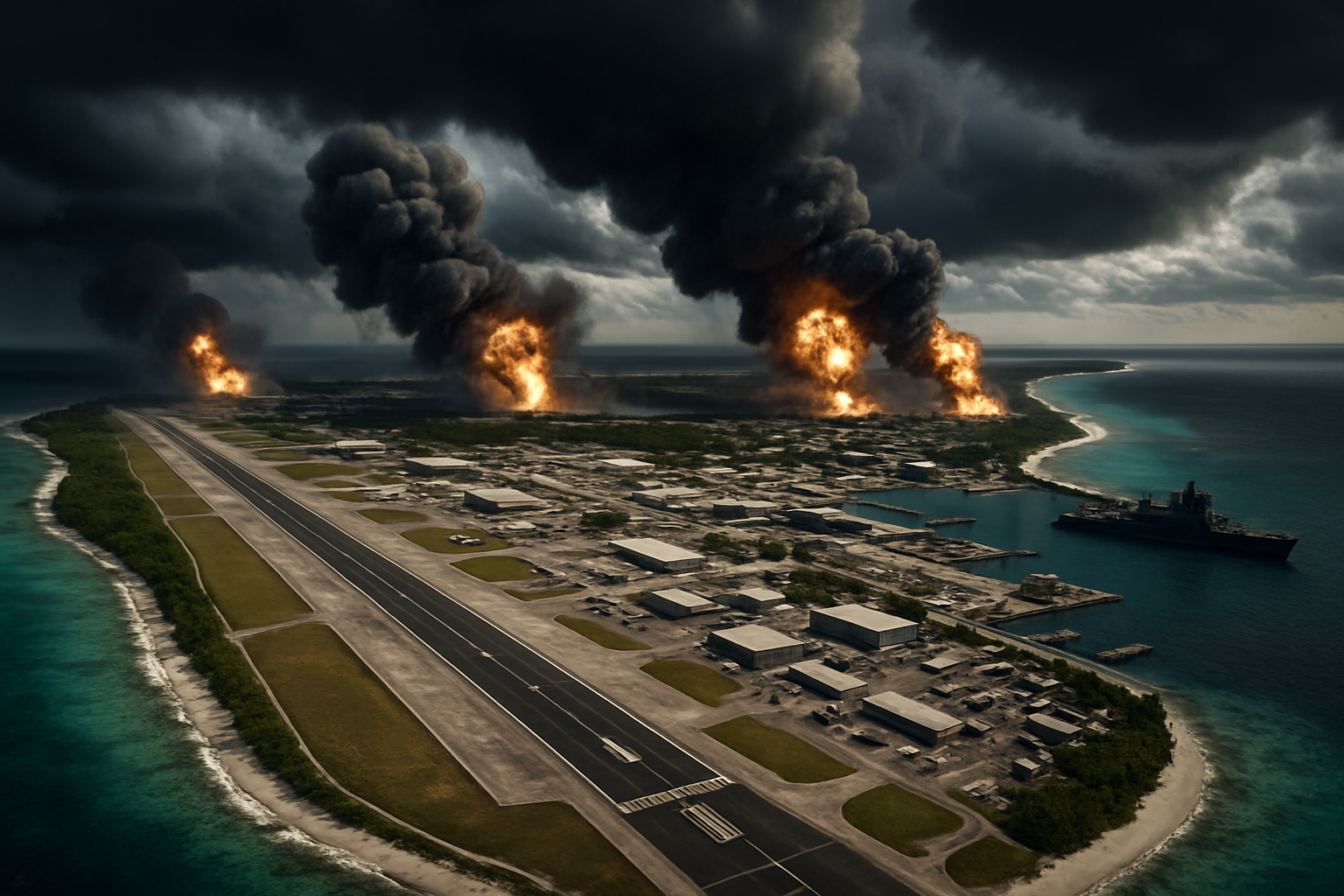
Iran has fired ballistic missiles at the strategic UK-US military base on Diego Garcia in the Indian Ocean, according to multiple US officials, marking the furthest projection of Iranian military power in the current Middle East conflict and escalating tensions into international waters thousands of miles from traditional theater operations.
The strikes, part of Iran's "Operation True Promise 4" retaliatory campaign, represent a dramatic expansion of the ongoing conflict beyond regional boundaries. Two intermediate-range ballistic missiles were launched at the joint British-American facility on Friday morning, though both failed to hit their target, according to Wall Street Journal and CNN reports citing senior US officials.
Strategic Significance of Diego Garcia Targeting
The attempted strike on Diego Garcia demonstrates Iran's ballistic missile capabilities extending far beyond what Western intelligence previously assessed. The base, located approximately 4,000 kilometers from Iranian territory, serves as a critical logistics hub for US Indian Ocean operations and a key staging area for Middle Eastern campaigns.
Iranian media reports emphasized that the targeting revealed "missile ranges exceeded what adversaries previously believed," with the Islamic Revolutionary Guard Corps (IRGC) describing it as a "significant step" in demonstrating Tehran's reach. The attack occurred as Iran declared "no red lines remain" following the death of Supreme Leader Ali Khamenei in US-Israeli "Operation Epic Fury" strikes.

UK Restricts US Operations From Cyprus
In a related development highlighting alliance strains, the United Kingdom has not authorized the United States to carry out strike missions from RAF Akrotiri in Cyprus as the Iran crisis intensifies. The BBC confirmed reports of the Diego Garcia missile launches after speaking to separate sources, while British officials remained cautious about confirming details.
The UK Ministry of Defence neither confirmed nor denied the Iranian missile attack, stating only that Iran's "reckless attacks across the region are a threat to British interests and British allies." This measured response reflects Britain's reluctance to be drawn deeper into the escalating conflict.
Broader Regional Impact
The Diego Garcia strike attempt comes amid the most dangerous international crisis since the Cold War, with Iran's systematic targeting of US facilities across the Gulf region causing widespread casualties and disruption. The conflict has already produced unprecedented global consequences:
- Over 18,000 flights cancelled worldwide - the most extensive aviation disruption since COVID-19
- Oil prices surging past $80 per barrel as Iran declares the Strait of Hormuz "unsafe for shipping"
- Eight Middle Eastern countries maintaining simultaneous airspace closures
- Dubai International Airport completely shut down from missile damage
Nuclear Diplomacy Collapse Context
The military escalation follows the complete breakdown of US-Iran nuclear negotiations despite achieving "broad agreement on guiding principles" in Geneva talks - the most significant diplomatic progress since the JCPOA collapse in 2018. The fundamental disagreement persisted over scope: Iran excluded ballistic missiles and regional proxies as "red lines" while demanding nuclear-only talks, versus US insistence on comprehensive agreements covering missiles, armed groups, and human rights.
"Iran will never abandon uranium enrichment even if war is imposed on us"
— Abbas Araghchi, Iranian Foreign Minister
Iran continues uranium enrichment at 60% purity versus the 3.67% JCPOA limit, with over 400 kilograms of weapons-grade material sufficient for multiple nuclear weapons if weaponized, according to former IAEA inspector Dr. Yusri Abu Shadi.
International Coalition Response
The Iranian attacks on Diego Garcia and European territory (RAF Akrotiri Cyprus) have prompted an unprecedented international naval response. HMS Dragon and Spanish frigates are deploying to protect Cyprus, while Italy, France, Netherlands, and Greece are contributing vessels in what represents the largest Mediterranean naval mobilization in decades.
This marks the first attack on European soil since World War II, fundamentally altering the conflict's scope from a regional Middle Eastern dispute to a direct threat to international security architecture.
US Military Response
The attacks occur against the backdrop of Operation Epic Fury, the largest US-Israeli coordinated military campaign since 2003, utilizing an unprecedented dual-carrier deployment of USS Gerald R. Ford and USS Abraham Lincoln representing approximately one-third of the active US Navy fleet.
In a historic development, the USS Charlotte submarine torpedoed and sank the Iranian frigate IRIS Dena in the Indian Ocean near Sri Lanka, killing over 80 crew members - the first enemy vessel sunk by a US submarine since World War II, according to Defense Secretary Pete Hegseth.
Congressional and Public Response
The expanding conflict has intensified Congressional scrutiny, with bipartisan lawmakers demanding answers on strategy, costs, and potential ground troop deployment. Senator Richard Blumenthal expressed being "more concerned than ever" about boots on the ground, while the conflict's unpopularity reaches "almost unprecedented" levels with only 25% American support.
Operation Epic Fury has cost $3.7 billion in the first week alone ($891.4 million daily), with the Pentagon now preparing operations through September - far beyond the initial 4-6 week timeline.
Global Economic Disruption
The conflict's expansion into the Indian Ocean threatens critical global supply chains beyond traditional Middle Eastern impact zones. Iran's closure of the Strait of Hormuz affects 40% of global seaborne oil transit, with over 150 tankers worth billions stranded in the Persian Gulf.
Natural gas prices have surged 24% in Europe and 78% in the United States, while major shipping companies Maersk and MSC have suspended Persian Gulf operations indefinitely. The aviation crisis has grounded hundreds of thousands of passengers globally as Middle Eastern hubs remain closed.
Nuclear Governance Crisis
The escalation occurs against the backdrop of a broader nuclear governance breakdown. The New START treaty expired in February 2026, marking the first time in over 50 years without US-Russia nuclear constraints. Combined with China's nuclear expansion, UN Secretary-General António Guterres warns that nuclear risks are at their "highest in decades."
Iranian Succession Crisis
Following Supreme Leader Ali Khamenei's death on March 1, Iran faces an unprecedented constitutional succession crisis during active warfare. The Assembly of Experts is selecting a new Supreme Leader, with Khamenei's son Mojtaba emerging as the favored candidate - potentially the first hereditary succession in the Islamic Republic's 47-year history.
CIA assessments suggest a Revolutionary Guards member is likely to become the next Supreme Leader, indicating a significant shift from clerical to military governance in Tehran.
Historical Template-Setting Moment
The Diego Garcia strike represents a watershed moment in 21st-century conflict resolution, demonstrating how rapidly diplomatic frameworks can collapse into military escalation in the multipolar era. The crisis affects regional war prevention, global energy security, nuclear governance credibility, and international law enforcement simultaneously.
Success in containing the escalation could provide a template for future nuclear crisis resolution, while failure may accelerate military solutions over diplomatic approaches, reshaping international relations for decades and encouraging nuclear proliferation elsewhere.
The targeting of Diego Garcia, thousands of miles from Iran's borders, illustrates the global reach of modern conflicts and the vulnerability of traditional power projection in an era of advanced missile technology. As UN Secretary-General Guterres noted, this represents "the greatest test of multilateral cooperation and crisis management in the modern era."