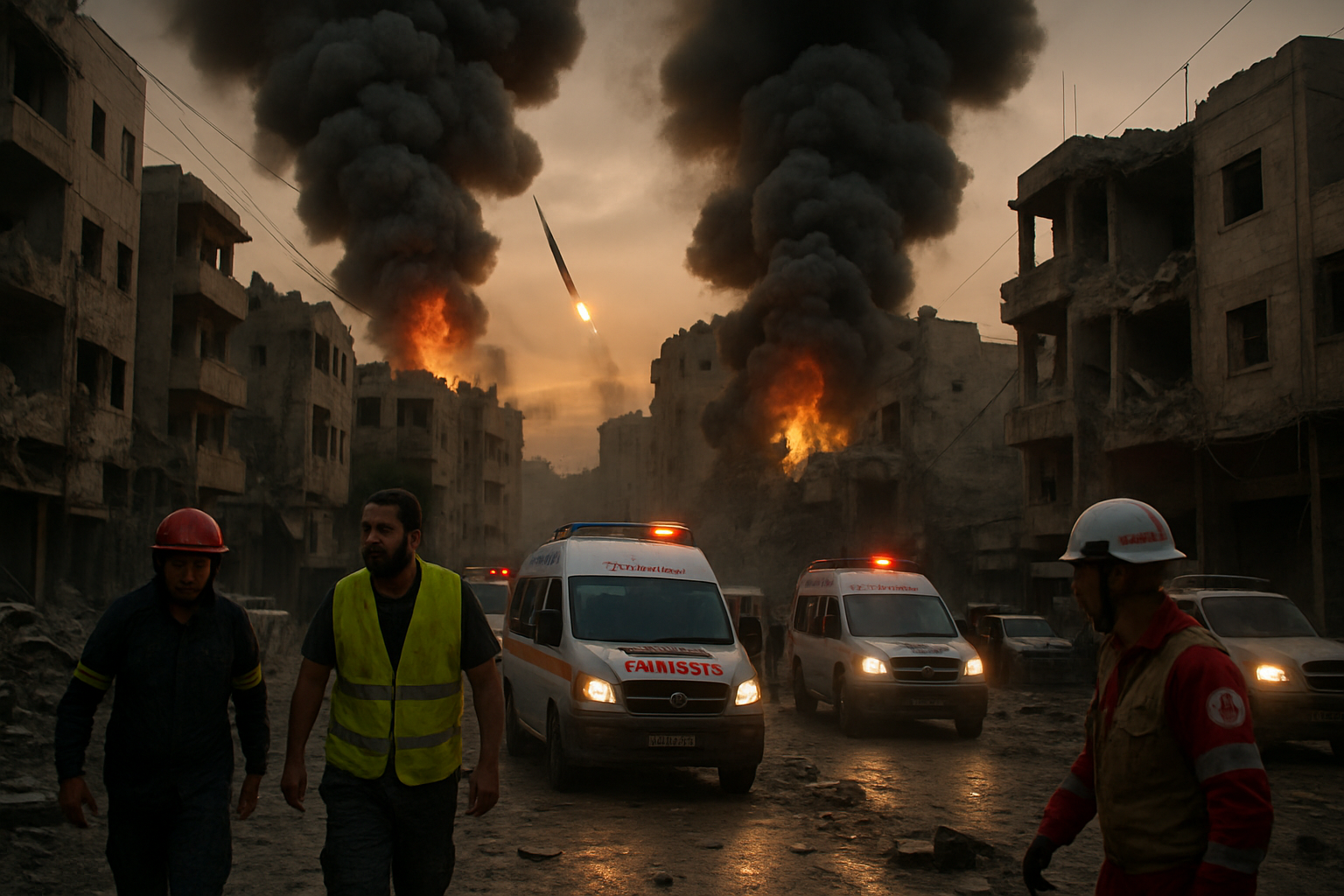
Iranian forces launched devastating hypersonic missile strikes on Israeli cities Dimona and Arad on Saturday evening, causing over 150 casualties and marking a dangerous new escalation in the Middle East conflict as it enters its fourth week. The attack on Dimona, home to Israel's primary nuclear research facility, represents the first direct assault on Israeli nuclear infrastructure during the ongoing crisis.
The Iranian Islamic Revolutionary Guard Corps (IRGC) launched what military sources describe as cluster warhead missiles using advanced Khorramshahr-4 and Qadr missile systems. The first strike hit Dimona in southern Israel at approximately 7:30 PM local time, followed hours later by a second devastating impact on the nearby city of Arad.
Dimona Nuclear Facility Under Attack
Iranian missiles struck the southern Israeli town of Dimona, located in the Negev Desert and home to Israel's primary nuclear research facility. While the International Atomic Energy Agency (IAEA) confirmed no damage to the nuclear reactor itself, the proximity of the strike to such sensitive infrastructure marks an unprecedented escalation in the three-week conflict.
"We are aware of reports about an impact in the city of Dimona in Israel, but we have no indications of any damage to the nuclear research center," stated IAEA Director General Rafael Grossi, calling for "maximum restraint" to avoid nuclear accidents.
The Dimona facility, officially known as the Shimon Peres Negev Nuclear Research Center, has been Israel's primary nuclear installation since the 1960s. The facility's targeting represents a significant escalation from conventional military targets to critical infrastructure.
Arad Suffers Direct Missile Impact
Hours after the Dimona strike, Iranian forces launched a second missile attack on Arad, a city of approximately 25,000 residents located 50 kilometers northeast of Dimona. This attack resulted in significantly higher casualties, with local emergency services reporting at least 100 people injured, including several in critical condition.
"There was a direct impact of a missile causing extensive damage and numerous casualties. We have declared a state of emergency and are working to rescue those still trapped under the rubble."
— Arad Municipal Emergency Response
Emergency helicopters were deployed to assist with rescue operations as first responders worked through the night to extract victims from collapsed residential buildings. Among the critically injured are a 5-year-old girl and a 12-year-old boy, according to medical officials.
Advanced Hypersonic Missile Technology
Military analysts confirmed that Iran employed its most advanced missile technology in Saturday's attacks. The projectiles carried warheads containing approximately half a ton of explosive materials, designed to penetrate reinforced structures and maximize damage to urban areas.
According to Israeli Channel 14 television reports cited by Al Jazeera, the new Iranian hypersonic missiles demonstrated capabilities beyond previous attacks in the ongoing conflict. The weapons' speed and trajectory made interception extremely difficult for Israeli Iron Dome defense systems.
Iranian parliamentary speaker Mohammad Bagher Qalibaf declared following the attacks: "Israeli skies are defenseless. The time has come to implement the next phase of our prepared plans."
Regional Escalation Beyond Israel
Saturday's strikes on Israeli territory coincided with Iranian missile launches against a joint US-UK military base on Diego Garcia in the Chagos Archipelago, approximately 4,000 kilometers from Iranian territory. While both missiles targeting the Indian Ocean base failed to hit their intended targets, the launches demonstrate Iran's expanding operational reach far beyond the Middle East.
The Diego Garcia strikes represent the furthest projection of Iranian military power during the current conflict, suggesting missile capabilities that extend Iranian reach to targets previously considered beyond their range.
Israeli Response and Casualties
Israeli Prime Minister Benjamin Netanyahu described Saturday evening as "very difficult" and vowed continued military operations against Iran. "This is a very difficult evening in the battle for our future," Netanyahu said in a televised statement. "We are determined to continue striking our enemies on all fronts until victory is achieved."
The Israeli leader personally contacted the mayor of Arad to coordinate emergency response and promised full government support for rescue operations. Medical facilities across southern Israel were placed on high alert as casualties were transported for treatment.
Israeli military spokesman confirmed that despite sophisticated air defense systems, the Iranian missiles successfully penetrated protective barriers due to their advanced hypersonic capabilities and unconventional flight patterns.
International Reactions and Nuclear Safety Concerns
The targeting of Dimona has triggered immediate international concern about the potential for nuclear accidents during active warfare. The IAEA issued urgent calls for all parties to avoid actions that could compromise nuclear safety and security.
European Union officials expressed "grave concern" about the escalation, particularly the proximity of strikes to nuclear facilities. Several EU member states called for emergency consultations on the implications of nuclear infrastructure being targeted during conventional conflicts.
The United Nations Security Council announced plans for emergency sessions to address what Secretary-General António Guterres described as "the most dangerous moment in decades" regarding nuclear safety during armed conflict.
War Context and Timeline
Saturday's devastating strikes occur as the Iran-Israel conflict enters its fourth week, following the confirmed death of Iran's Supreme Leader Ali Khamenei on March 1 during US-Israeli "Operation Epic Fury." The conflict has now expanded far beyond bilateral confrontation to include regional powers and global implications.
The war has already resulted in unprecedented consequences including:
- Over 18,000 flights cancelled worldwide - the most extensive aviation disruption since COVID-19
- Oil prices surging past $100 per barrel with Iran mining the Strait of Hormuz
- First attack on European territory since WWII when Iranian drones struck RAF Akrotiri in Cyprus
- Largest international evacuation effort since the Arab Spring with over 115,000 Australians trapped in the region
Nuclear Governance Crisis
The targeting of nuclear infrastructure occurs amid a broader nuclear governance crisis. The New START treaty between the United States and Russia expired on February 5, 2026 - the first time in over 50 years that the world's two largest nuclear powers operate without bilateral constraints.
Iran continues uranium enrichment at 60% purity, approaching the 90% threshold needed for weapons-grade material. International inspectors report Iran possesses over 400 kilograms of enriched uranium, sufficient for multiple nuclear weapons if weaponized.
The collapse of nuclear diplomacy - despite achieving "broad agreement on guiding principles" in Geneva talks just weeks before the conflict - represents a historic failure of international crisis management in the multipolar era.
Economic and Energy Implications
Saturday's escalation pushed oil markets to critical levels, with Brent crude approaching $120 per barrel. Iran's effective closure of the Strait of Hormuz through naval mining has stranded over 150 tankers carrying billions of dollars in cargo, affecting 40% of global seaborne oil transit.
The International Energy Agency announced its largest-ever strategic petroleum reserve release of 400 million barrels - the largest intervention in the agency's 50-year history - in an attempt to stabilize global energy markets.
Airlines have implemented emergency fuel surcharges as jet fuel costs jumped from $85-90 to $150-200 per barrel, severely impacting global transportation networks already strained by widespread airspace closures.
Congressional and Public Opinion
In the United States, Congressional pressure on the Trump administration continues mounting. Senator Richard Blumenthal stated he is "more concerned than ever" about potential ground troop deployment, while public support for the conflict remains at historically low levels of approximately 25%.
Operation Epic Fury has cost American taxpayers $11.3 billion in its first week alone, with Pentagon operations planned through September - far beyond the initially projected 4-6 week timeline. The financial markets have emerged as what analysts term the "ultimate constraint" on continued escalation.
Humanitarian Crisis Deepening
The humanitarian toll continues mounting with Iran's Red Crescent reporting over 787 civilian casualties from US-Israeli strikes. The conflict has expanded to Lebanon, where over 832,000 people have been displaced as Hezbollah joined the fighting in retaliation for Khamenei's death.
International evacuation efforts represent the largest coordinated operation since the Arab Spring in 2011, with multiple nations struggling to extract citizens from an increasingly dangerous region. The European Union activated its ESTIA evacuation protocol for the first time in the bloc's history following attacks on Cyprus.
Template-Setting Crisis
UN Secretary-General Guterres has described the current situation as "the greatest test of multilateral cooperation and crisis management in the modern era." The rapid transition from diplomatic breakthrough to military confrontation demonstrates what experts term the "fragility of crisis management in the multipolar era."
Saturday's targeting of nuclear infrastructure represents a watershed moment that will establish precedents for 21st-century conflict resolution approaches. The success or failure of international efforts to contain this crisis will influence global approaches to territorial disputes, nuclear governance, and energy security for decades to come.
As rescue operations continue in Dimona and Arad, the international community faces its most dangerous moment since the end of the Cold War, with implications extending far beyond the Middle East to affect global stability mechanisms and the post-World War II international order.