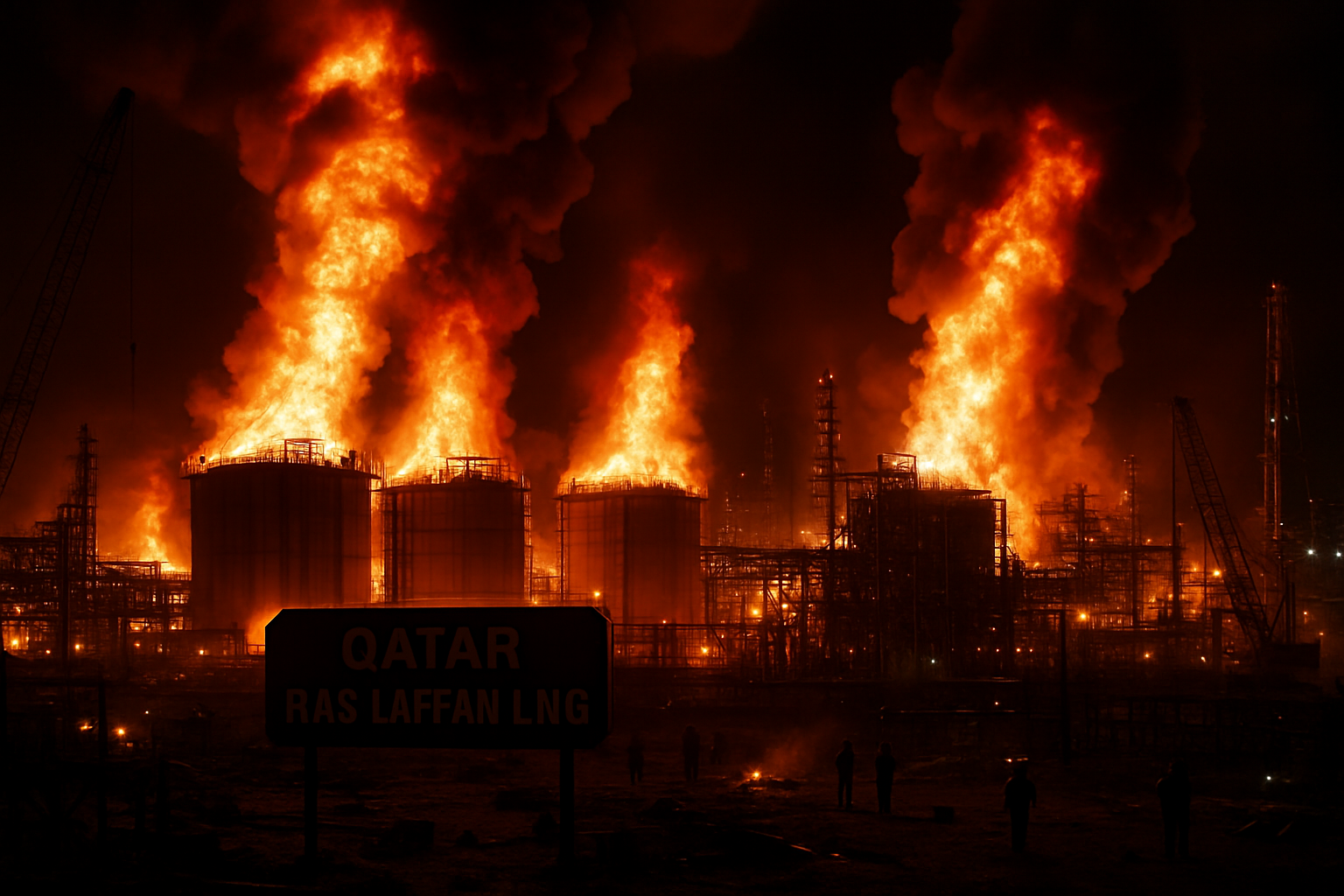
Iran dramatically escalated its war against Israel and the United States by launching devastating attacks on critical Gulf energy infrastructure, including Qatar's Ras Laffan Industrial City—the world's largest LNG export facility handling 20% of global supplies—as the conflict entered its most dangerous phase since beginning on March 1, 2026.
The Iranian Revolutionary Guard's "Operation True Promise 4" expanded beyond military targets to systematically strike energy facilities across multiple Gulf states in direct retaliation for Israel's destruction of Iran's South Pars gas field, the world's largest natural gas reservoir containing 70% of Iran's gas reserves.
Qatar Expels Iranian Diplomats After Ras Laffan Attack
Qatar's Foreign Ministry declared Iran's military attaché and security attaché persona non grata, ordering both diplomats to leave the country within 24 hours following the devastating attack on the Ras Laffan industrial zone. The facility, which handles approximately 20% of the world's LNG exports, suffered "extensive damage" according to QatarEnergy officials.
"This was a direct response to repeated Iranian targeting and what it called a dangerous escalation threatening regional security," the Qatari Foreign Ministry stated, marking a dramatic diplomatic rupture between the two nations that share the massive South Pars gas field.
The Ras Laffan complex, located 80 kilometers north of Doha, serves as Qatar's primary energy export hub and represents a critical chokepoint in global energy supplies. The facility's disruption immediately impacted European gas markets, with prices surging 35% within hours of the attack.
Global Energy Markets in Crisis
Oil prices breached $110 per barrel for the first time since the early phases of the conflict, with Brent crude reaching $119.50 and West Texas Intermediate jumping 18.98% to $108.15 in what analysts called the largest single-day increase on record. The surge reflects growing concerns that the conflict has evolved from a bilateral confrontation into a broader regional war targeting the world's most critical energy infrastructure.
Natural gas prices exploded across global markets, rising 24% in Europe and 78% in the United States to reach €47.32/MWh—the highest levels since February 2025. The Qatar LNG production halt at Ras Laffan and Mesaid facilities threatens to create severe shortages, particularly for European consumers heavily dependent on Qatari supplies.
"If this continues, Gulf states may be forced to declare force majeure within weeks, with oil approaching $150 per barrel that could bring down economies of the world."
— Saad Al Kaabi, Qatar Energy Minister
The International Energy Agency announced the largest strategic petroleum reserve release in its 50-year history, coordinating the deployment of 400 million barrels from 32 member countries—more than double the 182.7 million barrels released during the 2022 Ukraine crisis. Japan confirmed it would release 80 million barrels, marking the first such deployment since the 2011 Fukushima disaster.
Systematic Targeting of Gulf Energy Infrastructure
Iran's attacks extended far beyond Qatar, demonstrating a coordinated strategy to pressure regional allies supporting the US-Israeli campaign. Kuwait's National Petroleum Corporation confirmed that fires at the Mina Al-Ahmadi and Mina Abdullah refineries had been extinguished after Iranian drone strikes, while Saudi Arabia's SAMREF refinery in Yanbu port on the Red Sea was struck by missiles.
The systematic targeting represents a significant escalation in Iran's "no red lines remain" policy, moving beyond military installations to strike economic infrastructure that underpins the global energy system. Intelligence sources indicate Iran views these facilities as legitimate targets due to their countries' cooperation with US military operations.
Six firefighting teams worked to contain blazes at Kuwaiti facilities, while the UAE suspended operations at its Habshan gas facility after debris from intercepted Iranian missiles caused structural damage. The coordinated nature of the attacks suggests months of advance planning and intelligence gathering by Iranian forces.
Aviation Crisis Reaches Historic Proportions
The conflict has created the most extensive aviation disruption since the COVID-19 pandemic, with over 18,000 flights cancelled worldwide as eight Middle Eastern countries maintain simultaneous airspace closures. Dubai International Airport, the world's busiest with 86 million annual passengers, remains completely shut down due to missile damage sustained in earlier Iranian attacks.
Major carriers including Emirates, Air France-KLM, and Wizz Air have suspended operations indefinitely, affecting hundreds of thousands of passengers globally. The closure of Persian Gulf airspace has severed critical Asia-Europe flight corridors, forcing airlines to implement costly rerouting that has increased flight times and fuel consumption dramatically.
Jet fuel costs have soared from $85-90 per barrel to $150-200, representing a 122% increase that airlines are passing to consumers through emergency surcharges. The aviation crisis parallels the broader economic disruption as the conflict transforms from a localized confrontation into a global logistics nightmare.
Trump Administration Response and International Pressure
President Trump warned Iran would face "massive destruction" of its South Pars gas field if Tehran continues attacking Gulf energy infrastructure, while claiming the United States had "no prior knowledge" of Israel's initial strikes on Iranian gas facilities. The warning represents one of the most explicit threats against Iran's critical energy assets since the conflict began.
Congressional scrutiny of the administration's handling of the crisis has intensified, with Senator Richard Blumenthal expressing being "more concerned than ever" about potential ground troop deployment. The conflict's unpopularity among Americans has reached "almost unprecedented" levels, with only 25% supporting continued military operations according to recent polling.
Pentagon officials confirmed that Operation Epic Fury has cost $11.3 billion in its first week alone, with expenses running at $891.4 million daily. The scale represents the largest US military operation in the Middle East since the 2003 Iraq invasion, utilizing dual-carrier deployments and involving approximately one-third of the active US Navy fleet.
Regional Coalition Under Severe Strain
The unprecedented diplomatic consensus among Saudi Arabia, UAE, Qatar, and Egypt that initially supported diplomatic solutions has come under severe strain as Iranian retaliation directly targets member territories. Egypt's President Abdel Fattah el-Sisi condemned attacks on "sisterly Arab countries," warning of "comprehensive chaos" spreading across the region.
The UAE reported one civilian killed in Abu Dhabi from missile debris, while Kuwait confirmed 32 foreign nationals injured in airport strikes. Qatar successfully intercepted 65 missiles and 12 drones using Patriot systems but reported 8 individuals injured from fragments, highlighting the limitations of even advanced defensive systems against sustained bombardment.
Saudi Arabia has privately warned Iran against continued energy infrastructure attacks through diplomatic channels, while publicly maintaining support for de-escalation efforts. However, intelligence sources suggest the Kingdom is reassessing its position as Iranian strikes threaten its own economic interests.
Nuclear Diplomacy Completely Collapsed
The military escalation occurred despite breakthrough diplomatic progress in Geneva talks that achieved "broad agreement on guiding principles"—the most significant development since the collapse of the Joint Comprehensive Plan of Action in 2018. However, fundamental scope disagreements proved insurmountable, with Iran excluding ballistic missiles and proxy forces as "red lines" while the US demanded comprehensive agreements addressing all security concerns.
Iran continues uranium enrichment at 60% purity with over 400 kilograms of weapons-grade material—sufficient for multiple nuclear weapons if weaponized. The nuclear governance crisis has been compounded by the February 5 expiration of the New START treaty, leaving the world without US-Russia nuclear constraints for the first time in over 50 years.
UN Secretary-General António Guterres warned that nuclear risks are at their "highest in decades," calling the current crisis the "greatest test of multilateral cooperation in the modern era." The failure of promising diplomatic engagement raises fundamental questions about the viability of negotiated solutions to nuclear crises in the multipolar era.
Global Supply Chain Vulnerabilities Exposed
The Persian Gulf's role as a critical trade hub extending far beyond energy has become starkly apparent as the conflict disrupts manufacturing, shipping, and logistics networks worldwide. The 21-mile Strait of Hormuz represents a single-point failure for modern logistics, with Iran's closure affecting 40% of global seaborne oil transit and no realistic alternatives available.
Major shipping companies Maersk and MSC have suspended all Persian Gulf operations, leaving over 150 oil and LNG tankers stranded with billions of dollars in cargo. China suspended refined fuel exports, while Singapore reported 30% increases in logistics costs as supply chains scramble to adapt to the disruption.
Manufacturing sectors dependent on Gulf logistics networks, particularly automotive, electronics, and textiles industries, face severe disruptions that could persist long after any military resolution. The crisis has exposed dangerous over-dependence on strategic chokepoints that requires fundamental restructuring of global supply chains.
Financial Markets in Freefall
Global financial markets have experienced their most severe disruption from geopolitical crisis in years, with Pakistan's KSE-100 index suffering its largest single-day decline in history at -8.97%. South Korea's KOSPI triggered circuit breakers with a -12% drop, while the Korean won hit 17-year lows as foreign capital fled emerging markets.
Central banks from the European Central Bank to the Bank of Japan are coordinating emergency liquidity measures to prevent financial contagion, though traditional monetary policy tools have limited effectiveness against structural geopolitical disruptions. PayPal postponed its $1.1 billion IPO indefinitely due to market volatility.
Energy-intensive industries face particular pressure, with governments across Europe exploring state aid measures as soaring costs threaten factory closures. The crisis demonstrates how quickly geopolitical tensions can translate into economic disruption in an interconnected global economy.
Humanitarian Crisis and International Evacuations
The conflict has generated the largest coordinated international evacuation since the Arab Spring of 2011, with Australia reporting 115,000 nationals trapped in the region and Germany evacuating 30,000 tourists. The European Union activated its ESTIA crisis mechanism for Cyprus for the first time in the bloc's history after Iranian drones struck RAF Akrotiri—the first attack on European territory since World War II.
Iran's Red Crescent reports over 787 civilian casualties from US-Israeli strikes, while Pentagon officials confirmed US responsibility for an elementary school attack that killed 165-185 students due to "outdated targeting data." The incident has drawn international condemnation and calls for Geneva Conventions violations investigations.
The human cost extends beyond immediate casualties, with Lebanon reporting 968 killed including 83 children from Israeli strikes, while 832,000 people have been displaced as Hezbollah joins the conflict. Medical facilities have been systematically targeted, with 26 paramedics killed in Lebanon since the escalation began.
Long-term Implications for Global Energy Security
The crisis represents a watershed moment for international energy security architecture, exposing the dangerous vulnerability of over-dependence on strategic chokepoints subject to geopolitical volatility. Energy security experts argue that fundamental restructuring is needed to reduce dependence on volatile regions, though such diversification would require years or decades to implement.
Strategic petroleum reserves, while providing temporary buffering capacity, cannot address sustained disruptions of the scale currently experienced. The crisis accelerates urgency around supply diversification and renewable energy transitions that were already underway due to climate concerns.
"This is the most severe energy security crisis in decades, exposing single-chokepoint vulnerabilities that require fundamental restructuring of how we think about energy security planning."
— Samuel Ciszuk, Energy Security Analyst
Qatar's warning that Gulf states may declare force majeure within weeks, potentially driving oil prices to $150 per barrel, underscores the gravity of the situation. Such price levels could trigger global recession and fundamentally alter international economic relationships.
Template-Setting Crisis for 21st Century
The rapid transition from diplomatic breakthrough to military confrontation demonstrates the fragility of crisis management in the multipolar era, where multiple powers pursue competing interests without clear hierarchical authority. The failure of the most promising US-Iran diplomatic opening in years raises fundamental questions about the viability of negotiated solutions to nuclear disputes.
Success in containing the crisis could provide a framework for nuclear crisis resolution and strengthen diplomatic precedents for future conflicts. However, failure may accelerate preferences for military solutions over diplomatic engagement, reshaping Middle Eastern geopolitics for decades while encouraging nuclear proliferation globally and undermining diplomatic credibility worldwide.
The stakes extend far beyond the immediate participants, affecting regional war prevention, global energy security, nuclear governance credibility, and international law enforcement of post-World War II order principles. The coming days and weeks will determine whether the international community can successfully manage its greatest test of multilateral cooperation in the modern era.
Recovery Timeline Remains Uncertain
Unlike weather-related disruptions with predictable recovery timelines, the current crisis depends entirely on military operations resolution and diplomatic normalization between parties showing little interest in compromise. Aviation industries cannot implement long-term scheduling while multiple airspaces remain closed, and energy markets will remain volatile as long as critical transit routes are blocked.
The crisis has already lasted longer than initially anticipated by most analysts, with financial markets emerging as the "ultimate constraint" on prolonged conflict. However, the systematic targeting of energy infrastructure suggests Iranian strategy designed to impose maximum economic costs on adversaries regardless of domestic consequences.
As the world watches oil prices approach levels not seen since the height of previous energy crises, the March 2026 Iran-Gulf energy war may be remembered as the moment that fundamentally transformed international approaches to conflict resolution, energy security, and crisis management for the 21st century and beyond.