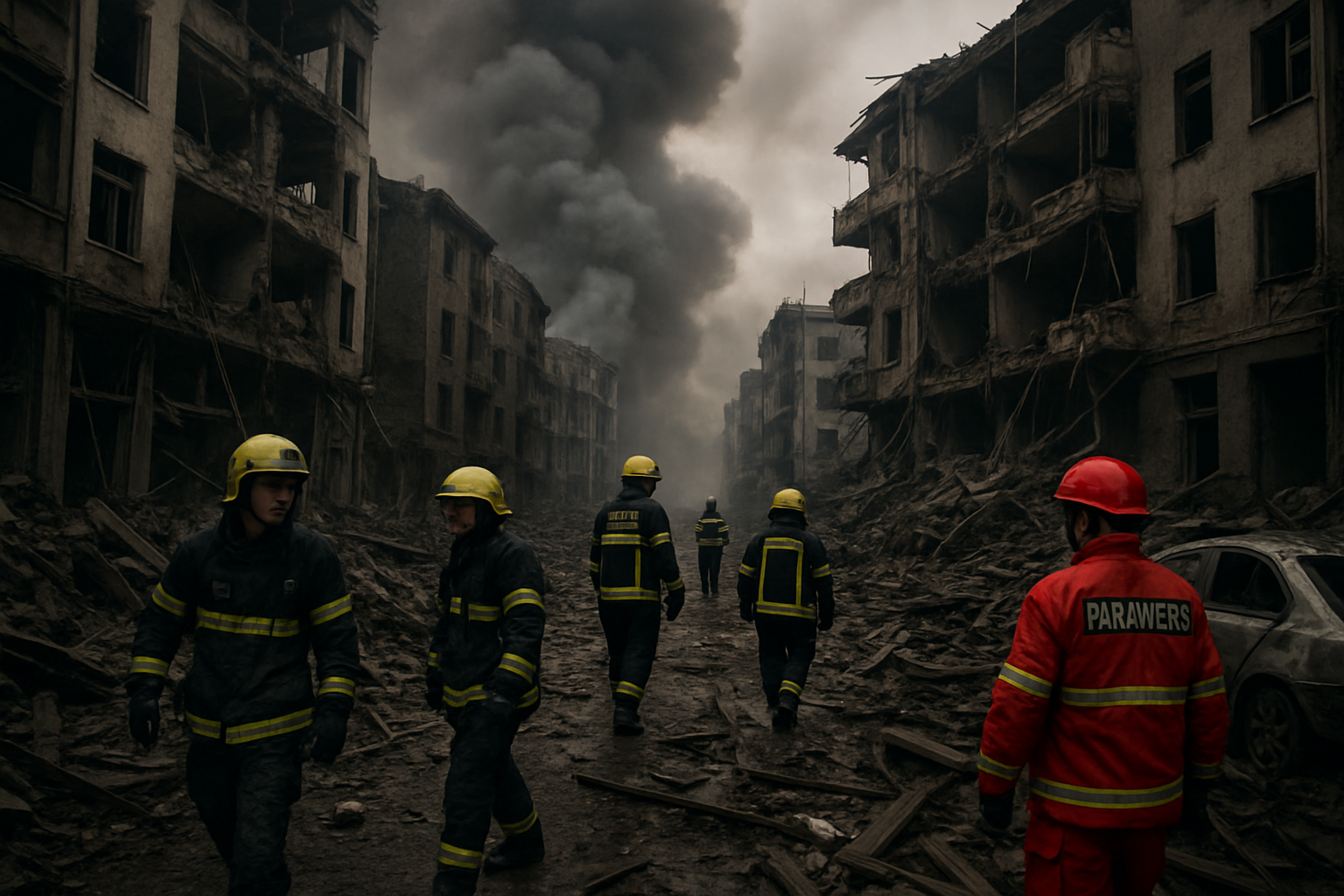
Iranian missile strikes directly hit a residential building in Haifa, leaving four people injured and four others feared trapped under rubble, as the month-long Middle East conflict enters its most dangerous phase since the crisis began in March 2026.
The strike represents a significant escalation in the ongoing Iran-Israel confrontation that has now expanded into a multi-front regional war affecting Lebanon, Yemen, and multiple Gulf states. Rescue services are conducting intensive search operations at the Haifa site, with one person reported in serious condition as emergency teams work to locate four missing individuals, including elderly residents and a child.
Escalating Multi-Front Warfare
The Iranian assault on Haifa comes amid a complex web of interconnected conflicts that began with the death of Iranian Supreme Leader Ali Khamenei on March 1, 2026. Intelligence sources confirm that Iran launched six separate missile salvoes against Israeli targets on Sunday, with the Haifa strike marking the most significant direct hit on civilian infrastructure to date.
Simultaneously, Hezbollah forces fired rockets at Deir al-Asad, injuring six people, demonstrating the coordinated nature of the Iranian-backed offensive. The Lebanese militant organization has fully committed to the conflict after abandoning the November 2024 US-French brokered ceasefire, citing an "impossible choice" between maintaining peace agreements and showing solidarity with Iran following Khamenei's death.
Military censorship restrictions prevent full disclosure of impact locations if they involve critical infrastructure or military installations, but emergency services report multiple impact sites across northern and central Israel. The systematic targeting represents Iran's "Operation True Promise 4," which Revolutionary Guards have declared follows a "no red lines remain" policy.
Regional Coalition Under Severe Strain
The escalation occurs against a backdrop of unprecedented regional instability. Israeli forces continue operations in Gaza despite an October 2025 ceasefire that has been violated over 1,600 times, resulting in more than 680 Palestinian deaths during what was supposed to be a truce period. Simultaneously, Israel has launched ground operations in southern Lebanon, moving beyond November 2024 ceasefire positions to establish new "security zones."
"Where is the ceasefire?"
— Dr. Mohamed Abu Selmiya, Director of Al-Shifa Hospital
The question posed by Gaza's leading medical official reflects growing international concern over systematic ceasefire violations that have characterized the conflict throughout 2026. Over 800,000 Lebanese civilians have been displaced since March, with emergency shelters overwhelmed and thousands sleeping on Beirut's streets as the humanitarian crisis deepens.
Unprecedented Global Disruptions
The regional war has created cascading global effects unprecedented since the Cold War era. Over 18,000 flights have been cancelled worldwide as eight Middle Eastern countries maintain simultaneous airspace closures. Dubai International Airport, the world's busiest with 86 million annual passengers, remains completely shuttered due to missile damage, effectively severing critical Europe-Asia aviation corridors.
Energy markets face their most severe crisis in decades. Oil prices have surged past $100 per barrel as Iran has effectively closed the Strait of Hormuz through naval mining operations, cutting off 40% of global oil transit. The International Energy Agency has implemented the largest strategic petroleum reserve release in its 50-year history—400 million barrels—in an attempt to stabilize global markets.
Nuclear Diplomacy Collapse and Succession Crisis
The current military confrontation emerged from the complete breakdown of nuclear negotiations despite achieving what diplomats described as "broad agreement on guiding principles"—the most significant progress since the 2018 JCPOA collapse. Fundamental disagreements over scope proved insurmountable, with Iran maintaining that ballistic missiles and regional proxies were "red lines" excluded from nuclear-only talks, while the United States demanded comprehensive agreements covering missiles, armed groups, and human rights.
Adding complexity to the crisis is Iran's first hereditary succession in the Islamic Republic's 47-year history. Mojtaba Khamenei, son of the deceased Supreme Leader, has consolidated power under unprecedented Revolutionary Guards military control, representing a fundamental shift from clerical to military governance during active warfare.
European Territory Under Attack
The conflict achieved historic significance when Iranian drones struck RAF Akrotiri in Cyprus—the first attack on European territory since World War II. This unprecedented escalation prompted the largest naval coalition in decades, with HMS Dragon leading Spanish, Italian, French, Dutch, and Greek vessels in protecting European airspace and territorial waters.
The European Union has activated its ESTIA evacuation protocol for Cyprus for the first time in the bloc's history, fundamentally altering the conflict's scope from a regional Middle Eastern dispute to one directly affecting European security architecture.
Congressional Scrutiny and Public Opposition
In Washington, the conflict faces unprecedented Congressional scrutiny as Operation Epic Fury costs have exceeded $11.3 billion in the first week alone. Senator Richard Blumenthal has expressed being "more concerned than ever" about potential ground troop deployment, while public support for military operations has dropped to historically low levels of just 25%.
The Pentagon confirms that operations are planned through September, far beyond initial 4-6 week timelines, raising questions about long-term strategic objectives and costs. First American casualties have been confirmed—three service members killed and 150 wounded—marking the first deaths in the largest U.S. Middle East operation since 2003.
Humanitarian Crisis and Medical Targeting
The systematic targeting of medical personnel has emerged as a particular concern for international humanitarian law experts. In Lebanon alone, 26 paramedics have been killed and 51 wounded since March 2, with the deadliest single attack occurring at the Burj Qalaouiyah healthcare center, where 12 medical workers were killed.
Israeli military spokespersons have threatened to strike ambulances and medical facilities, claiming Hezbollah military use without providing evidence—allegations that Hezbollah categorically denies. Such systematic targeting of protected humanitarian assets under the Geneva Conventions constitutes potential war crimes requiring international investigation.
Template-Setting Crisis for 21st Century
UN Secretary-General António Guterres has characterized the situation as "the greatest test of multilateral cooperation in crisis management of the modern era." The rapid transition from diplomacy to military confrontation demonstrates the fragility of crisis management mechanisms in the multipolar era, with implications extending far beyond current events.
The crisis occurs amid broader nuclear governance breakdown, including the February 5 expiration of the New START treaty—the first time in over 50 years without US-Russia nuclear constraints. Iran continues 60% uranium enrichment with over 400 kilograms of weapons-grade material, approaching the threshold for multiple nuclear weapons capability.
Global Supply Chain Vulnerabilities Exposed
The conflict has revealed fundamental vulnerabilities in global economic architecture. Major shipping companies Maersk and MSC have suspended Persian Gulf operations, leaving over 150 tankers stranded with billions of dollars in cargo. The disruption affects manufacturing sectors worldwide, particularly automotive, electronics, and textiles dependent on Gulf logistics networks.
Natural gas prices have surged 24% in Europe and 78% in the United States, while Qatar has halted LNG production, threatening European energy supplies. Airlines have implemented emergency fuel surcharges as jet fuel costs have jumped from $85-90 per barrel to $150-200 per barrel.
International Evacuation Operations
The crisis has triggered the largest international evacuation operations since the Arab Spring of 2011. Australia reports 115,000 citizens trapped in the region, while Germany is evacuating 30,000 stranded tourists and residents. Multiple countries have issued their strongest travel warnings, with embassies reducing to essential personnel only.
The scale of displacement within the region itself is staggering. UN High Commissioner for Refugees reports up to 3.2 million people internally displaced within Iran since military operations began—the most severe humanitarian crisis in the region since the Cold War's end. Lebanese displacement exceeds 800,000 people, representing nearly 20% of the country's population.
Looking Ahead: Critical Juncture
As emergency responders continue their search for survivors in the Haifa building rubble, the incident represents a microcosm of a larger crisis threatening to reshape Middle Eastern geopolitics for decades. French President Emmanuel Macron's offer to host direct Israel-Lebanon talks in Paris remains the only major diplomatic initiative, though prospects appear limited given the broader regional dynamics.
The coming days and weeks are critical in determining whether the crisis can be contained through renewed diplomatic intervention or will continue its trajectory toward broader regional warfare with devastating humanitarian consequences. The template being set by current events will influence approaches to 21st-century conflict resolution, energy security architecture, and nuclear governance credibility for decades beyond the immediate crisis.
The stakes extend far beyond the four people trapped under rubble in Haifa. They encompass regional war prevention, global energy security, nuclear governance credibility, and international law enforcement—all principles of the post-World War II order being tested simultaneously in what experts characterize as the most dangerous international crisis since the Cold War's end.