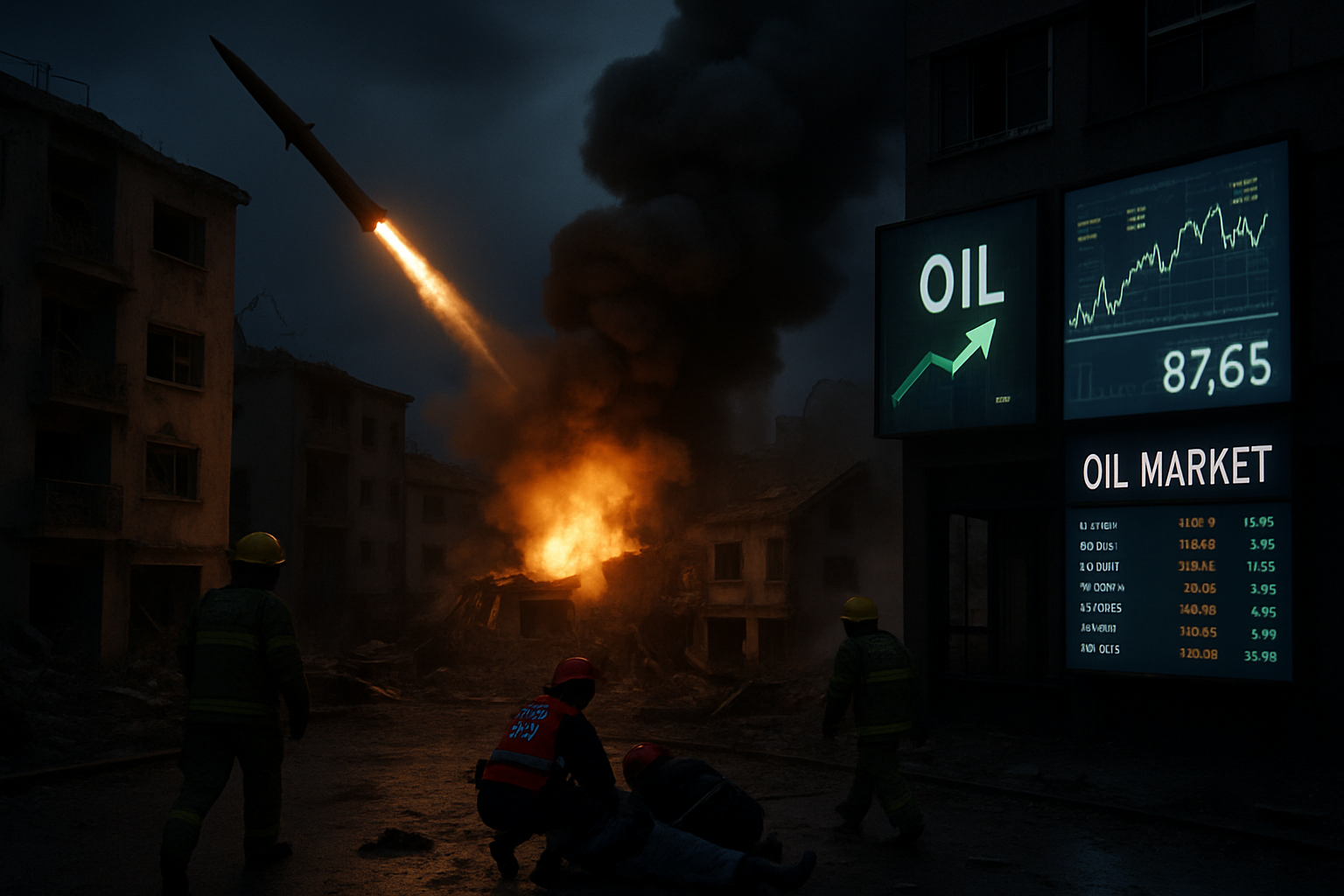
Iran launched devastating missile strikes on Israeli cities Arad and Dimona late Saturday, injuring over 100 people and marking the first direct assault on Israel's nuclear infrastructure region during the three-week war, while President Donald Trump issued a 48-hour ultimatum threatening to "obliterate" Iran's power plants if the Strait of Hormuz remains closed.
The Iranian Revolutionary Guard Corps (IRGC) used advanced Khorramshahr-4 and Qadr missiles with cluster warheads carrying half-ton explosive payloads in what represents the most dangerous nuclear security crisis since the conflict began March 1. The strikes targeted areas near Israel's primary nuclear research facility at Dimona, raising unprecedented concerns about attacks on critical nuclear infrastructure during armed conflict.
Unprecedented Nuclear Infrastructure Targeting
Israeli Prime Minister Benjamin Netanyahu described Saturday evening as "very difficult" after Iran's systematic targeting of Dimona, which houses the Shimon Peres Negev Nuclear Research Center - Israel's primary nuclear installation since the 1960s. While the International Atomic Energy Agency (IAEA) confirmed no direct damage to nuclear facilities, Director General Rafael Grossi called for "maximum restraint" to avoid nuclear accidents.
The attack on Arad killed at least five people and injured more than 100, with significant building damage and fires reported throughout the city. Iranian missiles penetrated Israel's air defense systems using hypersonic capabilities and unconventional flight patterns, demonstrating a significant evolution in Iran's military technology during the ongoing conflict.
"We are determined to continue striking our enemies on all fronts until victory is achieved."
— Benjamin Netanyahu, Israeli Prime Minister
Trump's 48-Hour Energy Ultimatum
President Trump escalated the crisis dramatically by issuing an ultimatum on Truth Social at 10:44 AM AEDT, demanding Iran fully reopen the Strait of Hormuz within 48 hours or face destruction of its power infrastructure. The waterway carries approximately 40% of global seaborne oil transit and has been effectively closed by Iranian mining operations.
"If Iran doesn't FULLY OPEN, WITHOUT THREAT, the Strait of Hormuz, within 48 HOURS from this exact point in time, the United States of America will hit and obliterate their various POWER PLANTS, STARTING WITH THE BIGGEST ONE FIRST," Trump posted, representing the most explicit energy infrastructure threat in the three-week conflict.
The ultimatum comes as oil prices have surged past $100 per barrel, with the International Energy Agency releasing a record 400 million barrels from strategic reserves - the largest intervention in the agency's 50-year history. Iran's mining of the strategic waterway with an estimated 2,000-6,000 naval mines has stranded over 150 tankers worth billions in cargo.
Global Aviation Crisis Deepens
The conflict continues to paralyze global air travel with over 18,000 flights cancelled worldwide - the most severe disruption since COVID-19. Eight Middle Eastern countries maintain simultaneous airspace closures, completely severing Asia-Europe flight corridors and stranding hundreds of thousands of passengers globally.
Dubai International Airport, the world's busiest with 86 million annual passengers, remains completely shut down from missile damage sustained earlier in the conflict. Major carriers including Emirates, Air France-KLM, and Wizz Air have suspended Middle Eastern operations indefinitely, fundamentally altering global aviation networks.
Iranian Leadership Succession Crisis
The strikes occur amid Iran's unprecedented succession crisis following Supreme Leader Ali Khamenei's death on March 1. Mojtaba Khamenei, the former leader's son, has been appointed as Supreme Leader - marking the first hereditary succession in the Islamic Republic's 47-year history and representing a fundamental shift from clerical to military governance.
CIA assessments suggest the Revolutionary Guards have consolidated unprecedented control over the Iranian state apparatus during the active warfare, indicating a permanent transformation in Iran's governing structure. The new leadership has maintained the IRGC's "no red lines remain" policy of systematic targeting across the region.
Regional Coalition Under Severe Strain
The unprecedented coalition of Saudi Arabia, UAE, Qatar, and Egypt that had supported diplomatic solutions is facing severe strain as Iranian retaliation directly targets member territories. Egyptian President Abdel Fattah el-Sisi condemned attacks on "sisterly Arab countries" while warning of "comprehensive chaos" spreading across the region.
The United Arab Emirates reported one civilian killed in Abu Dhabi from missile debris, while Kuwait has suffered 32 injured from airport drone strikes. Qatar successfully intercepted 65 missiles and 12 drones using Patriot systems but still recorded eight injured from falling fragments. The systematic targeting of coalition partners represents a dramatic escalation from conventional military confrontation.
European Territory Attacked for First Time Since WWII
Iranian drones struck RAF Akrotiri in Cyprus - marking the first attack on European territory since World War II and fundamentally altering the conflict's scope. The assault prompted an unprecedented naval coalition response with HMS Dragon, Spanish frigates, and vessels from Italy, France, the Netherlands, and Greece deployed to protect European interests.
The European Union activated its ESTIA emergency evacuation plan for Cyprus for the first time in the bloc's history, demonstrating how the Middle Eastern conflict has expanded beyond regional boundaries to threaten European security directly.
Operation Epic Fury Reaches Historic Scale
The US-Israeli "Operation Epic Fury" has become the largest coordinated military campaign in the Middle East since the 2003 Iraq invasion, with costs reaching $11.3 billion in the first week alone. The operation employs a dual-carrier deployment of USS Gerald R. Ford and USS Abraham Lincoln, representing approximately one-third of the active US Navy fleet.
US casualties have mounted to 150 troops wounded with eight in critical condition and three confirmed deaths - the first American military fatalities in a Middle Eastern operation since 2003. The USS Charlotte submarine achieved a historic milestone by sinking the Iranian frigate IRIS Dena near Sri Lanka, marking the first enemy vessel sunk by a US submarine since World War II.
Humanitarian Crisis Reaches Critical Levels
The Iran Red Crescent reports over 787 civilian casualties from US-Israeli strikes, including the devastating attack on Minab elementary school that killed between 53-85 students and staff. International human rights organizations have called for Geneva Conventions investigations into potential war crimes involving the targeting of educational facilities.
International evacuations have reached the largest scale since the Arab Spring of 2011, with Australia reporting 115,000 nationals trapped in the region and Germany struggling to extract 30,000 stranded tourists. Multiple countries have issued immediate evacuation orders citing "extremely uncertain" security conditions.
Nuclear Diplomacy Completely Collapsed
The current military confrontation emerged from the complete breakdown of nuclear negotiations despite achieving a "broad agreement on guiding principles" in Geneva talks - representing the most significant diplomatic progress since the 2018 JCPOA collapse. The fundamental disagreement remained unchanged: Iran excluded ballistic missiles and regional proxies as "red lines" while demanding nuclear-only talks, versus comprehensive US demands including missiles, armed groups, and human rights.
Iran continues uranium enrichment at 60% purity with over 400 kilograms of material approaching weapons-grade levels, sufficient for multiple nuclear weapons if weaponized. The crisis unfolds amid broader nuclear governance breakdown, with the New START treaty having expired in February - the first time in over 50 years without US-Russia nuclear constraints.
Congressional Opposition Mounts
Bipartisan congressional opposition to the conflict is intensifying, with lawmakers demanding comprehensive briefings on strategy, costs, and potential ground troop deployment. Senator Richard Blumenthal expressed being "more concerned than ever" about the possibility of boots on the ground, as Pentagon operations are reportedly planned through September - far beyond the initial 4-6 week timeline.
Public support for the conflict remains historically low at only 25% approval, creating what analysts describe as "almost unprecedented" unpopularity for early-stage military operations. Financial markets serve as what experts call the "ultimate constraint" on further escalation, with Pakistan's KSE-100 index suffering its largest single-day decline in history at -8.97%.
Template-Setting Crisis for 21st Century
UN Secretary-General António Guterres has characterized the crisis as the "greatest test of multilateral cooperation in crisis management of the modern era." The rapid transition from diplomatic breakthrough to military confrontation demonstrates the fragility of crisis management mechanisms in the multipolar era.
The stakes extend far beyond the Middle East, affecting regional war prevention, global energy security, nuclear governance credibility, and international law enforcement of post-WWII order principles. Success in containing the escalation could provide a framework for future nuclear crisis resolution, while failure may accelerate military solutions and reshape international approaches to conflict resolution for decades.
As the conflict enters its fourth week with no diplomatic solution visible and Trump's 48-hour ultimatum ticking down, the world faces a template-setting moment that will determine whether diplomatic or military solutions become the preferred approach to 21st-century international disputes. The implications of decisions made in the coming hours will reverberate through international relations for decades, affecting everything from energy architecture evolution to nuclear proliferation prevention mechanisms worldwide.