Iran launched devastating ballistic missile strikes against Israeli industrial zones and a Saudi air base housing US forces, marking one of the most significant escalations in the ongoing Middle East conflict as regional tensions reach a critical breaking point.
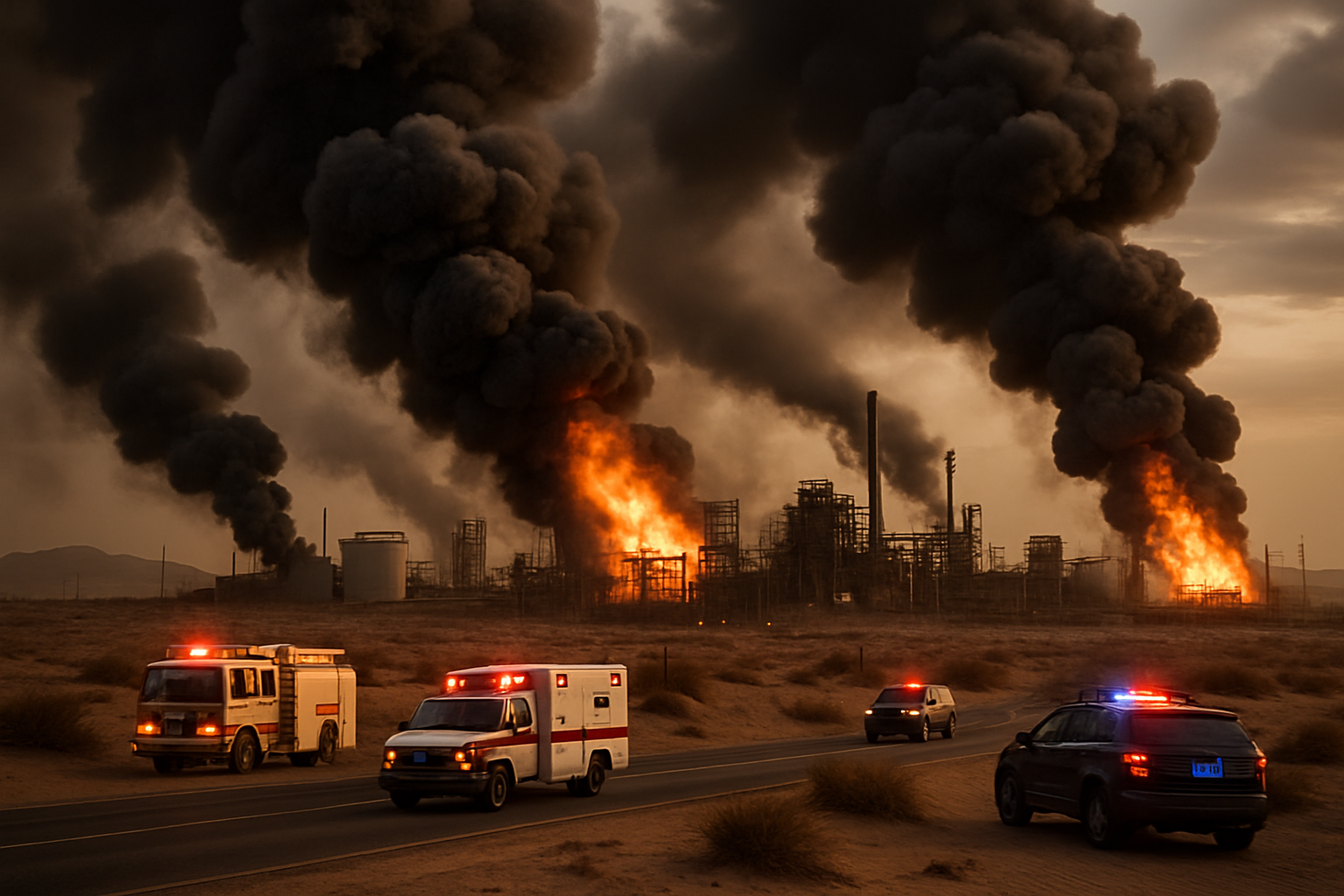
Multiple Iranian ballistic missiles penetrated Israeli air defenses Sunday evening, striking the Neot Hovav industrial zone south of Beersheba and causing massive fires that sent towering columns of black smoke across the Negev desert. The unprecedented strikes represent a dangerous expansion of Iran's military campaign as the Islamic Republic continues its "Operation True Promise 4" retaliation following weeks of escalating regional warfare.
Industrial Zone Devastated by Precision Strikes
Emergency responders confirmed that Iranian missiles successfully hit their targets in the strategically important Neot Hovav industrial complex, despite Israel's advanced air defense systems being actively engaged. The facility houses numerous chemical plants and hazardous materials, prompting Israeli authorities to establish a security cordon around the affected area and order evacuations from surrounding communities.
Greek rescue services reported that a large fire erupted in the industrial zone following the ballistic missile attack, with no injuries immediately reported. However, Israeli authorities confirmed that the targeted facilities contain dangerous materials, raising concerns about potential environmental and health impacts from the strikes.
Palestinian media sources described the attack as targeting a chemicals manufacturing plant near Beersheba, with Israeli radio confirming that the struck facility contains hazardous substances. The successful penetration of Israeli air defenses demonstrates Iran's evolving military capabilities and willingness to target critical infrastructure.
US Surveillance Aircraft Destroyed in Saudi Strike
In a parallel development that has sent shockwaves through Western intelligence circles, Iranian forces successfully struck the Prince Sultan Air Base in Saudi Arabia, reportedly destroying a highly valuable US E-3 Sentry AWACS surveillance aircraft worth an estimated $500 million. The sophisticated early warning aircraft represents one of the most significant American military assets lost in the current conflict.
Ukrainian President Volodymyr Zelenskyy revealed that Russian satellite images of the Prince Sultan Air Base were shared with Iran days prior to the attack, suggesting coordination between Moscow and Tehran in targeting US military assets. The strike also wounded 12 US soldiers stationed at the facility, marking a dangerous escalation in direct attacks against American personnel.
The E-3 Sentry aircraft, known by its distinctive rotating radar dome, serves as a critical component of US air surveillance and command capabilities in the region. Its destruction represents not only a massive financial loss but also a significant degradation of American intelligence-gathering capacity in the volatile Middle East theater.
"This attack represents a calculated escalation by Iran, targeting both Israeli civilian infrastructure and crucial US military assets in a coordinated campaign designed to maximize strategic impact."
— Defense analyst familiar with Middle East operations
Regional Coalition Under Severe Strain
The latest Iranian strikes have placed unprecedented pressure on the regional coalition of Arab states that had been supporting diplomatic efforts to contain the crisis. The successful attacks on both Israeli and Saudi territory demonstrate Iran's capability and willingness to strike at the heart of US-allied nations, fundamentally altering the strategic calculus for Gulf states.
Aluminum production facilities across the Gulf region have also come under Iranian attack, with Aluminium Bahrain reporting damage and injuries from Saturday's strikes. The company, which operates one of the world's largest aluminum smelters, confirmed that two employees were hurt in the Iranian assault, while Emirates Global Aluminium's facilities in the UAE sustained significant damage from coordinated missile and drone strikes.
The targeting of civilian industrial infrastructure represents a concerning escalation in Iran's military strategy, moving beyond purely military targets to encompass economic and industrial facilities that form the backbone of regional economies.
Global Energy Markets in Turmoil
Iran's continued closure of the Strait of Hormuz, through which 40% of global seaborne oil transit passes, has sent energy markets into crisis mode. Oil prices have surged past $110 per barrel, with analysts warning they could approach $200 if the conflict continues to escalate.
The Islamic Republic has deployed an estimated 2,000-6,000 naval mines throughout the critical waterway, effectively creating a blockade that has stranded over 150 tankers carrying billions of dollars worth of cargo. Major shipping companies including Maersk and MSC have suspended operations in the Persian Gulf, while the International Energy Agency has announced its largest-ever strategic petroleum reserve release of 400 million barrels.
Natural gas prices have similarly spiked, rising 24% in Europe and 78% in the United States as regional supply chains face unprecedented disruption. Qatar, which provides approximately 20% of global LNG exports, has been forced to halt production following Iranian infrastructure attacks.
Diplomatic Collapse and Military Escalation
The current military escalation represents the complete breakdown of what had been the most promising diplomatic engagement between the US and Iran in years. Despite achieving "broad agreement on guiding principles" through Geneva negotiations—the most significant progress since the 2018 JCPOA collapse—fundamental disagreements over scope proved insurmountable.
Iran maintained that ballistic missiles and regional proxy forces were "red lines" that must be excluded from any nuclear-focused agreement, while US Secretary of State Marco Rubio insisted on comprehensive accords addressing missiles, armed groups, and human rights. These same structural obstacles that have prevented breakthrough agreements for over a decade remained unchanged despite intensive diplomatic efforts.
The rapid transition from diplomatic framework to military confrontation demonstrates the fragility of crisis management mechanisms in the current multipolar era. President Trump's demands for Iran's "unconditional surrender" and his claim of the right to personally choose Iran's next Supreme Leader have effectively eliminated any remaining diplomatic pathways.
Aviation Crisis Reaches Global Scale
The conflict has generated the most severe aviation disruption since the COVID-19 pandemic, with over 18,000 flights cancelled worldwide. Eight Middle Eastern countries have simultaneously closed their airspace, creating unprecedented challenges for international air travel and trade routes.
Dubai International Airport, the world's busiest with 86 million passengers annually, remains completely shut down following missile damage from Iranian strikes. Major carriers including Emirates, Air France-KLM, and Wizz Air have suspended operations indefinitely, affecting hundreds of thousands of passengers globally.
The closure of Middle Eastern airspace has severed critical Europe-Asia corridors, forcing airlines to implement extensive rerouting that adds hours to flight times and dramatically increases operational costs. The aviation industry is implementing emergency fuel surcharges as jet fuel prices have jumped from $85-90 per barrel to $150-200.
Nuclear Governance Crisis Deepens
The current crisis unfolds against the backdrop of a broader nuclear governance breakdown, occurring after the New START Treaty's expiration on February 5—the first time in over 50 years that the US and Russia lack nuclear constraints. Combined with China's nuclear expansion and Iran's continued uranium enrichment to 60% purity, the international community faces what UN Secretary-General António Guterres has called the "highest nuclear risks in decades."
Iran possesses over 400 kilograms of enriched uranium, sufficient material for multiple weapons if weaponized, while continuing to refuse limitations on its ballistic missile program. The Islamic Republic's approach to 90% weapons-grade uranium levels represents a critical threshold that could fundamentally alter regional security dynamics.
Humanitarian Impact Mounting
International evacuations are reaching scales not seen since the Arab Spring of 2011, with Australia reporting 115,000 nationals trapped in the region and Germany coordinating the evacuation of 30,000 stranded citizens. The European Union has activated its ESTIA crisis response mechanism for Cyprus following the first attack on European territory since World War II.
The Iran Red Crescent reports over 787 civilian casualties from US-Israeli strikes, including the devastating attack on an elementary school in Minab that killed 53-85 students and staff. The systematic targeting of civilian infrastructure and the mounting humanitarian toll have prompted international calls for investigations into potential Geneva Conventions violations.
Lebanon has been particularly affected, with over 832,000 people displaced as Hezbollah's entry into the conflict has collapsed the November 2024 ceasefire that had held for over a year. The systematic targeting of medical personnel—with 26 paramedics killed and 51 wounded—represents a concerning escalation in attacks on humanitarian workers.
Congressional Pressure and Public Opinion
Operation Epic Fury, the US-Israeli military campaign, has already cost $11.3 billion in its first week alone, making it one of the most expensive military operations in recent history. With 150 US troops wounded, eight in critical condition, and three confirmed killed, domestic political pressure is mounting on the Biden administration.
Senator Richard Blumenthal has expressed being "more concerned than ever" about the deployment of ground troops, while public support for the conflict stands at an "almost unprecedented" low of just 25%. Pentagon operations are now planned through September, far beyond the initial 4-6 week timeline presented to Congress.
Financial markets have emerged as what analysts call the "ultimate constraint" on further escalation, with stock markets crashing globally. Pakistan's stock exchange recorded its largest single-day decline in history at -8.97%, while international corporations are postponing major transactions due to market volatility.
Global Implications and Historical Significance
UN Secretary-General António Guterres has characterized the current crisis as the "greatest test of multilateral cooperation and crisis management in the modern era." The rapid transition from diplomatic breakthrough to military escalation represents a template-setting moment for 21st-century conflict resolution approaches.
The successful Iranian strikes on both Israeli industrial zones and US military assets demonstrate the Islamic Republic's evolving military capabilities and strategic coordination with allies including Russia. The sharing of satellite intelligence and the precision of the attacks suggest a level of planning and international cooperation that fundamentally alters regional power dynamics.
The conflict's expansion beyond the Middle East, with attacks reaching European territory in Cyprus and affecting global supply chains, energy markets, and aviation networks, illustrates how regional conflicts can rapidly acquire worldwide implications in an interconnected world.
As the crisis enters what many analysts consider its most dangerous phase, the stakes extend far beyond the immediate participants. The success or failure of containing this escalation will establish precedents for diplomatic versus military solutions to international crises, nuclear governance mechanisms, and the effectiveness of multilateral cooperation in managing conflicts that threaten global stability.
The template-setting nature of this crisis means its resolution—or continued escalation—will influence international approaches to territorial disputes, nuclear proliferation, and energy security for decades beyond the current events, making the coming days and weeks critical for the future of international relations and post-World War II institutional order.