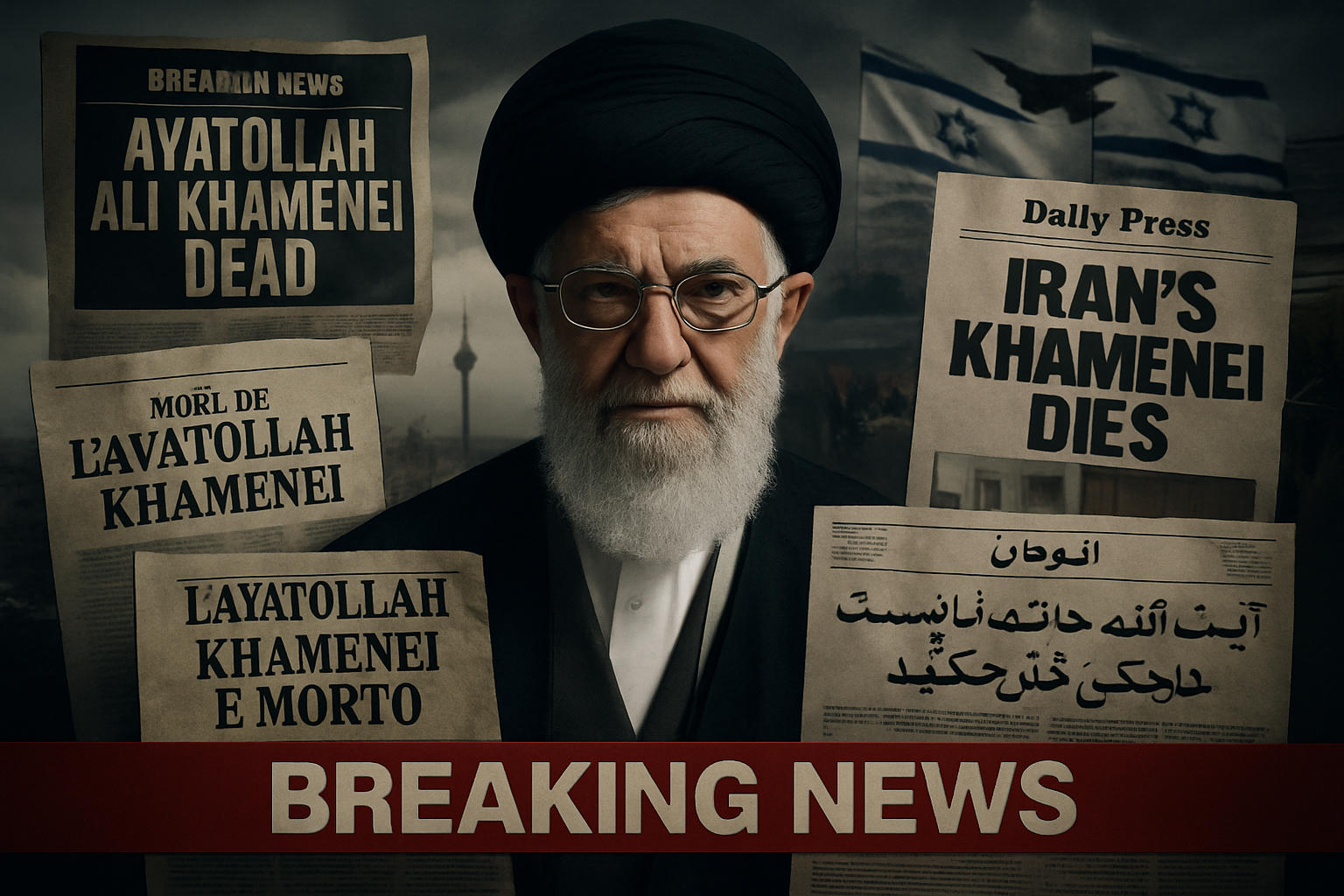
Unconfirmed reports emerged Saturday evening that Iran's Supreme Leader Ayatollah Ali Khamenei may have been killed during coordinated US-Israeli military strikes, creating a fog of uncertainty as Israeli sources claim confirmation while Iranian officials vehemently deny the reports, calling them "psychological warfare."
According to Reuters, a senior Israeli official claimed that Khamenei, 85, was killed and his body found during what Israel and the United States dubbed "Operation Epic Fury" - the most significant military escalation against Iran in decades. However, no official confirmation has been issued by either Israeli or American governments.
Conflicting Claims and Information War
Iranian semi-official media outlets Tasnim and Mehr quickly countered the Israeli claims, stating that Khamenei is alive and "firmly and decisively managing the situation." Iranian Foreign Ministry spokesperson Esmail Baghaei assured that both the Supreme Leader and President are "well," dismissing the death reports as part of an enemy "psychological warfare" campaign.
"The enemy resorts to methods of psychological warfare, and all should maintain awareness against the enemy's obvious lies and avoid spreading them"
— Iranian official statement
Israeli Prime Minister Benjamin Netanyahu added fuel to the controversy during a televised address, stating there were "many signs" that Khamenei was "no longer with us" following strikes that allegedly destroyed the Supreme Leader's compound. Netanyahu claimed the operation eliminated senior Iranian officials, Islamic Revolutionary Guard Corps (IRGC) commanders, and key figures in Iran's nuclear program.
Operation Epic Fury Launches Massive Strike Campaign
The military operations mark the culmination of escalating tensions that followed the complete breakdown of nuclear negotiations between Iran and the United States. Despite recent diplomatic progress in Geneva talks that achieved what Iranian Foreign Minister Abbas Araghchi called "broad agreement on guiding principles," fundamental disagreements over scope proved insurmountable.
The strikes came after President Trump issued a 10-day ultimatum warning that "bad things will happen" if no meaningful nuclear deal was reached. The operation involved an unprecedented dual-carrier deployment of USS Gerald R. Ford and USS Abraham Lincoln, representing the largest US Middle East naval presence since the 2003 Iraq invasion.
Multiple explosions were reported across Tehran, with Iranian state media IRNA confirming "heavy smoke rising over the capital." Israel, Iran, Iraq, UAE, and Qatar all closed their airspace to civilian traffic, causing massive flight cancellations worldwide and disrupting the critical Middle East aviation hub that connects Europe and Asia.
Swift Iranian Retaliation Targets Regional Allies
Iran's response was immediate and severe, with the IRGC launching what it termed a "first wave" of retaliatory strikes against multiple Gulf countries. The Iranian military declared that "no red lines remain" and that all US and Israeli assets in the region were now "legitimate targets."
The retaliation caused casualties across the region:
- UAE: One civilian killed in Abu Dhabi from missile debris, with explosions reported in Dubai
- Kuwait: Airport struck by Iranian drones, causing employee injuries and evacuations
- Qatar: Successfully intercepted incoming missiles using Patriot defense systems
- Bahrain: Iranian missiles targeted the US Fifth Fleet headquarters
The attacks disrupted an unprecedented regional coalition of Saudi Arabia, UAE, Qatar, and Egypt that had been supporting the diplomatic process. Egypt condemned Iran for targeting "sisterly Arab countries" and warned of "comprehensive chaos."
Nuclear Diplomacy Collapse Context
The military escalation followed the breakdown of intensive nuclear negotiations that had shown the most promise since the 2018 collapse of the Joint Comprehensive Plan of Action (JCPOA). Iran continued enriching uranium to 60% purity - significantly above the 3.67% limit set by the original nuclear deal and approaching the 90% threshold needed for weapons-grade material.
Despite framework progress achieved through Switzerland-Oman mediation, the same fundamental obstacle that has prevented breakthroughs for over a decade remained unchanged: Iran excluded ballistic missiles and regional proxy relationships as "red lines" from nuclear-only talks, while the US demanded a comprehensive agreement addressing missiles, armed groups, and human rights.
Global Aviation Crisis and Market Impact
The conflict immediately triggered a global aviation crisis as multiple Middle Eastern countries closed their airspace. Flight tracking showed Iranian and Iraqi airspace completely empty, while major international carriers including Emirates, Air France-KLM, Wizz Air, and Bulgaria Air suspended operations to key Middle Eastern destinations.
Oil prices rose immediately on concerns about the Strait of Hormuz, through which 40% of global oil transit passes. The potential for regional war escalation threatens to disrupt worldwide energy markets and supply chains far beyond the immediate conflict zone.
International Response and Emergency Sessions
The crisis prompted emergency diplomatic activity, with the UN Security Council scheduling an emergency session requested by France, China, Russia, Colombia, and Bahrain. Russia condemned what it called "reckless actions by Washington and West Jerusalem" as violations of international law principles.
European governments issued urgent travel warnings, with multiple countries including the UK, France, Germany, and Poland advising against travel to the region. The United States authorized the departure of non-essential embassy personnel from Israel, with Ambassador Mike Huckabee telling staff to leave "today."
Historical Context and Nuclear Governance Crisis
The crisis unfolds against the backdrop of a broader nuclear governance breakdown, following the expiration of the New START treaty on February 5, 2026 - the first time in over 50 years that the United States and Russia have operated without nuclear constraints. Combined with China's nuclear expansion, UN Secretary-General António Guterres has warned that nuclear risks are at their "highest in decades."
Khamenei, who has served as Iran's highest authority since 1989 following the death of the Islamic Republic's founder Ayatollah Ruhollah Khomeini, transformed Iran into a powerful anti-US force and extended its military influence across the Middle East. His reported death, if confirmed, would represent a seismic shift in regional geopolitics.
Verification Challenges and Uncertainty
The conflicting reports highlight the challenges of verifying information during active military operations. Iranian authorities have maintained strict control over communications, with mobile services disrupted in Tehran and contact lost with senior leadership during the strikes.
International observers note that Iranian media's firm denials, combined with the absence of visual evidence or official confirmation from US or Israeli governments, suggests the reports remain unverified. However, the scale of the military operations and their targeting of Iranian leadership compounds indicates this represents a potential turning point in Middle East conflict dynamics.
The crisis represents a template-setting moment for 21st-century diplomacy versus military confrontation, with implications extending far beyond the immediate region. Success in containing the escalation could provide a framework for future nuclear crisis resolution, while failure may accelerate military solutions and reshape Middle Eastern geopolitics for decades to come.