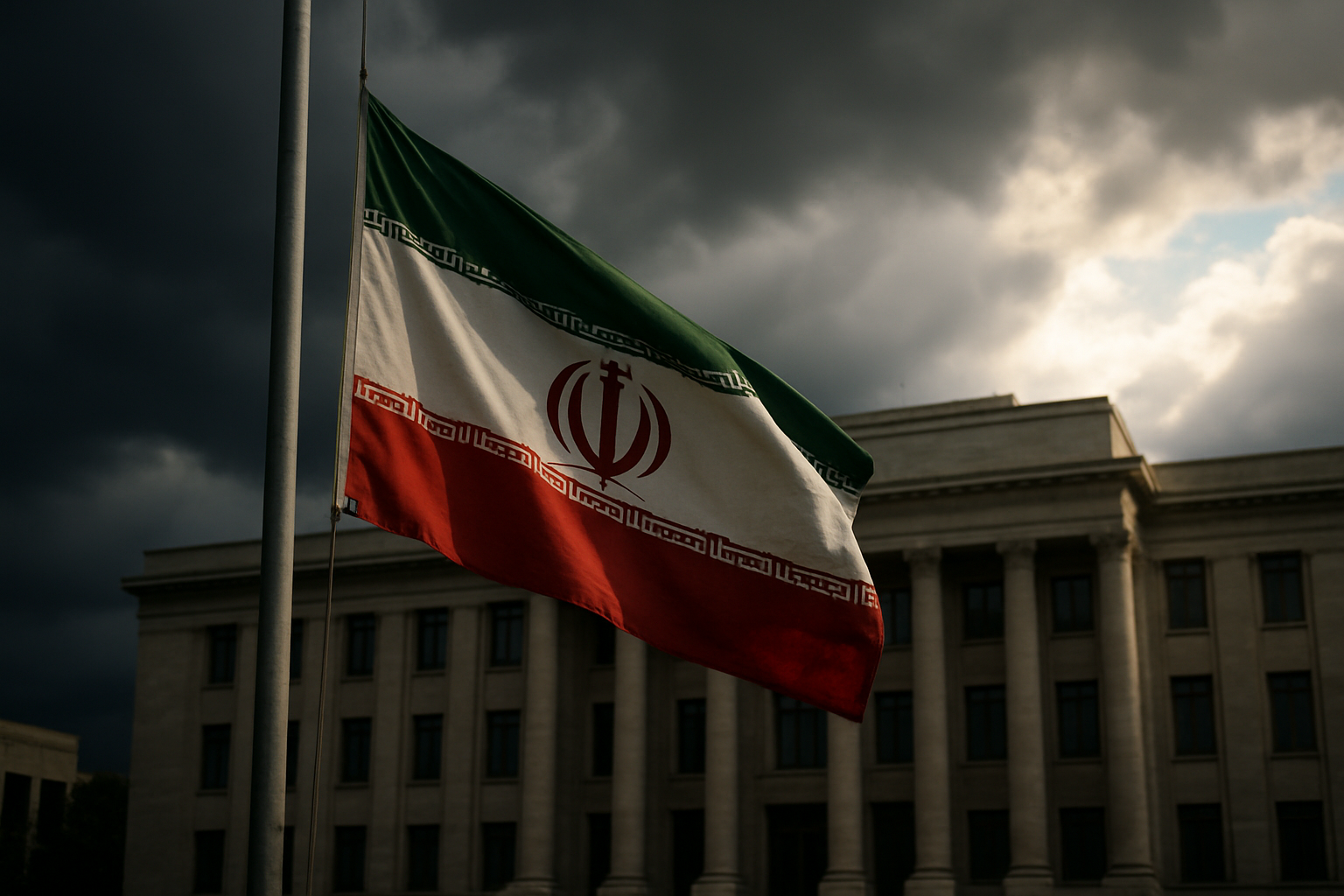
Iran's Supreme Leader Ayatollah Ali Khamenei has been officially confirmed dead by Iranian state media following coordinated US-Israeli military strikes in what officials call "Operation Epic Fury," triggering the Islamic Republic's most severe constitutional crisis since the 1979 revolution and raising questions about the regime's survival.
Iranian state television, along with official news agencies Fars, Mehr, and Press TV, confirmed the 86-year-old leader's death on March 1, 2026, stating he died "at his place of work" in the Tehran leadership compound while "performing official duties." The confirmation came hours after President Donald Trump announced Khamenei's death via Truth Social, calling him "one of the most evil people in History."
Operation Epic Fury: Unprecedented Scale of Strikes
The coordinated US-Israeli military campaign represents the largest Middle East operation since the 2003 Iraq invasion, involving an unprecedented dual-carrier deployment of the USS Gerald R. Ford and USS Abraham Lincoln—approximately one-third of the active US Navy fleet positioned 800 kilometers from Iran's coast.
The strikes, which followed the complete breakdown of nuclear negotiations despite a Geneva framework breakthrough, resulted in massive casualties among Iran's leadership. Confirmed dead alongside Khamenei include Defense Minister Aziz Nasirzadeh, Islamic Revolutionary Guard Corps (IRGC) Chief Mohammad Pakpour, and senior aide Ali Shamkhani, among more than 40 high-ranking officials.
"This is the single greatest chance for the Iranian people to take back their country."
— President Donald Trump, Truth Social
Tragically, the strikes also resulted in significant civilian casualties, including Khamenei's family members. Fars News Agency confirmed that his daughter, son-in-law, and granddaughter were killed in the compound strikes, representing an unprecedented escalation in targeting a sitting head of state's immediate family.
Constitutional Succession Crisis Unfolds
In accordance with Article 111 of Iran's constitution, a three-member transitional council has been established to govern the country during the succession process. The council consists of President Masoud Pezeshkian, judiciary head Gholamhossein Mohseni Ejei, and Guardian Council jurist Ayatollah Alireza Arafi.
The Assembly of Experts, composed of 88 senior clerics, now faces the unprecedented task of selecting a permanent successor during wartime conditions. Iranian authorities have declared 40 days of mourning and seven days of public holidays as the nation grapples with the end of Khamenei's 37-year rule that began in 1989.
US intelligence assessments suggest that a Revolutionary Guards member is likely to be chosen as the next Supreme Leader, indicating potential hardline military influence in Iran's future direction—a development that could further destabilize the region.
Massive Iranian Retaliation Spreads Across Region
Iran's response, dubbed "Operation True Promise 4," saw the IRGC declare that "no red lines remain," designating all US and Israeli assets as "legitimate targets." The systematic retaliation has caused casualties across multiple Gulf states:
- UAE: One civilian killed in Abu Dhabi from missile debris, with Dubai International Airport—the world's busiest—completely shut down due to missile damage
- Kuwait: International Airport struck by Iranian drones, with employee injuries reported
- Qatar: Successfully intercepted 65 missiles and 12 drones using Patriot systems, with 8 people injured from fragments
- Bahrain: Fifth Fleet headquarters targeted in coordinated strikes
- Israel: Beit Shemesh residential area hit, killing 9 and wounding 28
Global Aviation Crisis Paralyzes Air Travel
The conflict has triggered the most extensive aviation disruption since COVID-19, with Iran, Iraq, Israel, UAE, Qatar, Syria, Kuwait, and Bahrain simultaneously closing their airspace. Over 18,000 flights have been cancelled worldwide, affecting hundreds of thousands of passengers.
Major carriers including Emirates, Air France-KLM, Wizz Air, and Bulgaria Air have suspended Middle East operations indefinitely. The closure of Dubai International Airport has particularly severe implications for global connectivity, as the facility serves as a critical hub linking Europe, Asia, and Africa.
Energy Security Under Severe Threat
Oil prices have surged 10% to $80 per barrel as Iran threatens to block the Strait of Hormuz, through which 40% of global seaborne oil transit passes. Major shipping companies Maersk and MSC have suspended operations, with over 150 tankers carrying crude oil and liquefied natural gas now anchored in the Persian Gulf.
Natural gas prices have jumped 24% in Europe and 78% in the United States, while Iran's warnings that shipping through the strait is "not allowed" have raised fears of a global energy crisis. The regional conflict risks disrupting worldwide supply chains far beyond the Middle East's borders.
Diplomatic Breakdown Despite Recent Progress
The military escalation came despite what had been the most promising US-Iran diplomatic opening in years. Recent Geneva talks had achieved a "broad agreement on guiding principles"—the most significant progress since the 2018 JCPOA collapse.
However, fundamental disagreements proved insurmountable. Iran maintained that ballistic missiles and regional proxies were "red lines" to be excluded from nuclear-only talks, while US Secretary of State Marco Rubio insisted on a comprehensive agreement addressing missiles, armed groups, and human rights.
Iran continues to enrich uranium at 60% purity—approaching the 90% threshold needed for weapons—with former IAEA inspector Dr. Yusri Abu Shadi confirming that Iran possesses over 400 kilograms of enriched uranium, making nuclear weapons "easily achievable" if weaponized.
Regional Coalition Under Severe Strain
The unprecedented coalition of Saudi Arabia, UAE, Qatar, and Egypt that had backed the diplomatic process now faces severe challenges as Iranian retaliation targets their territories. Egyptian President Abdel Fattah el-Sisi condemned attacks on "sisterly Arab countries," warning of "comprehensive chaos" spreading across the region.
Multiple countries have initiated emergency evacuations, with Sweden and Serbia ordering immediate departures of their citizens from Iran citing "extremely uncertain" security conditions. The US has authorized the departure of non-essential embassy personnel from Israel.
International Response and Nuclear Governance Crisis
UN Secretary-General António Guterres has declared the military actions a "serious threat to international peace and security," warning they could "trigger a chain of events no one can control." An emergency Security Council session has been called, with Russia condemning what it terms "reckless actions by Washington and West Jerusalem."
The crisis unfolds against the backdrop of a broader nuclear governance breakdown. The New START treaty expired on February 5, 2026—the first time in over 50 years without US-Russia nuclear constraints—while China continues its nuclear expansion. Guterres has warned that nuclear risks are at their "highest in decades."
First US Military Casualties Reported
US Central Command has confirmed three American service members were killed and five wounded during Operation Epic Fury—the first confirmed US military deaths in the largest Middle East operation since 2003. The casualties underscore the serious escalation in what had begun as targeted strikes but has evolved into a broader regional conflict.
Mixed Global Reactions to Khamenei's Death
The confirmation of Khamenei's death has triggered sharply contrasting reactions worldwide. In Tehran, residents celebrated spontaneously, dancing at bus stops and organizing car parades while chanting "the tyrant is no more." Revolutionary Guards have reportedly told citizens to leave the city as celebrations spread.
Similar celebrations erupted among Iranian diaspora communities in Rome, Oslo, Paris, and other European cities, with protesters waving pre-revolutionary Iranian flags featuring the lion and sun symbol.
However, violent protests have also emerged in Pakistan, where 23 people were killed, including attacks on US consular facilities. Iraqi police used tear gas against protesters attempting to storm Baghdad's Green Zone.
Historical Significance and Future Implications
March 1-2, 2026, marks what analysts describe as the most dangerous moment since the Cold War's end—a watershed in Middle Eastern geopolitics with global implications extending decades into the future.
The rapid transition from diplomatic breakthrough to military confrontation demonstrates the fragility of modern crisis management in the multipolar era. Success in containing the escalation could provide a template for future nuclear crisis resolution, while failure may accelerate military solutions to international disputes, encouraging nuclear proliferation elsewhere and undermining diplomatic credibility worldwide.
The stakes encompass not only regional war prevention and global energy security but also nuclear governance credibility and international law enforcement mechanisms that have underpinned the post-World War II order.
Coming Phase Decisive for Global Stability
As Iran's transitional government establishes itself and the Assembly of Experts begins the succession process, the international community faces its greatest test of multilateral cooperation and crisis management in the modern era.
The coming days and weeks will determine whether this remains a contained regional confrontation or escalates into a broader Middle Eastern war with worldwide implications for energy markets, supply chains, and the fundamental principles governing international stability.
With diplomatic channels strained and military positions hardening globally, the decisions made in response to Khamenei's death will reverberate through international relations for decades, affecting approaches to conflict resolution, territorial sovereignty enforcement, and nuclear proliferation prevention mechanisms across the globe.