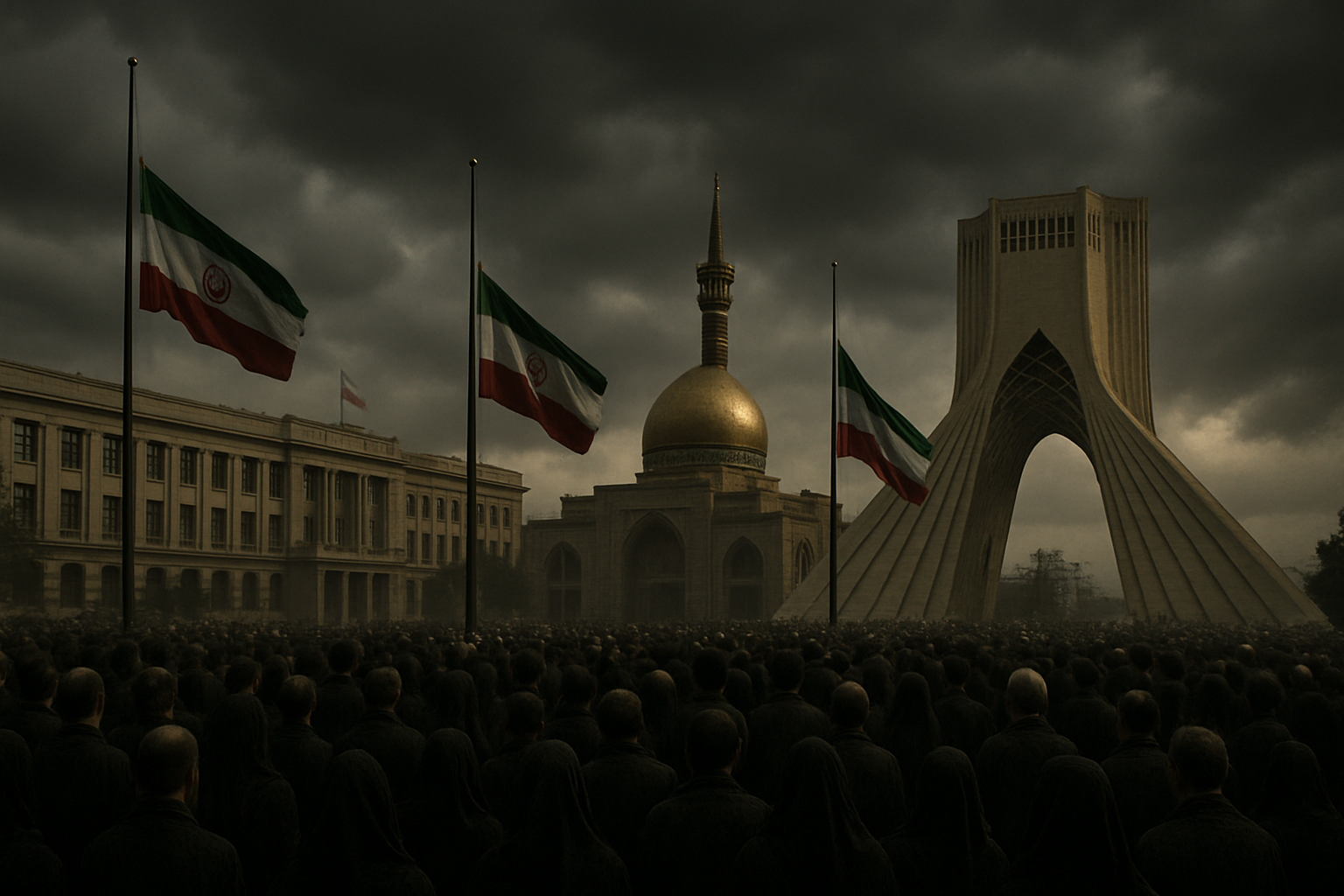
Iranian state media confirmed Sunday morning that Supreme Leader Ayatollah Ali Khamenei was killed in coordinated US-Israeli military strikes on Tehran, ending the 86-year-old cleric's 37-year rule and marking one of the most consequential developments in modern Middle Eastern history.
Multiple Iranian news agencies, including Fars News Agency, Mehr News, and Press TV, announced that Khamenei was "martyred" during the joint military operation known as "Operation Epic Fury," which began early Saturday morning. The confirmation came after hours of conflicting reports and information warfare between Israeli and Iranian sources.
The Strike That Changed History
According to Iranian state broadcaster IRIB, Khamenei was killed "at his place of work" within his leadership compound in central Tehran. The announcement aimed to dispel earlier rumors that the Supreme Leader had been moved to a "safe and secret location" prior to the attack.
"The Supreme Leader of the Islamic Revolution of Iran reached martyrdom at his office," IRIB reported. The broadcaster added that at the time of the "cowardly attack," Khamenei was performing his official duties, describing his presence at the compound as proof that he stood "fearless and brave at the front line of responsibility."
The strikes also claimed the lives of several members of Khamenei's immediate family, including his daughter, son-in-law, granddaughter, and daughter-in-law, according to Fars News Agency and sources close to the Supreme Leader's office.
International Reactions and Confirmations
US President Donald Trump had announced Khamenei's death hours before Iranian confirmation, posting on Truth Social: "Khamenei, one of the most evil people in History, is dead." Trump described the killing as "the single greatest chance for the Iranian people to take back their Country."
Israeli Prime Minister Benjamin Netanyahu claimed there were "growing indications" that Khamenei was "no longer with us" after Israeli strikes destroyed the Supreme Leader's compound. Israeli sources had cited the recovery of bodies from the targeted residential compound.
"This is a historic moment for the entire Iranian nation and the region. The Iranian people now have their greatest opportunity for freedom in over four decades."
— Benjamin Netanyahu, Israeli Prime Minister
The Path to Military Confrontation
The strikes came after the complete breakdown of nuclear negotiations between the United States and Iran, despite recent diplomatic progress. Geneva talks had achieved what Iranian Foreign Minister Abbas Araghchi called "broad agreement on guiding principles" – representing the most significant progress since the JCPOA collapse in 2018.
However, fundamental disagreements persisted. Iran maintained that ballistic missiles and regional proxy activities were "red lines" that should be excluded from nuclear-only talks, while US Secretary of State Marco Rubio demanded a comprehensive agreement addressing missiles, armed groups, and human rights.
Trump had issued an explicit 10-day ultimatum warning that "bad things will happen" if no meaningful nuclear deal was reached. The President deployed an unprecedented dual-carrier strike force – USS Gerald R. Ford and Abraham Lincoln – creating the largest US Middle East naval presence since the 2003 Iraq invasion.
Iran's Nuclear Program at the Center
At the time of the strikes, Iran was enriching uranium at 60% purity, far exceeding the 3.67% limit under the original JCPOA and approaching the 90% weapons-grade threshold. According to former IAEA inspector Dr. Yusri Abu Shadi, Iran possessed over 400 kilograms of enriched uranium, making weapons development "easily achievable."
Intelligence reports had suggested Iran might consider major concessions, including a three-year uranium enrichment halt and transferring stockpiles to Russia. However, hardline statements from Iranian officials cast doubt on such compromises, with Araghchi declaring Iran would "never abandon enrichment even if war is imposed."
Immediate Iranian Retaliation
Iran's Revolutionary Guard Corps (IRGC) launched what it called a "first wave" of retaliatory strikes against US and Israeli assets across the Gulf region within hours of the confirmation. The IRGC declared that "no red lines remain" and that all US and Israeli assets were now "legitimate targets."
The Iranian retaliation resulted in casualties across multiple Gulf states:
- UAE: One civilian killed in Abu Dhabi from missile debris, with explosions reported in Dubai
- Kuwait: Airport Terminal struck by drones, causing employee injuries and flight suspensions
- Qatar: 65 ballistic missiles and 12 drones detected, with Patriots intercepting most
- Bahrain: US Fifth Fleet headquarters targeted in Manama
Global Aviation Crisis
The military escalation triggered a massive global aviation crisis as Iran, Iraq, Israel, UAE, and Qatar closed their airspace to civilian traffic. Major airlines including Emirates, Air France-KLM, Wizz Air, and Bulgaria Air suspended operations, affecting hundreds of thousands of passengers worldwide.
The Middle East serves as a critical Europe-Asia connecting hub, and the closures forced complex rerouting that disrupted international travel patterns. Dubai International Airport, one of the world's busiest, was completely shut down.
Regional Coalition Under Strain
The military escalation severely strained an unprecedented regional coalition of Saudi Arabia, UAE, Qatar, and Egypt that had been backing the diplomatic process. These Gulf states found themselves caught between supporting negotiations and defending against Iranian retaliation on their own territories.
Egyptian President Abdel Fattah el-Sisi condemned the Iranian attacks on "sisterly Arab countries," warning of "comprehensive chaos" in the region. The coalition's unity, which had represented remarkable Middle Eastern consensus for preventing military confrontation, faced its greatest test.
The End of an Era
Khamenei's death ends more than three decades of rule during which he transformed Iran into a regional anti-US power and extended Iranian military influence across the Middle East. Since taking power in 1989 following the death of Ayatollah Ruhollah Khomeini, Khamenei had been the ultimate authority over Iran's foreign policy, armed forces, and revolutionary direction.
Under his leadership, Iran developed an extensive network of regional proxies, including Hezbollah in Lebanon, various groups in Iraq, the Houthis in Yemen, and Hamas in Gaza. His nuclear program advancement had brought Iran to the threshold of weapons capability while maintaining claims of peaceful intent.
Constitutional Succession Process
Iran has announced the formation of a three-member transitional council to assume leadership duties, consisting of the president, the head of the judiciary, and one Islamic jurist from the Guardian Council. The Islamic Republic has declared 40 days of official mourning and a seven-day public holiday.
The succession process, outlined in Iran's constitution, faces unprecedented challenges given the elimination of multiple senior officials during the strikes. The Assembly of Experts, an 88-member clerical body, will ultimately be responsible for selecting a new Supreme Leader, but the process could take months amid the current crisis.
Celebrations and Protests
News of Khamenei's death triggered contrasting reactions globally. In Iranian cities, spontaneous celebrations broke out with residents dancing at bus stops, participating in car parades, and chanting "The tyrant is no more." Revolutionary Guards reportedly told citizens to leave Tehran, fearing mass celebrations.
Meanwhile, protests erupted in New York and other international cities, with demonstrators marching through Manhattan and gathering at the White House to condemn Trump's military action. The Iranian diaspora in Rome and Oslo held celebrations outside embassies, breaking into dance and declaring the "end of Khamenei."
Nuclear Governance Crisis
The crisis occurs amid a broader breakdown of global nuclear governance. The New START treaty between the US and Russia expired on February 5, marking the first time in over 50 years without nuclear constraints between the superpowers. Combined with China's nuclear expansion and Iran's advanced program, UN Secretary-General António Guterres has warned that nuclear risks are at their "highest in decades."
The collapse of the most promising US-Iran diplomatic opening in years raises fundamental questions about the viability of diplomatic solutions to modern nuclear crises and may set a precedent for military rather than diplomatic approaches to proliferation challenges.
Economic and Energy Implications
Oil prices rose immediately following the confirmation of Khamenei's death, with concerns about the Strait of Hormuz – through which 40% of global oil transit passes. The broader regional conflict risks disrupting worldwide supply chains and destabilizing energy markets.
Iran had reportedly warned shipping operators that the Strait of Hormuz was "not allowed" for international traffic, though the practical implementation of such restrictions remained unclear amid the ongoing military operations.
International Emergency Response
The UN Security Council scheduled an emergency session requested by France, China, Russia, Colombia, and Bahrain. Russia condemned what it called "reckless actions by Washington and West Jerusalem" as violations of international law.
Multiple countries issued urgent travel warnings and began emergency evacuations. Sweden and Serbia ordered immediate citizen evacuations from Iran citing "extremely uncertain" security conditions, while the US authorized non-essential embassy personnel to leave Israel.
Looking Forward: An Uncertain Future
With Khamenei's confirmed death, a hugely consequential chapter in Iran's modern history closes with little certainty about what comes next. The Islamic Republic faces its greatest crisis since the 1979 revolution, with succession questions, international isolation, and domestic unrest converging simultaneously.
The international community faces the urgent challenge of preventing further escalation while addressing the underlying issues that led to this dramatic diplomatic breakdown. The success or failure of containing this crisis could provide a template for nuclear crisis resolution in the 21st century – or demonstrate the limitations of diplomatic solutions in an increasingly multipolar world.
As one Iranian official told AFP: "This is not just the end of Khamenei – this could be the end of the Islamic Republic as we know it." Whether that proves accurate may depend on the choices made in the crucial days and weeks ahead by leaders across the region and around the world.