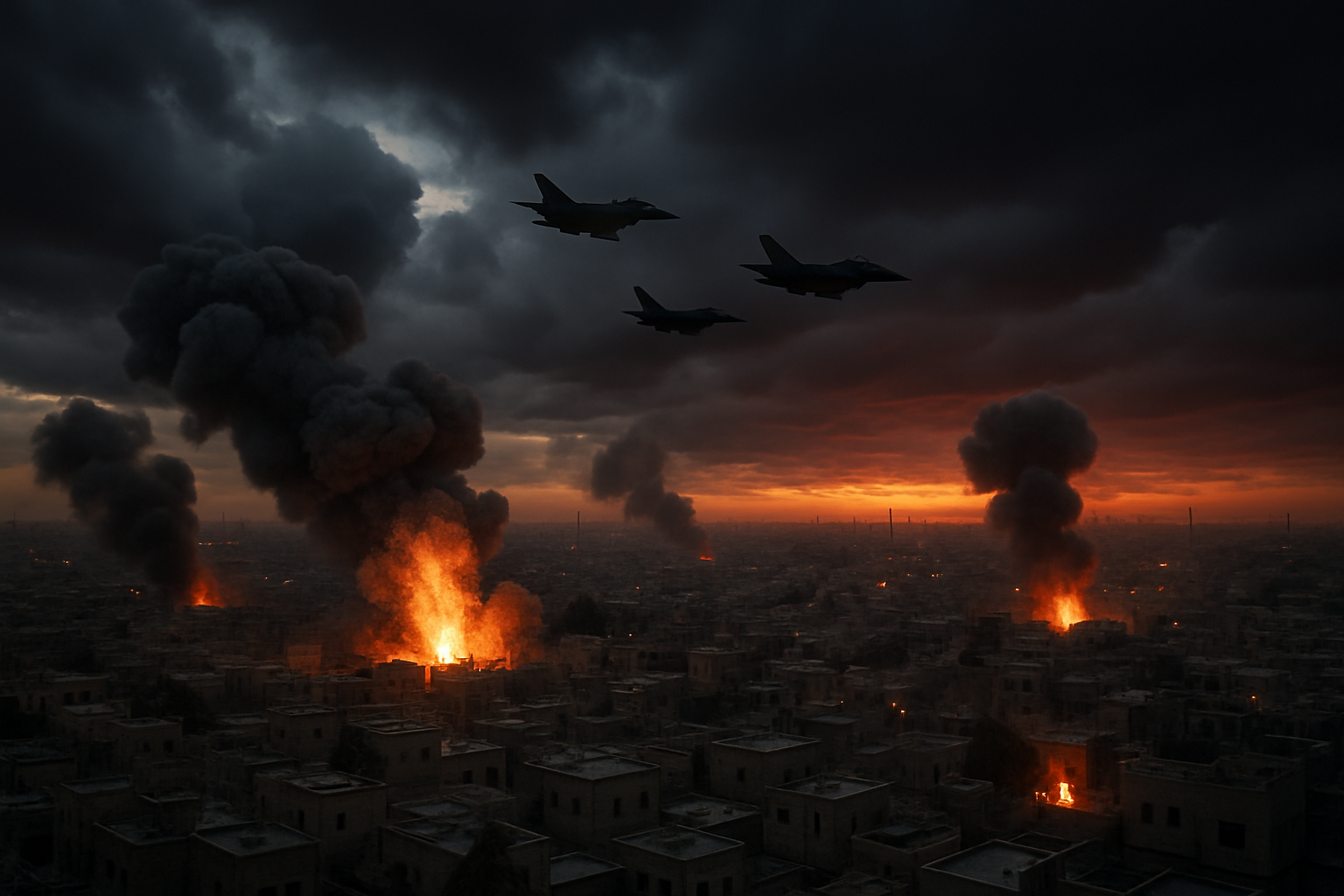
The Middle East crisis has entered its most dangerous phase since the Cold War, with Iran launching coordinated strikes across multiple Gulf states while confirming Mojtaba Khamenei as the new Supreme Leader following the death of his father Ali Khamenei in US-Israeli operations.
The conflict, now in its second week, has resulted in over 1,230 casualties in Iran according to Associated Press sources, with at least 397 additional deaths reported in Lebanon during the past week of escalating violence. The appointment of Mojtaba Khamenei marks the first hereditary succession in the Islamic Republic's 47-year history, consolidating Revolutionary Guards control over the Iranian state.
Regional Attacks Expand Conflict
Iranian forces launched their most extensive regional retaliation campaign yet, with "Operation True Promise 4" targeting US military installations and allied nations across the Middle East. At least 32 people were injured in Bahrain following a reported drone attack, with casualties including civilians and a two-month-old infant, according to Bahraini health ministry reports.
The Bapco oil refinery in Bahrain was among targets struck, while Kuwait's airport facilities suffered drone attacks resulting in significant disruptions. Qatar reported intercepting 65 missiles and 12 drones using Patriot defense systems, with 8 people injured from falling debris despite the successful interceptions.
"No red lines remain," declared Iran's Revolutionary Guard Corps spokesman. "The US has opened a new chapter in the war by bombing Iran's energy infrastructure."
— IRGC Spokesman, Al Jazeera Interview
European Territory Attacked for First Time Since WWII
In an unprecedented escalation, Iranian drones struck RAF Akrotiri base in Cyprus, marking the first attack on European territory since World War II. The assault prompted an immediate response from European naval forces, with HMS Dragon, Spanish frigates, and vessels from Italy, France, Netherlands, and Greece deploying to protect Cyprus.
The European Union activated its ESTIA evacuation protocol for the first time, coordinating the largest international evacuation since the Arab Spring in 2011. Australia reported 115,000 nationals trapped in the region, while Germany confirmed 30,000 stranded tourists requiring immediate assistance.
Global Economic Impact Intensifies
The conflict has created unprecedented disruption to global trade and energy markets. Over 18,000 flights have been cancelled worldwide as eight countries simultaneously closed their airspace - the most extensive aviation crisis since COVID-19. Dubai International Airport, the world's busiest, remains completely shut down due to missile damage.
Oil prices have surged 10% past $80 per barrel as Iran declared the Strait of Hormuz "unsafe," effectively threatening 40% of global oil transit. Natural gas prices have increased 24% in Europe and 78% in the United States. Major shipping companies Maersk and MSC have suspended operations, leaving over 150 tankers stranded in the Persian Gulf with billions of dollars in cargo.
US-Israeli Operations Continue
The US-Israeli "Operation Epic Fury" has become the largest coordinated military campaign in the Middle East since the 2003 Iraq invasion. American forces deployed two aircraft carriers - USS Gerald Ford and USS Abraham Lincoln - representing approximately one-third of the US Navy's active fleet.
In a historic naval engagement, the USS Charlotte submarine sank the Iranian frigate IRIS Dena off Sri Lanka, killing over 80 crew members - the first enemy vessel sunk by a US submarine since World War II. The attack expanded the conflict beyond Middle Eastern boundaries into the Indian Ocean.
Pentagon officials confirmed the first US casualties, with 3 service members killed and 5 wounded. Operation costs have reached $3.7 billion in the first week alone, averaging $891.4 million daily.
Diplomatic Efforts Face Challenges
Despite the escalation, Iranian President Masoud Pezeshkian issued an unprecedented televised apology to neighboring countries affected by Iranian military actions. He announced a conditional suspension of attacks against regional neighbors unless Iran is attacked from their territories.
However, President Trump rejected any diplomatic solutions, demanding Iran's "unconditional surrender" and claiming the right to personally choose Iran's next Supreme Leader. This represents the most direct assertion of American control over Iranian affairs since 1979.
The nuclear diplomacy framework that had achieved "broad agreement on guiding principles" - the most progress since the JCPOA collapse in 2018 - has completely broken down. Iran continues uranium enrichment at 60% purity with over 400kg of weapons-grade material, approaching multiple weapons capability.
International Response and Concerns
UN Secretary-General António Guterres called the crisis "the greatest test of multilateral cooperation and crisis management in the modern era." Emergency Security Council sessions have been convened, with Russia condemning "reckless actions by Washington and West Jerusalem" and China issuing its strongest condemnation in years regarding "sovereignty violations."
Congressional scrutiny in Washington is intensifying, with bipartisan lawmakers demanding answers about strategy, costs, and potential ground troop deployment. Senator Richard Blumenthal expressed being "more concerned than ever" about the possibility of American boots on the ground.
Humanitarian Crisis Deepens
The Iranian Red Crescent reports over 787 civilian casualties from US-Israeli strikes, with international condemnation focusing on the Minab school attack that killed 53-85 students and staff. Human Rights Watch has accused Israel of unlawfully using white phosphorus in residential areas of southern Lebanon.
In Lebanon, the death toll has reached 394 civilians, including 83 children and 42 women, according to Health Minister Rakan Nasreddine. The violence has displaced over 454,000 Lebanese civilians, overwhelming emergency shelters nationwide in the worst humanitarian crisis since 2006.
Regional Coalition Under Strain
The unprecedented diplomatic coalition of Saudi Arabia, UAE, Qatar, and Egypt that had supported negotiations is severely strained as Iranian attacks directly target member territories. Egyptian President Abdel Fattah al-Sisi condemned attacks on "sisterly Arab countries" while warning of "comprehensive chaos" spreading across the region.
Saudi Arabia has warned Iran through diplomatic channels against continued attacks on the kingdom's energy sector, while Arab foreign ministers held emergency video conferences to address the "dangerous escalation."
Looking Ahead
As the conflict enters its second week, the international community faces what UN officials describe as the most dangerous crisis since the Cold War's end. The combination of regional warfare, energy market disruption, nuclear proliferation concerns, and the breakdown of diplomatic frameworks presents challenges with implications extending decades beyond current events.
The success or failure of containing this escalation will likely determine whether 21st-century international disputes are resolved through diplomatic or military means, setting precedents for future territorial and nuclear conflicts worldwide. With oil infrastructure under attack, global supply chains disrupted, and European territory targeted for the first time in nearly 80 years, the stakes could not be higher.
The appointment of Mojtaba Khamenei as Supreme Leader, representing a shift from clerical to military influence in Iranian governance, suggests the conflict may intensify further rather than move toward resolution. As world leaders grapple with this unprecedented crisis, the coming days will prove crucial in determining whether the Middle East descends into broader regional warfare or finds a path back from the brink.