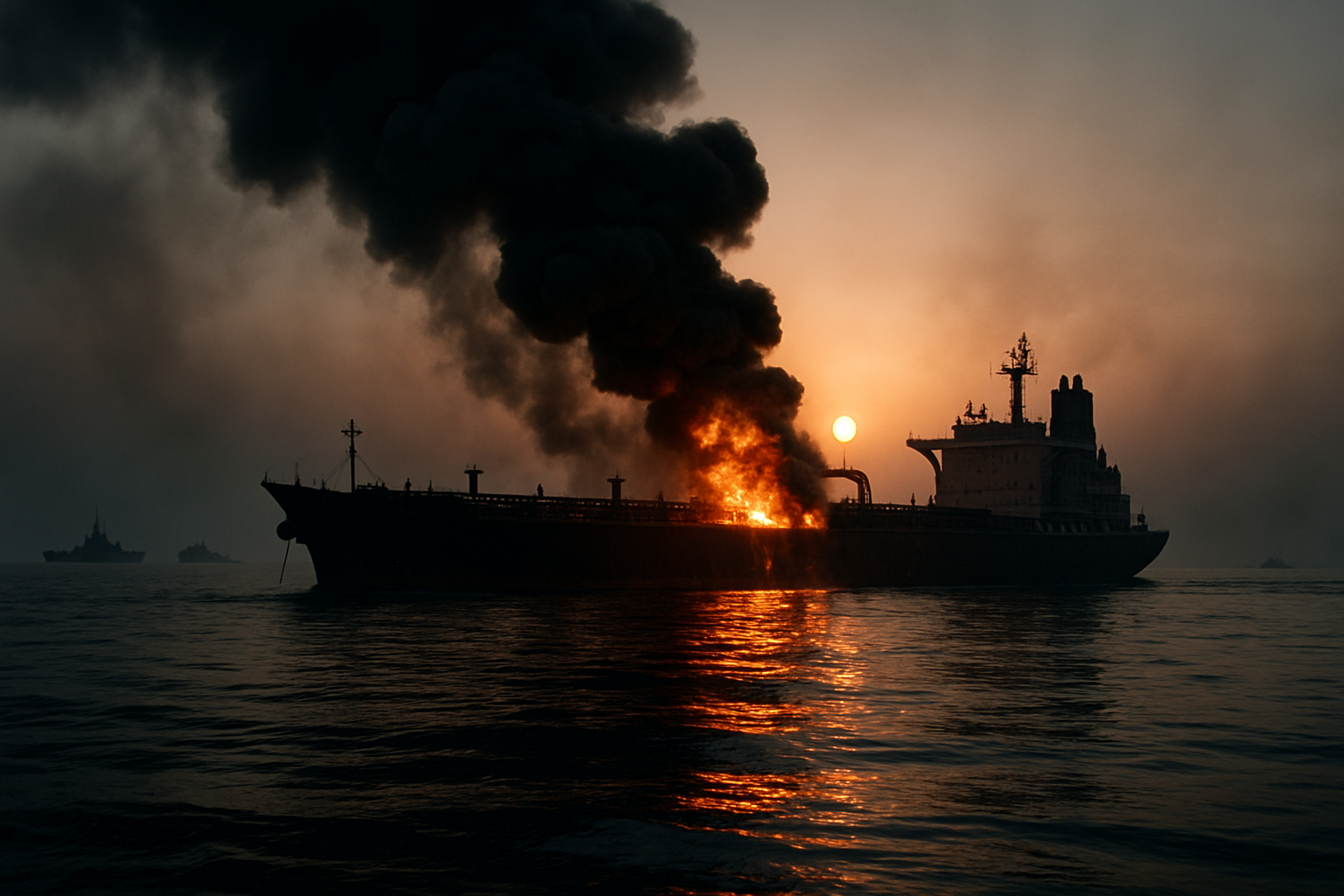
Iranian forces launched three missiles toward Qatari assets in territorial waters, with two successfully intercepted and one striking an oil tanker chartered to QatarEnergy, escalating maritime tensions in the volatile Persian Gulf region.
Qatar's Defense Ministry confirmed Wednesday that Iranian missiles targeted the QatarEnergy-chartered fuel oil tanker in Qatari waters, causing damage to the vessel but no casualties. The attack represents a dangerous escalation in regional maritime tensions that have already disrupted global energy markets and shipping lanes.
Attack Details and Response
According to Qatar's Defense Ministry, Iranian forces fired three missiles toward Qatari maritime assets, demonstrating the country's effective defense capabilities when two projectiles were intercepted before reaching their targets. The third missile successfully struck the tanker, which was operating under charter to QatarEnergy, the state energy company.
"There were no casualties reported in the incident," the Defense Ministry stated, emphasizing that while the vessel sustained damage, all crew members remained safe. Qatari authorities launched an immediate investigation into the attack while coordinating with international maritime security agencies.
"This unprovoked attack on a civilian vessel in our territorial waters represents a clear violation of international maritime law and threatens the safety of commercial shipping in the region."
— Qatar Defense Ministry Official
Regional Context and Escalation
The attack occurs against the backdrop of the most severe energy crisis since the 1970s oil shocks, triggered by Iran's Revolutionary Guard declaring the Strait of Hormuz "unsafe for shipping." This critical waterway handles 40% of global seaborne oil transit, and its effective closure has sent oil prices surging past $100 per barrel for the first time since 2022.
The incident follows a pattern of Iranian attacks under "Operation True Promise 4," where the Islamic Revolutionary Guard Corps has declared "no red lines remain" in targeting assets associated with what it considers hostile nations. Regional casualties have mounted across Gulf states as Iranian forces systematically target infrastructure and maritime assets.
Recent Iranian attacks have struck multiple Gulf nations: the UAE reported one civilian killed in Abu Dhabi, Kuwait suffered 32 injuries from airport strikes, and Qatar has intercepted 65 missiles and 12 drones using Patriot defense systems, resulting in 8 injuries from falling debris.
Impact on Global Energy Markets
The attack comes as Qatar has already halted LNG production at its Ras Laffan and Mesaid facilities following previous Iranian strikes. These facilities represent approximately 20% of global LNG exports, and their shutdown has contributed to natural gas prices exploding by 24% in Europe and 78% in the United States.
Major shipping companies Maersk and MSC have suspended operations in the Persian Gulf, leaving over 150 oil and LNG tankers stranded with billions of dollars in cargo. The maritime crisis has prompted the International Energy Agency to announce its largest strategic petroleum reserve release in 50 years—400 million barrels from 32 countries.
Aviation and Supply Chain Disruption
The maritime tensions have coincided with an unprecedented aviation crisis, with over 18,000 flights cancelled worldwide—the most extensive disruption since COVID-19. Eight Middle Eastern countries have simultaneously closed their airspace, severing critical Asia-Europe air corridors and leaving hundreds of thousands of passengers stranded.
Dubai International Airport, the world's busiest with 86 million passengers annually, remains completely shut down due to missile damage, while major carriers including Emirates, Air France-KLM, and Wizz Air have suspended operations indefinitely.
International Response
The attack on the Qatari vessel has prompted renewed calls for international maritime protection in the Persian Gulf. European nations have deployed unprecedented naval coalitions to protect Cyprus following Iranian drone strikes on RAF Akrotiri—the first attack on European territory since World War II.
HMS Dragon leads a multinational coalition including Spanish frigates and vessels from Italy, France, the Netherlands, and Greece in what represents the largest Eastern Mediterranean naval mobilization since 1974.
The crisis has also strained traditional regional alliances, with the unprecedented Saudi-UAE-Qatar-Egypt diplomatic consensus severely threatened as Iranian attacks directly target member territories. Egyptian President Abdel Fattah el-Sisi condemned attacks on "sisterly Arab countries," warning of "comprehensive chaos" spreading throughout the region.
Diplomatic Breakdown
The maritime attacks follow the complete collapse of US-Iran nuclear negotiations, despite February's Geneva breakthrough that achieved the most progress since the 2018 JCPOA collapse. Fundamental disagreements over scope—Iran's exclusion of ballistic missiles and proxy groups as "red lines" versus US demands for comprehensive agreements—proved insurmountable.
Iran continues uranium enrichment at 60% purity with over 400 kilograms of weapons-grade material, sufficient for multiple nuclear weapons if weaponized. The nuclear governance crisis has been exacerbated by the February expiration of New START, creating the first gap in US-Russia nuclear constraints in over 50 years.
Looking Ahead
The attack on the QatarEnergy tanker represents another dangerous escalation in what UN Secretary-General António Guterres has called "the greatest test of multilateral cooperation in the modern era." With oil prices heading toward $150 per barrel warnings and Gulf states threatening force majeure declarations, the crisis affects not just regional security but global economic stability.
Energy experts warn that the current crisis exposes dangerous over-dependence on strategic chokepoints, requiring fundamental restructuring of global energy architecture. The 21-mile Strait of Hormuz has become a single-point failure in modern logistics, with no realistic alternatives for regional oil exports.
As international evacuations continue on a scale not seen since the Arab Spring, the maritime crisis in the Persian Gulf threatens to reshape global energy security, supply chain resilience, and conflict resolution approaches for decades to come.