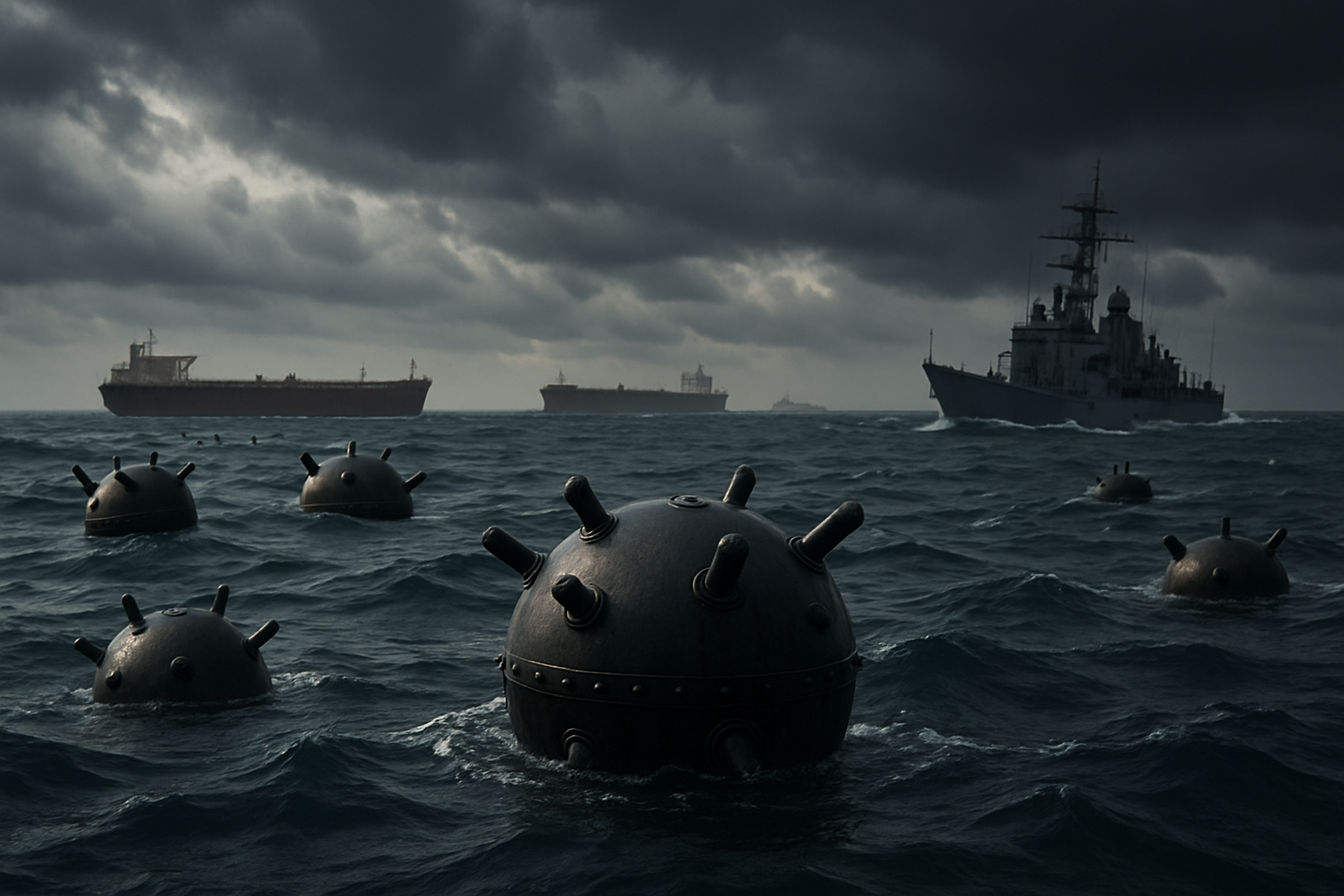
Iran's Defence Council issued stark warnings Monday that any attack on the Islamic Republic's coasts or islands will trigger the systematic mining of Persian Gulf shipping routes and comprehensive strikes against regional infrastructure, representing the most severe escalation threat since the current Middle East crisis began.
The unprecedented warning, delivered through state media outlets and confirmed by multiple international sources, marks a dangerous new phase in Iran's confrontation with the United States and Israel. Tehran explicitly threatened to deploy "various types of sea mines, including floating mines that can be released from the coast" if subjected to land invasion or attacks on its energy facilities.
Scale and Scope of Iranian Threats
According to reports from Fars News Agency and other Iranian media, the Defence Council declared that "the entire Gulf will practically be in a situation similar to the Strait of Hormuz for a long time" if attacks on Iranian territory proceed. The warning specifically references Iran's demonstrated ability to deploy between 2,000-6,000 naval mines, effectively weaponizing the critical waterway that handles 40% of global seaborne oil transit.
The threat extends beyond naval mining to encompass systematic attacks on electrical plants and water infrastructure throughout Gulf Arab states. Iranian officials warned that if the United States and Israel strike Iranian power facilities, Tehran will retaliate by targeting "all US/Israeli energy facilities, IT infrastructure, desalination plants throughout the Middle East."
"Any attempt to attack Iran's coasts or islands will cause all access routes in the Gulf to be mined with various types of sea mines, including floating mines that can be released from the coast."
— Iranian Defence Council Statement
The Iranian statement ominously referenced the "failure of more than 100 minesweepers in the 1980s" during the Iran-Iraq War, suggesting confidence in their ability to sustain a prolonged mining campaign against international naval forces.
Context of Escalating Crisis
These threats emerge as President Trump issued a 48-hour ultimatum demanding Iran "fully open, without threat, the Strait of Hormuz" or face attacks on Iranian power plants "starting with the biggest one first." The ultimatum represents the most explicit threat to civilian infrastructure since the crisis began following the collapse of nuclear negotiations in Geneva.
The current crisis stems from the complete breakdown of US-Iran nuclear talks despite achieving a "broad agreement on guiding principles" in February 2026 - the most significant diplomatic progress since the JCPOA collapse in 2018. Fundamental disagreements over scope proved insurmountable, with Iran excluding ballistic missiles and regional proxies as "red lines" while the US demanded comprehensive agreements covering missiles, armed groups, and human rights.
Iran continues uranium enrichment at 60% purity with over 400 kilograms of material, approaching the 90% threshold needed for weapons-grade uranium. Intelligence assessments suggest sufficient material exists for multiple nuclear weapons if weaponized.
Global Energy and Security Implications
The Iranian threats carry catastrophic implications for global energy markets, already experiencing severe disruptions. Oil prices have surged past $100 per barrel for the first time since 2022, with Brent crude reaching $119.50 and WTI hitting $108.15 in record single-day jumps. The International Energy Agency has released a record 400 million barrels from strategic petroleum reserves - the largest intervention in the agency's 50-year history.
The Persian Gulf's strategic importance cannot be overstated. The 21-mile-wide Strait of Hormuz represents a single-point failure for modern global logistics, with no realistic alternative transit routes for the massive volumes of oil and liquefied natural gas that flow through the waterway daily.
Current disruptions have already triggered unprecedented responses:
- Over 18,000 flights cancelled worldwide - the most severe aviation crisis since COVID-19
- Eight countries maintaining simultaneous airspace closures
- Dubai International Airport, the world's busiest, remains shut due to missile damage
- Over 150 oil and LNG tankers stranded in the Persian Gulf with billions in cargo
- Major shipping companies Maersk and MSC have suspended all Gulf operations
Regional Coalition Under Pressure
Iran's systematic targeting strategy has severely strained the unprecedented regional coalition that initially supported diplomatic solutions. Saudi Arabia, the UAE, Qatar, and Egypt had formed extraordinary Middle Eastern consensus backing negotiations, but Iranian retaliation attacks on member territories have threatened this unity.
Recent Iranian strikes have caused casualties across the region: one civilian killed in Abu Dhabi, 32 injured in Kuwait airport strikes, and eight wounded in Qatar despite Patriot missile intercepts of 65 missiles and 12 drones. Egyptian President Sisi condemned attacks on "sisterly countries" while warning of "comprehensive chaos" spreading throughout the region.
The conflict has now expanded to European territory for the first time since World War II, with Iranian drones striking RAF Akrotiri in Cyprus. This unprecedented attack prompted a naval coalition response involving HMS Dragon and frigates from Spain, Italy, France, the Netherlands, and Greece. The European Union activated its ESTIA evacuation mechanism for the first time in the bloc's history.
Military and Economic Consequences
Operation Epic Fury, the largest US-Israeli military campaign since 2003, has cost $11.3 billion in its first week alone, with Pentagon operations planned through September 2026 - far beyond the initially projected 4-6 week timeline. The human cost continues mounting with 150 US troops wounded (8 critical) and 3 confirmed killed.
The USS Charlotte submarine achieved a historic milestone by sinking the Iranian frigate IRIS Dena - the first enemy vessel sunk by a US submarine since World War II. Iran's Revolutionary Guards have responded with "Operation True Promise 4," maintaining their doctrine that "no red lines remain" in their systematic targeting campaign.
Financial markets reflect the crisis severity with Pakistan's KSE-100 recording its largest single-day decline in history (-8.97%) and South Korea's KOSPI falling 12% with circuit breakers triggered. The Korean won hit a 17-year low, while major IPOs including PayPal's $1.1 billion offering have been postponed indefinitely.
Nuclear Governance Crisis Context
The Iranian mining threats occur against the backdrop of a broader nuclear governance crisis. The New START treaty expired in February 2026, marking the first time in over 50 years without US-Russia nuclear constraints. Combined with China's nuclear expansion and Iran's advancing uranium enrichment, UN Secretary-General António Guterres warns that nuclear risks are at their "highest in decades."
The succession crisis following Supreme Leader Ali Khamenei's death on March 1 has resulted in Mojtaba Khamenei becoming Iran's first hereditary Supreme Leader in the Islamic Republic's 47-year history. Intelligence assessments suggest the Revolutionary Guards have consolidated unprecedented control, representing a shift from clerical to military governance during active warfare.
International Response and Evacuations
The crisis has triggered the largest international evacuation since the Arab Spring of 2011, with Australia reporting 115,000 citizens trapped in the region and Germany attempting to evacuate 30,000 stranded nationals. Multiple countries have ordered immediate evacuations from Iran, citing "extremely uncertain" security conditions.
Congressional opposition in the United States is mounting, with only 25% American support for the conflict - described as "almost unprecedented" unpopularity for early-stage military operations. Senator Richard Blumenthal expressed being "more concerned than ever" about potential ground troop deployments.
Template-Setting Crisis for 21st Century
UN Secretary-General Guterres described the current situation as "the greatest test of multilateral cooperation in the modern era." The rapid transition from diplomatic framework to military confrontation demonstrates the fragility of crisis management in the multipolar era.
The stakes extend far beyond the immediate region. Success in containing the crisis could provide a nuclear dispute resolution framework and strengthen diplomatic precedents globally. Failure may accelerate military solutions in international disputes for decades, encourage nuclear proliferation worldwide, and undermine diplomatic credibility for future territorial and security conflicts.
Looking Forward
Iran's threats to mine the Persian Gulf and systematically target regional infrastructure represent a potential point of no return in the current crisis. The warning explicitly targets the economic lifelines of Gulf Arab states while threatening the global energy supply chain that underpins the world economy.
The international community faces a critical decision point: whether diplomatic engagement can still provide pathways to de-escalation, or whether the crisis will expand into the most dangerous military confrontation since the Cold War ended. The outcome will establish precedents for 21st-century conflict resolution, energy security planning, and international cooperation mechanisms for decades to come.
As oil prices continue their upward trajectory toward analysts' warnings of $150-200 per barrel, and with supply chain disruptions affecting manufacturing from automotive to electronics globally, the Iranian threat represents more than a regional crisis - it poses a fundamental challenge to the interconnected global economy built around stable energy transit through strategic chokepoints.