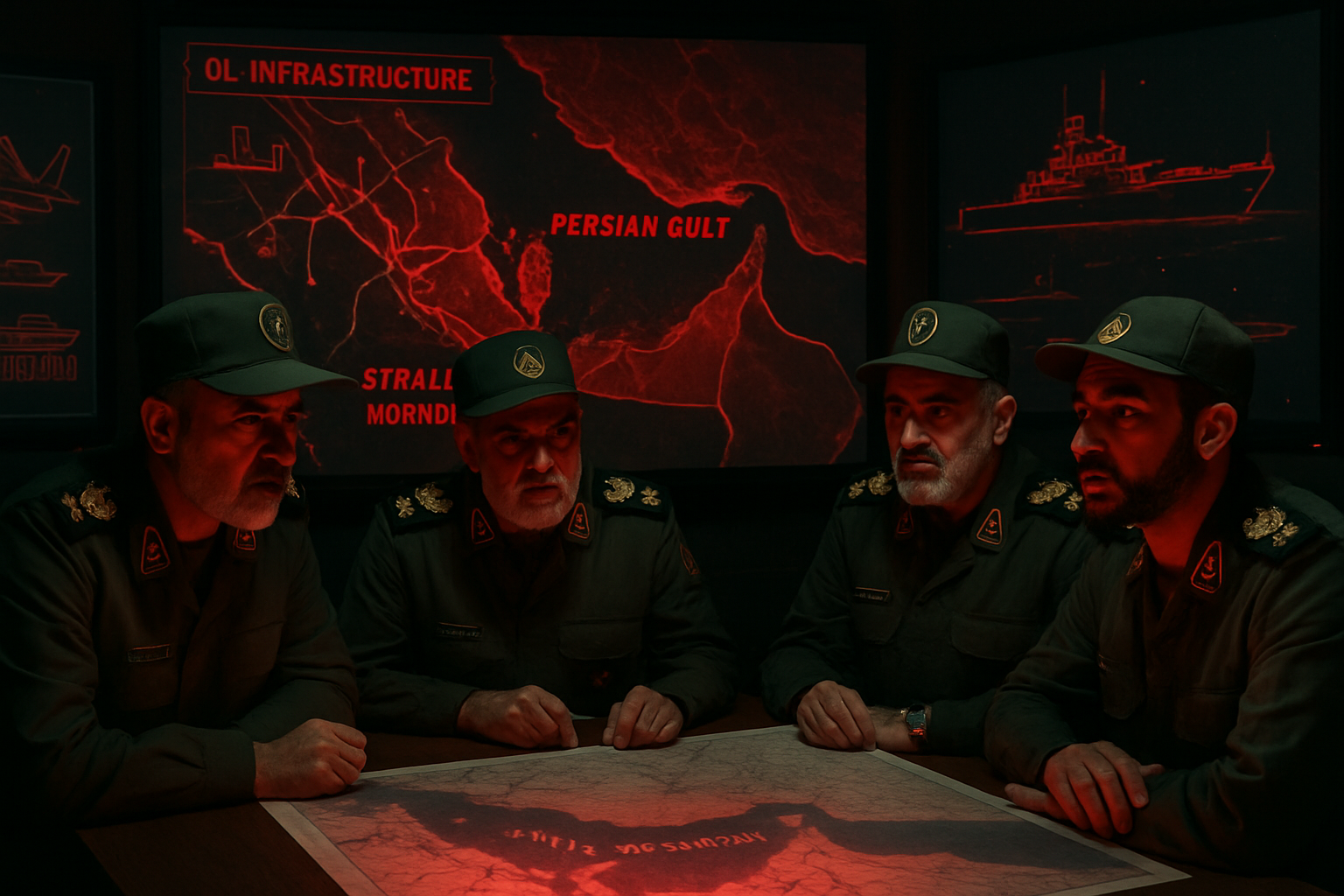
Iranian armed forces have issued stark warnings of retaliation against oil and energy infrastructure linked to the United States, following President Donald Trump's announcement that American forces destroyed military targets on Iran's main oil hub of Kharg Island.
The threats, delivered through Iranian state media on Saturday, mark a dramatic escalation in what has become the most dangerous international crisis since the Cold War ended. Iran's military declared that any attack on the Islamic Republic's oil and energy infrastructure would lead to immediate strikes on energy facilities owned by companies cooperating with the United States across the Middle East region.
Kharg Island Under Fire
President Trump confirmed Friday evening that U.S. forces had "completely destroyed" military targets on Iran's Kharg Island, the critical export terminal that handles approximately 90% of Iran's oil shipments. The island, located 300 miles northwest of the strategically vital Strait of Hormuz, processes 1.6 million barrels per day and represents Iran's economic lifeline in the Persian Gulf.
Trump emphasized that while military installations were targeted, oil infrastructure was deliberately spared "out of consideration," though he warned of immediate reconsideration if Iran continues disrupting shipping through the Strait of Hormuz. The waterway carries 40% of global seaborne oil transit, making it one of the world's most critical energy chokepoints.
"We destroyed every military target on that island, but we were very careful not to hit their oil facilities," Trump stated. "That could change very quickly if they keep interfering with shipping."
— President Donald Trump
Iran's Sweeping Retaliation Threat
The Iranian Revolutionary Guard Corps (IRGC) responded with unprecedented threats, warning through official channels that "all economic centers" in the Middle East would become legitimate targets. Iranian military officials specifically threatened to attack energy infrastructure belonging to oil companies that maintain cooperative relationships with the United States in the region.
The threats extend Iran's previously declared "Operation True Promise 4" retaliation campaign, which has already caused casualties across multiple Gulf states. Under the policy of "no red lines remain," Iran has systematically targeted U.S. facilities and allies since the commencement of Operation Epic Fury, the largest coordinated U.S.-Israeli military campaign since 2003.
Global Energy Crisis Deepens
The latest escalation has sent shockwaves through global energy markets, with oil prices surging past $80 per barrel—a 10% increase from previous levels. Iran has declared the Strait of Hormuz "unsafe for shipping," effectively closing the waterway that carries 40% of global oil transit.
Major shipping companies Maersk and MSC have suspended operations in the Persian Gulf, leaving more than 150 oil and LNG tankers stranded with billions of dollars in cargo. Natural gas prices have exploded by 24% in Europe and 78% in the United States, while Qatar has halted LNG production following Iranian infrastructure attacks, threatening 20% of global LNG exports.
The aviation industry faces parallel chaos, with over 18,000 flights cancelled worldwide—the most extensive disruption since COVID-19. Eight countries have simultaneously closed their airspace, including Iran, Iraq, Israel, UAE, Qatar, Syria, Kuwait, and Bahrain, severing critical Asia-Europe air corridors.
Regional Coalition Under Strain
The escalating conflict has severely strained the unprecedented Middle Eastern coalition that had previously backed diplomatic efforts. Saudi Arabia, UAE, Qatar, and Egypt had formed an extraordinary consensus supporting negotiations, but Iranian retaliation targeting their territories has tested these relationships.
Egyptian President Abdel Fattah el-Sisi condemned attacks on "sisterly Arab countries," warning of "comprehensive chaos" if the conflict continues to expand. The UAE reported one civilian killed in Abu Dhabi, while Kuwait confirmed 32 foreign nationals injured in airport drone strikes.
Nuclear Diplomacy Collapse
The military escalation follows the complete breakdown of nuclear negotiations despite a February breakthrough in Geneva that achieved "broad agreement on guiding principles"—the most significant diplomatic progress since the 2018 JCPOA collapse. However, fundamental scope disagreements proved insurmountable, with Iran excluding ballistic missiles and regional proxies as "red lines" while demanding nuclear-only talks, versus U.S. demands for comprehensive agreements including missiles, armed groups, and human rights.
Iran continues enriching uranium at 60% purity, approaching the 90% weapons-grade threshold, with over 400 kilograms of enriched material—sufficient for multiple weapons if weaponized. The collapse occurs amid a broader nuclear governance crisis, as the New START treaty expired February 5, 2026, marking the first time in over 50 years without U.S.-Russia nuclear constraints.
International Response
The crisis has prompted the largest international evacuation since the Arab Spring of 2011, with Australia reporting 115,000 nationals trapped and Germany evacuating 30,000 tourists. The European Union activated its ESTIA evacuation plan for Cyprus for the first time after Iranian drones struck RAF Akrotiri—the first attack on European territory since World War II.
UN Secretary-General António Guterres has called the situation "the greatest test of multilateral cooperation in crisis management of the modern era," while emergency Security Council sessions continue amid strong condemnations from Russia and China of what they term violations of international law.
Economic and Strategic Implications
The conflict has exposed fundamental vulnerabilities in global energy architecture, with the Persian Gulf's role extending far beyond oil to LNG exports, manufacturing supply chains, and shipping routes connecting Asia and Europe. Stock markets worldwide have crashed, with Pakistan's KSE-100 suffering its largest single-day decline in history at -8.97%.
Defense analysts note that Iran's threats against U.S.-linked energy infrastructure could potentially target facilities across the Gulf region, where American companies have significant investments and partnerships. The breadth of Iran's warning suggests a strategy aimed at economic warfare rather than purely military objectives.
Trump Administration Response
The Trump administration has maintained its position demanding Iran's "unconditional surrender," with the President claiming the right to personally choose Iran's next Supreme Leader following the confirmed death of Ali Khamenei on March 1. This represents the most direct assertion of American control over Iranian affairs since the 1979 revolution.
Congressional scrutiny is intensifying, with bipartisan lawmakers demanding answers on strategy, costs, and the potential for ground troop deployment. Senator Richard Blumenthal expressed being "more concerned than ever" about the possibility of boots on the ground, as Pentagon operations are prepared through September—far beyond Trump's initial timeline.
Historical Significance
The March 2026 crisis represents a watershed moment in Middle Eastern geopolitics, with implications extending decades beyond current events. The rapid transition from diplomatic framework to military escalation demonstrates the fragility of crisis management in the multipolar era.
Success in containing the conflict could provide a template for nuclear crisis resolution and regional stability. Failure may accelerate military solutions, reshape Middle Eastern geopolitics for decades, encourage nuclear proliferation elsewhere, and undermine diplomatic credibility for future international disputes.
As the world watches this template-setting moment unfold, the stakes include regional war prevention, global energy security, nuclear governance credibility, and international law enforcement—all tested simultaneously in what experts describe as the most dangerous international crisis since the Cold War's end.