The United States has extended its ceasefire with Iran to April 26, but the temporary truce faces its gravest threat yet as Iran's Revolutionary Guard seized multiple commercial vessels in the Strait of Hormuz on Wednesday while categorically rejecting further negotiations under what Tehran calls "the shadow of threats."
The extension comes as Iran's Parliament Speaker Mohammad Bagher Ghalibaf warned that Tehran is prepared to demonstrate "a new balance of power on the battlefield" with prepared "new cards," signaling a dangerous escalation in the world's most critical waterway that handles 40% of global oil transit.
Revolutionary Guard Seizes Multiple Vessels
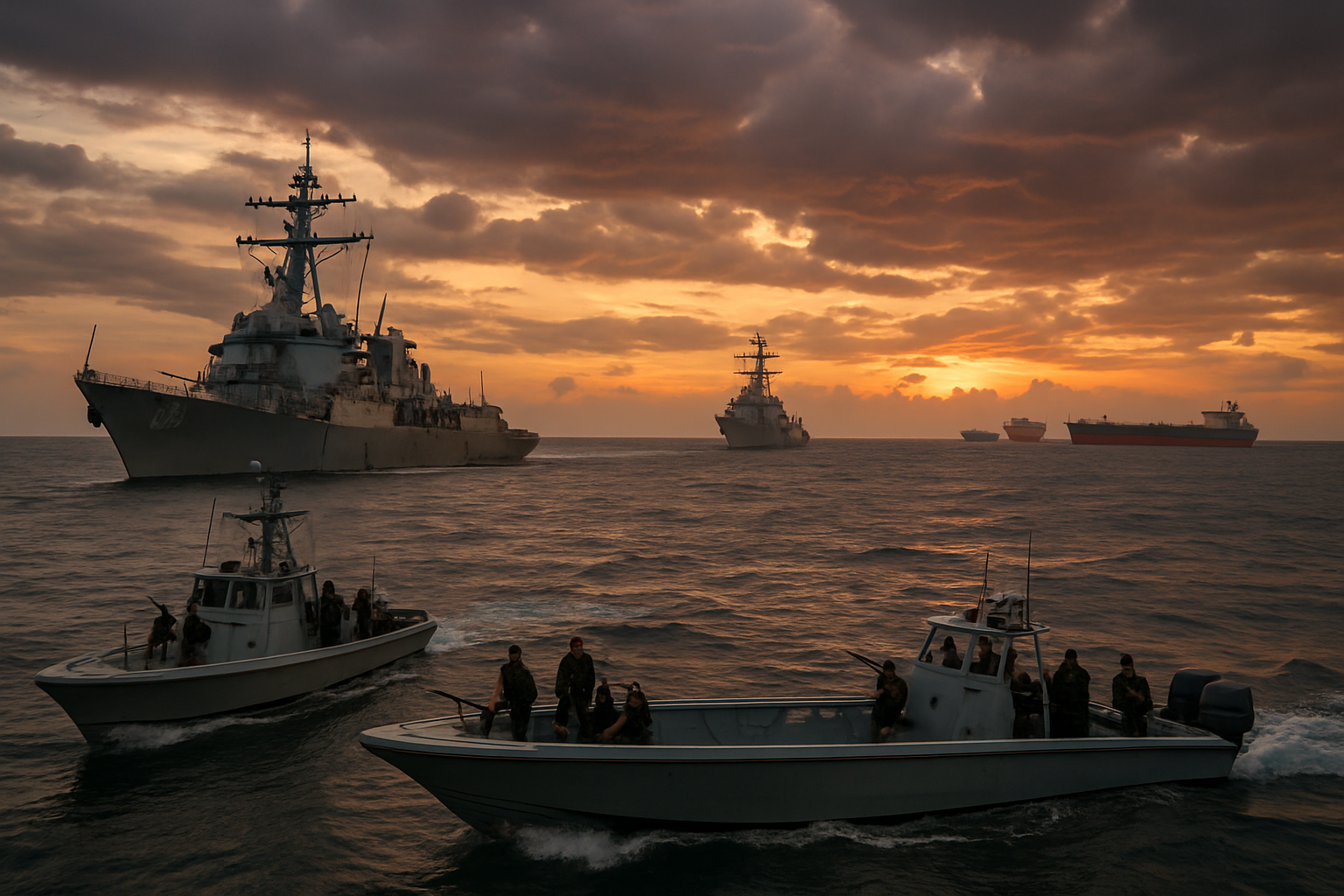
Iranian forces targeted three container ships on Wednesday, seizing two and firing on a third, according to global security monitors and the Revolutionary Guards. The Iranian vessels MSC Francesca and Epaminondas were taken into Iranian custody for "operating without authorization and tampering with navigation systems," according to an IRGC statement.
British maritime security agency UKMTO confirmed that an Iranian gunboat fired at a container ship off the coast of Oman without warning, causing "heavy damage to the bridge" but no fires or environmental impact. The master of the Epaminondas, operated by Greek shipping company Technomar, confirmed that all crew members are safe.
The Revolutionary Guard justified the seizures, claiming the vessels were "attempting covert exit" and violating Iran's blockade of the route. "Any disruption of order and security in the Strait of Hormuz is our red line," declared IRGC naval command.
Trump Extends Ceasefire Indefinitely
President Trump announced the extension via Truth Social, stating the ceasefire will continue "until such time as their leaders and representatives can come up with a unified proposal." The decision came at the request of Pakistani Prime Minister Shehbaz Sharif and Field Marshal Asim Munir, who successfully mediated the historic breakthrough in April.
White House Press Secretary Karoline Leavitt clarified there is "no hard deadline" for Iran's response, contradicting earlier reports suggesting Trump would give Tehran only "3-5 days." She emphasized that "it will be up to President Trump to decide on the future of the truce."
However, the US continues to maintain its naval blockade of Iranian ports, which Iran considers an "act of war" under international law, while demanding comprehensive negotiations covering Iran's nuclear program, ballistic missiles, and regional proxy activities.
Iran Categorically Rejects Negotiations
Iran's Foreign Ministry spokesman Esmaeil Baghaei declared there are "no plans for further negotiations with the United States," citing "excessive demands, unrealistic expectations, and the ongoing naval blockade." This represents a significant hardening of Iran's position from earlier diplomatic openings.
Ghalibaf went further, warning that Iran will not negotiate "under the shadow of threats" and threatening to reveal "new cards" that could alter "the balance of power on the battlefield." The Iranian leadership maintains that reopening the Strait of Hormuz is "impossible as long as the ceasefire is openly violated" by the US naval blockade.
"The reopening of the Strait of Hormuz is impossible as long as the ceasefire is openly violated by a naval blockade."
— Mohammad Bagher Ghalibaf, Iranian Parliament Speaker
Pakistan's Historic Mediation Framework Under Threat
The current crisis threatens to unravel Pakistan's remarkable diplomatic achievement. The "Islamabad Accord" framework, brokered by PM Shehbaz Sharif and Field Marshal Asim Munir, achieved a ceasefire just 88 minutes before Trump's "whole civilization will die tonight" deadline on April 8.
That breakthrough crashed oil prices by 20% from $119.50 to $100 per barrel, ended the cancellation of 18,000+ flights, and represented the most direct US-Iran diplomatic engagement since the 1979 Islamic Revolution. Pakistan's innovative "message relay system" demonstrated how middle powers can bridge major adversaries when traditional mechanisms fail.
Chinese support proved crucial during the mediation, with Foreign Minister Wang Yi providing "full support" for Pakistan's initiative. Germany also noted "positive signs" during the diplomatic process, highlighting international backing for the peace framework.
Nuclear Sticking Points Remain Unchanged
The fundamental disagreements that led to the collapse of the 21-hour marathon talks in Islamabad on April 12-13 remain unresolved. The US demands that Iran suspend its uranium enrichment to 60% purity and abandon its stockpile of over 400 kilograms of weapons-grade material sufficient for multiple nuclear devices.
Iranian Foreign Minister Abbas Araghchi maintains Iran's position: "Iran will never abandon enrichment even if war is imposed." This represents the same structural obstacle that has prevented breakthroughs since the collapse of the JCPOA nuclear deal in 2018.
The stakes are heightened by the expiration of the New START treaty between the US and Russia in February 2026, marking the first time in over 50 years that the superpowers lack nuclear constraints. UN Secretary-General António Guterres has called this "the greatest test of multilateral cooperation in the modern era."
The Lebanon Loophole Crisis
A critical factor undermining the ceasefire is Israeli Prime Minister Benjamin Netanyahu's explicit exclusion of Lebanon from the Pakistan-mediated agreement. Israeli strikes killed over 254 people in a single day during the April talks, displacing 1.2 million Lebanese civilians—25% of the population.
Iran has demanded comprehensive enforcement on all fronts, threatening withdrawal from negotiations unless the violence against Iranian-backed Hezbollah forces ends. VP JD Vance acknowledged Iran's "legitimate misunderstanding" about Lebanon's inclusion, but the US never agreed to include Israeli operations against Hezbollah in the ceasefire framework.
International Coalition Fractures
The crisis has exposed deep divisions within traditional alliances. NATO allies have largely rejected Trump's demands for broader military support, with UK Prime Minister Keir Starmer declaring Britain "will not be dragged into an Iran war." France and Germany have emphasized diplomatic approaches over military solutions.
Australia and Japan declined to provide naval vessels, representing the most significant rejection of American military leadership since the Iraq War in 2003. Only Israeli Prime Minister Netanyahu has offered "full support and close coordination" with US operations, highlighting the isolation of American policy.
Global Economic Stakes
The ship seizures have sent oil markets surging, with Brent crude reaching $106.04 and WTI hitting $104.29—the second time in 2026 that prices have exceeded $100 per barrel. Iran's deployment of 2,000-6,000 naval mines in the Strait of Hormuz has effectively created a maritime death trap for commercial vessels.
Major shipping companies Maersk and MSC have suspended Persian Gulf operations indefinitely, leaving over 150 oil tankers stranded with billions of dollars in cargo. The International Energy Agency continues to maintain its record strategic petroleum reserve release of 400 million barrels—the largest intervention in the agency's 50-year history.
The crisis threatens to reverse the consumer relief that began with the April ceasefire breakthrough. Bangladesh faces renewed fuel rationing affecting 170 million people, Pakistan confronts wartime austerity measures, and European households face surging heating costs as Qatar's LNG exports—representing 20% of global supply—remain disrupted.
Congressional Opposition Reaches Historic Levels
Operation Epic Fury has encountered unprecedented domestic opposition, with only 25% of Americans supporting the military action—historic lows for any conflict. Senator Richard Blumenthal has expressed being "more concerned than ever" about potential ground troop deployment.
The operation has cost $11.3 billion in its first week alone, with Pentagon officials projecting operations through September—far beyond initial 4-6 week timelines. Financial markets have become "the ultimate constraint," with Pakistan's stock exchange suffering its largest single-day decline in history at -8.97%.
Humanitarian Crisis Continues
The Iranian Red Crescent reports over 787 civilian casualties from US-Israeli strikes, including a Pentagon-confirmed elementary school strike that killed 165-185 students due to "outdated targeting data." War crimes investigations are now underway into systematic civilian targeting.
International evacuations have reached Arab Spring-scale proportions, with Australia reporting 115,000 citizens trapped in the region and Germany evacuating 30,000 nationals. The European Union activated its ESTIA crisis mechanism for the first time in bloc history after Iranian drones struck RAF Akrotiri in Cyprus—the first attack on European territory since World War II.
Regional Coalition Under Maximum Strain
The traditional Middle Eastern coalition of Saudi Arabia, UAE, Qatar, and Egypt remains intact but faces maximum pressure. Iranian "Operation True Promise 4" attacks targeted these territories directly: one killed in Abu Dhabi, 32 injured at Kuwait airports, and eight wounded in Qatar despite Patriot missile intercepts of 65 missiles and 12 drones.
Egyptian President Abdel Fattah el-Sisi's warnings of "comprehensive chaos among sisterly countries" have proven increasingly prophetic as diplomatic failures mount and military escalation threatens regional stability.
"We are going into some very demanding months. The US and Iran are fighting in one of the world's most important oil routes while sailors plead to be allowed safe passage."
— Norwegian maritime analyst, as reported in VG
Ukrainian Military Involvement
In an unexpected development, Ukrainian military officials are participating in a London conference to discuss ways to reopen the Strait of Hormuz, according to Ukraine's state news agency Ukrinform. This demonstrates the global reach of the crisis and the international effort required to resolve the maritime blockade.
Template-Setting Crisis for the 21st Century
The Iran-US confrontation represents what UN Secretary-General Guterres calls "the greatest test of multilateral cooperation in the modern era." The crisis simultaneously affects territorial sovereignty, energy security architecture, nuclear governance credibility, and international law enforcement mechanisms.
Success in containing the conflict could provide a framework for 21st-century nuclear crisis resolution, strengthening diplomatic credibility over military escalation. Failure risks accelerating military solutions as the preferred approach to international disputes, encouraging proliferation and undermining diplomatic mechanisms worldwide.
Pakistan's mediation demonstrates that middle powers can play crucial roles in bridging major adversaries when traditional great power mechanisms fail. The innovative "message relay system" has become a template for crisis management in an increasingly multipolar world.
Critical Juncture Ahead
The extension of the ceasefire to April 26 creates a narrow window for diplomatic breakthrough, but fundamental disagreements over Iran's nuclear program, regional conflicts, and the Lebanon question remain unresolved. Iran's categorical rejection of negotiations under US pressure, combined with continued ship seizures in the Strait of Hormuz, signals a dangerous escalation.
The world now faces a critical choice between diplomatic innovation and military confrontation that could reshape international relations for decades. The stakes extend far beyond bilateral US-Iran tensions, affecting global energy security, nuclear proliferation mechanisms, and the sustainability of the post-World War II international order.
As Iranian forces demonstrate their "complete control" over the world's most critical maritime chokepoint, and Trump maintains his naval blockade while demanding "unconditional surrender," the coming days will determine whether Pakistani diplomatic innovation can bridge decade-old disagreements or whether the world returns to the most dangerous international crisis since the Cold War.