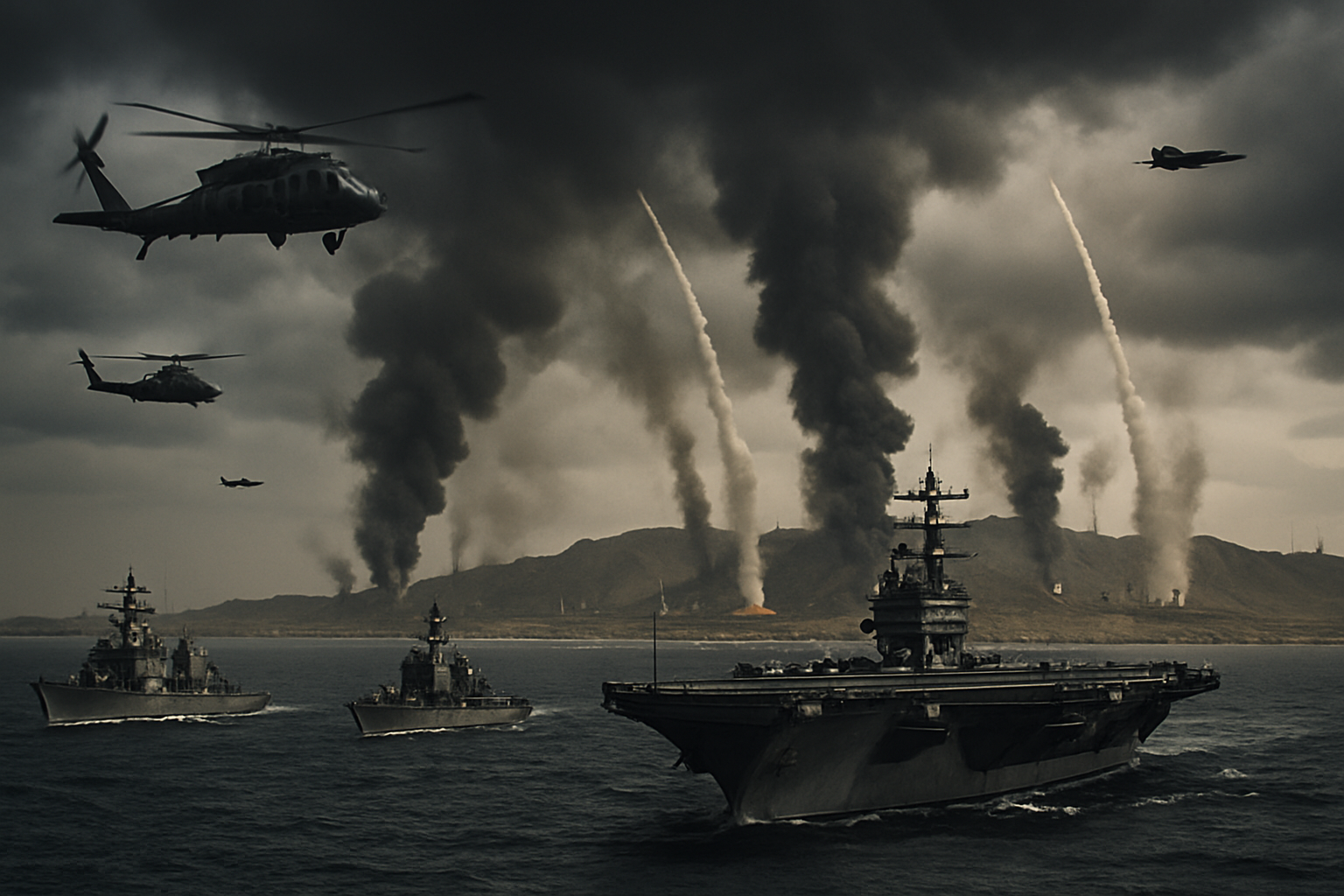
Iranian forces shot down a US F-15E fighter jet over southwestern Iran, triggering a high-stakes rescue mission as military confrontations between Tehran and Washington reach unprecedented levels with far-reaching implications for global energy security and regional stability.
The downing of the American aircraft marks a significant escalation in the months-long crisis that began with failed nuclear negotiations and has now evolved into active military engagement affecting multiple nations across the Middle East. Footage obtained by international media shows Iranian forces firing at low-flying US helicopters conducting search and rescue operations in the area where the F-15E was brought down.
Nuclear Diplomacy Collapse Leads to Military Action
The current military escalation stems from the complete breakdown of nuclear negotiations that had shown unprecedented promise earlier this year. Despite achieving what Iranian Foreign Minister Abbas Araghchi described as "broad agreement on guiding principles" during Geneva talks mediated by Switzerland and Oman, fundamental disagreements over scope proved insurmountable.
Iran had maintained that ballistic missiles and regional proxy activities were "red lines" that should be excluded from nuclear-only discussions. However, US Secretary of State Marco Rubio insisted on a comprehensive agreement addressing missiles, armed groups, and human rights issues alongside nuclear concerns.
"Iran will never abandon uranium enrichment even if war is imposed upon us,"
— Abbas Araghchi, Iranian Foreign Minister
The negotiations collapsed despite Iran's uranium enrichment continuing at 60% purity - significantly above the 3.67% limit established in the 2015 Joint Comprehensive Plan of Action (JCPOA) and approaching the 90% threshold required for weapons-grade material. Intelligence assessments suggest Iran possesses sufficient enriched uranium for multiple weapons if weaponized.
Global Aviation and Shipping Crisis
The military confrontation has triggered the most severe global transportation crisis since COVID-19, with over 18,000 flights cancelled worldwide. Eight Middle Eastern countries have simultaneously closed their airspace to civilian traffic, including Iran, Iraq, Israel, UAE, Qatar, Syria, Kuwait, and Bahrain.
Dubai International Airport, the world's busiest with 86 million passengers annually, remains closed due to missile damage. Major carriers including Emirates, Air France-KLM, Wizz Air, and Bulgaria Air have suspended Middle East operations indefinitely, affecting hundreds of thousands of passengers globally.
The Strait of Hormuz, through which 40% of the world's seaborne oil transits, has become a critical flashpoint. Iran has declared the vital waterway "unsafe for shipping," with reports indicating the deployment of between 2,000 and 6,000 naval mines. More than 150 oil and LNG tankers worth billions of dollars in cargo remain stranded in Persian Gulf waters.
Regional Retaliation Spreads Conflict
Iran's "Operation True Promise 4" has systematically targeted multiple nations across the region under a declared policy of "no red lines remain." The retaliation has caused casualties and damage across several countries:
- UAE: One civilian killed in Abu Dhabi from missile shrapnel
- Kuwait: 32 people injured in drone strikes on airport facilities
- Qatar: Eight wounded despite Patriot missile systems intercepting 65 missiles and 12 drones
- Cyprus: RAF Akrotiri military base struck - the first attack on European territory since World War II
Iraqi media reports indicate that more than 12 drones attacked Erbil within a 30-minute period, though air defense units successfully intercepted the aircraft. Additionally, Iranian missiles targeted what Iranian media described as an industrial complex affiliated with Israel's Defense Ministry in Beersheba, while Israeli broadcasting reported debris and shrapnel falling at 17 locations across seven central Israeli cities.
Energy Markets in Crisis
Oil prices have surged dramatically, with Brent crude reaching $119.50 and WTI hitting $108.15 per barrel - representing an 18.98% daily increase that marks one of the largest single-day jumps in crude oil history. Natural gas prices have exploded by 24% in Europe and 78% in the United States.
The International Energy Agency has announced its largest strategic petroleum reserve release in its 50-year history, coordinating the deployment of 400 million barrels from 32 member countries - more than double the 182.7 million barrels released during the 2022 Ukraine crisis. Japan is releasing 80 million barrels beginning March 16, its first strategic reserve deployment since the 2011 Fukushima disaster.
International Naval Response
The unprecedented nature of the crisis has prompted an extraordinary international naval coalition response. Following the Iranian attack on Cyprus - the first strike on European territory since World War II - naval vessels from multiple nations have deployed to protect European interests:
- HMS Dragon from the United Kingdom
- Spanish frigates
- Italian, French, Dutch, and Greek naval vessels
French and Japanese ships have successfully crossed the Strait of Hormuz in the first such civilian transit since the conflict began, demonstrating international determination to maintain freedom of navigation through the critical waterway.
US Military Deployment and Casualties
The United States has deployed its most significant Middle Eastern naval presence since the 2003 Iraq invasion, with the USS Gerald R. Ford and USS Abraham Lincoln carrier strike groups - representing approximately one-third of the active US Navy fleet - positioned in the Arabian Sea roughly 800 kilometers from Iran's coast.
The Pentagon has confirmed the first US casualties of the operation, with three service members killed and five wounded. The downing of the F-15E fighter jet and the subsequent rescue mission under fire represent some of the most direct military engagement between US and Iranian forces in decades.

Nuclear Governance Crisis
The collapse of Iran-US nuclear diplomacy occurs against the backdrop of a broader nuclear governance crisis. The New START treaty between the United States and Russia expired on February 5, 2026 - the first time in over 50 years that the world's two largest nuclear powers have operated without bilateral arms control constraints.
UN Secretary-General António Guterres has warned that nuclear risks are at their "highest level in decades," describing the current situation as a "grave turning point" for international security. The failure to resolve the Iranian nuclear issue diplomatically raises serious questions about the viability of negotiated solutions to modern nuclear proliferation challenges.
Economic Ripple Effects
The conflict's economic impact extends far beyond energy markets. Stock exchanges worldwide have experienced severe volatility, with Pakistan's KSE-100 index recording its largest single-day decline in history at -8.97%, while South Korea's KOSPI fell 12%, triggering circuit breakers as the Korean won hit a 17-year low.
Major shipping companies Maersk and MSC have suspended operations in the Persian Gulf, while Qatar Energy has halted LNG production at its Ras Laffan and Mesaid facilities, which account for approximately 20% of global LNG exports. The disruption affects supply chains far beyond the immediate region, impacting manufacturing in automotive, electronics, and textile industries dependent on Gulf-based networks.
Regional Coalition Under Strain
The extraordinary regional coalition of Saudi Arabia, UAE, Qatar, and Egypt that had supported the diplomatic process is now under severe strain following direct Iranian attacks on member territories. Egyptian President Abdel Fattah el-Sisi condemned the attacks on "sisterly Arab countries," warning of "comprehensive chaos" if the situation continues to escalate.
The fracturing of this unprecedented Middle Eastern consensus represents a significant blow to regional stability and demonstrates how quickly diplomatic progress can unravel in the face of military action.
International Evacuation Efforts
The scale of international evacuation efforts represents the largest coordinated civilian evacuation since the Arab Spring of 2011. Australia reports 115,000 citizens trapped in the region, while Germany has 30,000 nationals stranded. The European Union has activated its ESTIA crisis mechanism for the first time in history to coordinate the evacuation of European and third-country nationals from Cyprus.
Multiple countries including Sweden and Serbia have ordered immediate evacuation of their citizens from Iran, citing "extremely uncertain security conditions." The United States has authorized the departure of non-essential embassy personnel from Israel, with Ambassador Mike Huckabee advising staff to leave "today."
Looking Ahead: Template for 21st Century Conflicts
The rapid transition from diplomatic breakthrough to military confrontation represents what experts describe as a "template-setting moment" for 21st-century international relations. The crisis demonstrates the fragility of diplomatic progress in an increasingly multipolar world where traditional conflict prevention mechanisms face unprecedented challenges.
The stakes extend far beyond the immediate region, affecting global energy security, nuclear governance credibility, and the enforcement of international law. The outcome of this crisis will likely influence approaches to territorial disputes, nuclear proliferation, and diplomatic conflict resolution for decades to come.
"This represents the greatest test of multilateral cooperation in the modern era,"
— António Guterres, UN Secretary-General
As rescue operations continue for the downed US fighter jet crew and regional tensions show no signs of abating, the international community faces urgent challenges in preventing further escalation while addressing the underlying issues that led to this dangerous confrontation. The success or failure of these efforts will have profound implications for international security architecture and conflict resolution mechanisms in the decades ahead.