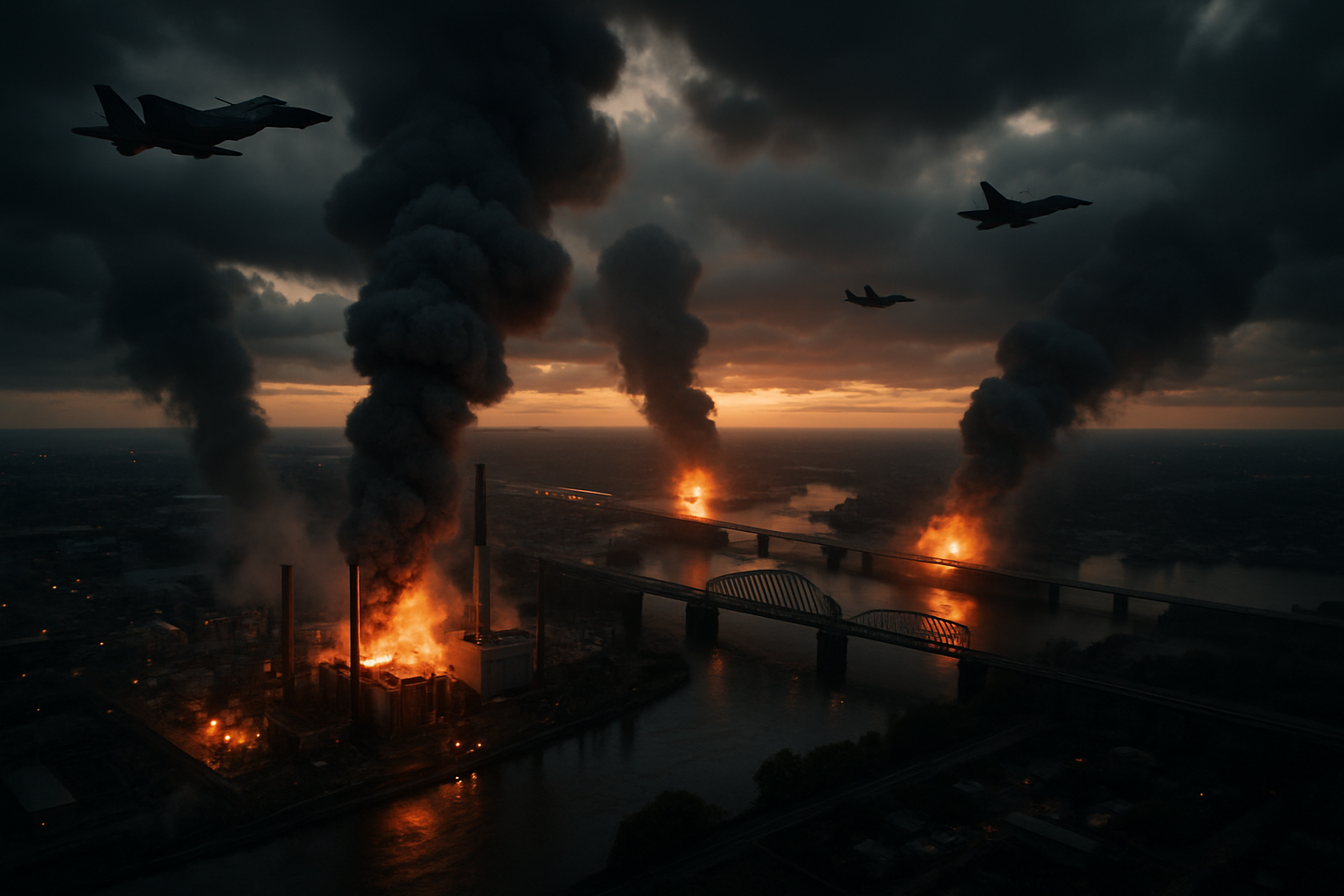
Israeli and American forces have launched a systematic campaign targeting Iran's critical infrastructure, striking railways, bridges, and energy facilities across the Islamic Republic in what appears to be the most comprehensive infrastructure warfare operation since the conflict began in March 2026.
The coordinated strikes come just hours before President Donald Trump's Tuesday evening deadline for Iran to reopen the Strait of Hormuz, marking a dangerous escalation in the five-week conflict that has already brought the global economy to the brink of crisis.
Infrastructure Warfare Reaches New Scale
Israeli Prime Minister Benjamin Netanyahu confirmed Tuesday that forces had destroyed "a large number of railway tracks and bridges" used by Iran's Revolutionary Guards (IRGC) for military transportation. According to multiple regional sources, at least eight strategic bridges across Iran were struck, including key installations near the holy city of Qom and railway infrastructure in the central city of Kashan.
The strikes represent a significant expansion from conventional military targets to civilian infrastructure, with Israeli officials describing the campaign as targeting "arteries" of Iranian logistics. Two people were reportedly killed and three injured in Kashan when a railway-carrying bridge was destroyed, according to Iranian state media.
"We do not act to strike the Iranian population but the regime that oppresses it"
— Benjamin Netanyahu, Israeli Prime Minister
A key highway in northern Iran connecting Tabriz to Tehran via Zanjan was also closed after strikes approximately 90 kilometers outside Tabriz, with Iranian officials reporting damage to an overpass bridge.
Kharg Island Under Attack Again
Most significantly, US and Israeli forces struck Iran's critical Kharg Island oil export terminal for the second time since the conflict began. The island, which handles approximately 90% of Iran's oil exports worth 1.6 million barrels per day, represents the economic lifeline of the Iranian regime.
Iranian media reported "several explosions" on the island, though Iranian sources claimed that oil facilities continued to operate normally despite the military targeting. The semi-official Mehr news agency stated that the situation on Kharg Island was "under control" and that no significant damage had been caused to critical petroleum infrastructure.
However, the attacks have raised global oil prices, with markets responding to the potential threat to one of the world's most critical energy chokepoints. The Strait of Hormuz, through which Kharg Island's exports flow, carries 40% of global seaborne oil transit.
Iran's Defiant Response
Iran's response has been swift and uncompromising. The Revolutionary Guards confirmed that Iranian forces had launched retaliatory strikes on Saudi Arabia's Jubail petrochemical complex, described as "the heart of the kingdom's downstream sector." The Islamic Revolutionary Guard Corps claimed the attacks were "in response to the enemy's crimes in the aggression against Iran's Asaluyeh petrochemical plants."
The escalation represents Iran's implementation of its declared policy that "no red lines remain," with Revolutionary Guard officials warning that all economic centers affiliated with the United States would become "legitimate targets" if infrastructure attacks continued.
Regional Implications and Casualties
The infrastructure campaign has already caused casualties across the region as Iran retaliates with its "Operation True Promise 4." Regional governments report:
- UAE: 1 civilian killed in Abu Dhabi from missile debris
- Kuwait: 32 people injured in airport strikes by Iranian forces
- Qatar: 8 injured while intercepting Iranian missiles and drones
- Cyprus: Iranian drones struck RAF Akrotiri base - the first attack on European territory since World War II
The attacks have severely strained the unprecedented regional coalition of Saudi Arabia, UAE, Qatar, and Egypt that had previously backed diplomatic solutions to the crisis.
Global Economic Crisis Deepens
The infrastructure warfare campaign has accelerated the global economic crisis triggered by the Iran conflict. Oil prices have surged past $115 per barrel, with analysts warning of potential $200 per barrel pricing if the Strait of Hormuz remains closed.
The aviation industry continues to face unprecedented disruption, with over 18,000 flights cancelled worldwide - the most severe crisis since the COVID-19 pandemic. Eight Middle Eastern countries have closed their airspace simultaneously, severing critical Asia-Europe air corridors.
Trump's Ultimate Deadline
President Trump has issued what may be his final ultimatum, demanding Iran fully reopen the Strait of Hormuz by Tuesday evening or face the destruction of "every bridge and power plant in Iran." The president posted on Truth Social that "all of Iran can be taken out in one night, and that night might be tomorrow night."
Iran's Foreign Minister Abbas Araghchi dismissed Trump's threats as "baseless" statements from a "delusional president," while the Revolutionary Guards maintain their position that no temporary measures would be acceptable - demanding a permanent end to hostilities before reopening the strategic waterway.
Nuclear Diplomacy Completely Collapsed
The infrastructure warfare represents the complete breakdown of diplomatic efforts that had shown promising progress in Geneva talks earlier this year. Despite achieving a "broad agreement on guiding principles" - the most significant diplomatic progress since the 2018 JCPOA collapse - fundamental disagreements over scope proved insurmountable.
Iran continues to enrich uranium at 60% purity levels, approaching the 90% threshold needed for weapons-grade material. Intelligence sources confirm Iran possesses over 400 kilograms of enriched uranium, sufficient for multiple nuclear weapons if weaponized.
Congressional Opposition Mounts
The escalation comes amid unprecedented congressional opposition to the administration's military campaign. With only 25% American public support - described by analysts as "almost unprecedented" unpopularity for early-stage military operations - bipartisan lawmakers are demanding comprehensive strategy answers.
Senator Richard Blumenthal expressed being "more concerned than ever" about potential ground troop deployments, while the Pentagon has confirmed operations are planned through September, far beyond the initial 4-6 week timeline presented to Congress.
Historical Watershed Moment
Military analysts describe the infrastructure warfare campaign as a watershed moment in 21st-century conflict. UN Secretary-General António Guterres has called the crisis the "greatest test of multilateral cooperation in crisis management in the modern era."
The systematic targeting of civilian infrastructure represents an escalation beyond conventional military objectives, potentially setting precedents for future international conflicts. The crisis affects multiple domains simultaneously: regional war prevention, global energy security, nuclear governance credibility, and international law enforcement.
What Comes Next
As Trump's Tuesday evening deadline approaches, the world faces a potential point of no return in the Iran crisis. The infrastructure warfare campaign suggests a shift from military pressure to comprehensive economic targeting designed to collapse Iranian state capacity.
With Iran showing no signs of backing down from its closure of the Strait of Hormuz and Revolutionary Guards warning of systematic retaliation against regional energy facilities if infrastructure strikes continue, the coming hours may determine whether the crisis can be contained or will expand into a broader regional war with global implications lasting decades.
The April 7, 2026 infrastructure warfare campaign represents the most dangerous phase yet of a conflict that has already fundamentally altered Middle Eastern geopolitics, global energy markets, and international crisis management approaches. Success in containing the escalation could provide a framework for 21st-century nuclear crisis resolution, while failure may accelerate military solutions that reshape international conflict resolution approaches worldwide for generations to come.