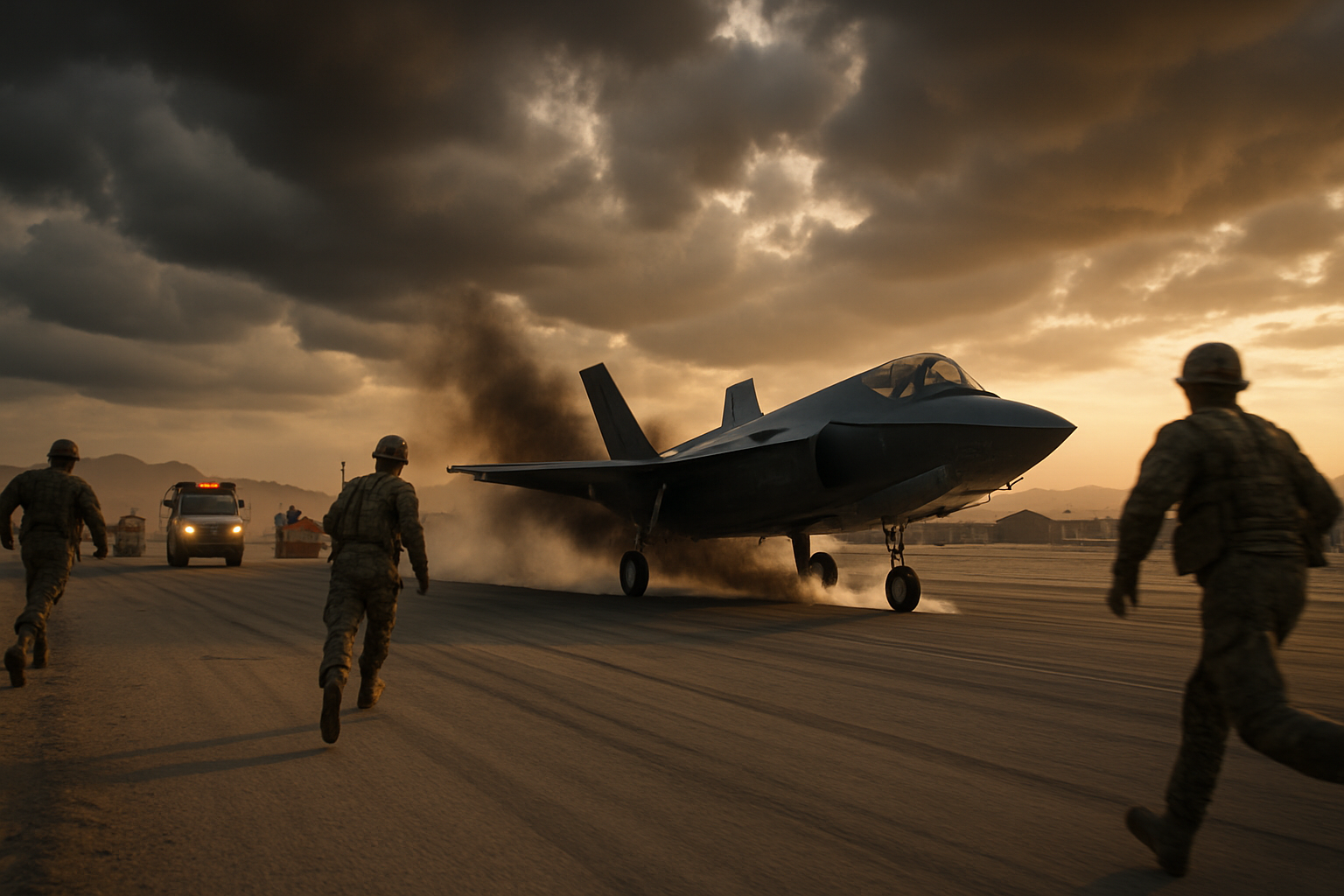
The Iran-US-Israel military conflict reached critical new escalation levels on March 19, 2026, as Iranian forces scored their first confirmed strike against a US F-35 stealth fighter jet while launching unprecedented attacks on energy infrastructure across the Gulf region, sending global oil prices soaring past $100 per barrel.
A US F-35 fighter aircraft was forced to make an emergency landing at a Middle Eastern airbase after being hit by suspected Iranian fire during combat operations over Iran, according to US Central Command. This marks the first time Iran has successfully struck one of America's most advanced stealth fighters since the beginning of Operation Epic Fury on February 28, representing a significant escalation in the world's most dangerous crisis since the Cold War.
"The aircraft landed safely, and the pilot is in stable condition," said Captain Tim Hawkins, spokesman for US Central Command, confirming the jet was "flying a combat mission over Iran" when the incident occurred. The F-35, valued at approximately $100 million, represents the cornerstone of US air superiority in the region.
Pentagon Demands Historic War Funding
As military operations intensify, the Pentagon submitted a request to the White House for an additional $200 billion to fund the Iran war - one of the largest single military appropriations in recent US history. Defense Secretary Pete Hegseth justified the massive expenditure during a press conference, stating bluntly: "It takes money to kill bad guys."
The request comes as Operation Epic Fury, the largest US-Israeli coordinated military campaign since the 2003 Iraq invasion, has already cost $11.3 billion in its first week alone, according to defense officials. The dual-carrier deployment of USS Gerald R. Ford and USS Abraham Lincoln represents approximately one-third of the US Navy's active fleet positioned just 800 kilometers from Iran's coast.
Congressional opposition is mounting, with Senator Richard Blumenthal expressing that he is "more concerned than ever" about potential ground troop deployment. The conflict's unpopularity has reached "almost unprecedented" levels according to polling data, with only 25% of Americans supporting the military strikes.
Global Energy Crisis Reaches Peak Severity
Iran's systematic targeting of Gulf energy infrastructure has triggered the most severe global energy crisis since the 1970s oil shocks. Iranian forces launched devastating attacks on Qatar's Ras Laffan Industrial City, responsible for roughly 20% of world LNG production, causing what QatarEnergy described as "extensive damage" to critical facilities.
Oil prices have surged past $100 per barrel for the first time since 2014, with Brent crude reaching $119.50 and WTI hitting $108.15 as Iran effectively closed the Strait of Hormuz - the world's most critical energy chokepoint handling 40% of global seaborne oil transit. Iran's Revolutionary Guard has deployed an estimated 2,000-6,000 naval mines, stranding over 150 tankers worth billions in cargo.
The International Energy Agency responded with its largest strategic petroleum reserve release in the organization's 50-year history, coordinating the deployment of 400 million barrels from 32 countries - double the amount released during the 2022 Ukraine crisis.
"This attack has significant repercussions for global energy supply," declared Qatar's Prime Minister Sheikh Mohamed bin Abdulrahman Al Thani following the strikes on Ras Laffan.
— Qatar's Prime Minister on energy infrastructure attacks
Aviation Industry in Unprecedented Crisis
The conflict has triggered the most comprehensive aviation disruption since COVID-19, with over 18,000 flights cancelled worldwide as eight Middle Eastern countries simultaneously closed their airspace. Dubai International Airport, the world's busiest with 86 million annual passengers, remains completely shuttered due to missile damage.
Major carriers including Emirates, Air France-KLM, and Wizz Air have suspended operations indefinitely, affecting hundreds of thousands of passengers globally. The closures have severed critical Asia-Europe flight corridors, forcing airlines to implement emergency fuel surcharges as jet fuel prices jumped from $85-90 per barrel to $150-200.
European Territory Attacked for First Time Since WWII
In a historic escalation, Iranian drones struck RAF Akrotiri in Cyprus - marking the first attack on European territory since World War II. The unprecedented assault prompted an immediate naval coalition response, with HMS Dragon, Spanish frigates, and vessels from Italy, France, Netherlands, and Greece deploying to protect Europe.
The European Union activated its ESTIA evacuation plan for Cyprus for the first time in the bloc's history, underscoring the conflict's expansion beyond traditional Middle Eastern boundaries. French President Emmanuel Macron conducted an emergency visit to Cyprus, emphasizing the gravity of the situation.
Trump Administration's Hardline Stance
President Donald Trump has escalated his demands for Iran's "unconditional surrender" while claiming the right to personally choose Iran's next Supreme Leader. Trump explicitly rejected Mojtaba Khamenei, the son of deceased Supreme Leader Ali Khamenei, calling him a "lightweight" in the most direct assertion of American control over Iranian internal affairs since 1979.
However, Trump appeared to distance himself from some Israeli actions, particularly the March 18 attack on Iran's South Pars gas field. "No further attacks will be carried out by Israel," Trump posted on Truth Social, suggesting growing tensions within the US-Israeli partnership over targeting energy infrastructure.
Defense Secretary Hegseth confirmed that the US has no set "time frame" for ending the war, leaving timeline decisions to President Trump's discretion. Pentagon officials are reportedly preparing operations to continue through September, far beyond the initially projected 4-6 week campaign.
Iranian Leadership Transition Under Fire
Following Ali Khamenei's confirmed death on March 1, Iran has undergone its first hereditary succession in the Islamic Republic's 47-year history. Mojtaba Khamenei has assumed the role of Supreme Leader under unprecedented wartime conditions, representing a fundamental shift from clerical to military governance as Revolutionary Guards consolidate control over the state apparatus.
CIA assessments suggest the new leadership represents a more hardline military approach to governance, potentially making diplomatic resolution even more challenging. The succession occurred while Iran continues its "Operation True Promise 4" systematic retaliation campaign, which Iranian officials describe as having "no red lines remaining."
Humanitarian and Economic Toll Mounting
The humanitarian crisis continues to deepen, with Iran's Red Crescent reporting over 787 civilian casualties from US-Israeli strikes. The Pentagon has confirmed US responsibility for an elementary school attack that killed 165-185 students using what officials called "outdated targeting data."
International evacuations have reached their largest scale since the Arab Spring of 2011, with Australia reporting 115,000 nationals trapped in the region and Germany coordinating the evacuation of 30,000 stranded tourists. The global economic disruption has caused stock market crashes worldwide, with Pakistan's KSE-100 suffering its largest single-day decline in history at -8.97%.
Nuclear Diplomacy Remains Collapsed
The military escalation follows the complete breakdown of nuclear diplomacy, despite talks in Geneva achieving "broad agreement on guiding principles" - the most progress since the 2018 JCPOA collapse. However, fundamental disagreements over scope proved insurmountable, with Iran maintaining ballistic missiles and regional proxies as "red lines" while the US demanded comprehensive agreements covering missiles, armed groups, and human rights.
Iran continues uranium enrichment at 60% purity with over 400 kilograms of material approaching weapons-grade levels. The crisis occurs amid a broader nuclear governance breakdown following the February 5 expiration of the New START treaty - the first time in over 50 years without US-Russia nuclear constraints.
Regional Coalition Under Severe Strain
The unprecedented regional coalition of Saudi Arabia, UAE, Qatar, and Egypt that had supported diplomatic solutions is severely strained as Iranian attacks have directly targeted member territories. Egyptian President Abdel Fattah el-Sisi condemned attacks on "sisterly Arab countries," warning of "comprehensive chaos" spreading across the region.
Greek military personnel operating a US-made Patriot air defense system in Saudi Arabia intercepted two Iranian ballistic missiles targeting oil refineries, marking the first operational use of the Greek-operated system since its 2021 deployment.
Template-Setting Crisis for 21st Century
UN Secretary-General António Guterres has characterized the crisis as the "greatest test of multilateral cooperation and crisis management in the modern era." The rapid transition from diplomatic framework to military confrontation demonstrates the fragility of crisis management in the multipolar era.
The conflict's outcome will establish precedents for 21st-century international dispute resolution, affecting approaches to nuclear proliferation, territorial sovereignty, and the credibility of diplomatic solutions versus military force. Success in containment could provide a framework for future nuclear crisis resolution, while failure may accelerate the preference for military solutions globally, potentially undermining diplomatic credibility for decades.
As the conflict enters its third week, the stakes continue to rise: regional war prevention, global energy security, nuclear governance credibility, and international law enforcement are all being tested simultaneously in what has become the most consequential international crisis since the end of the Cold War.