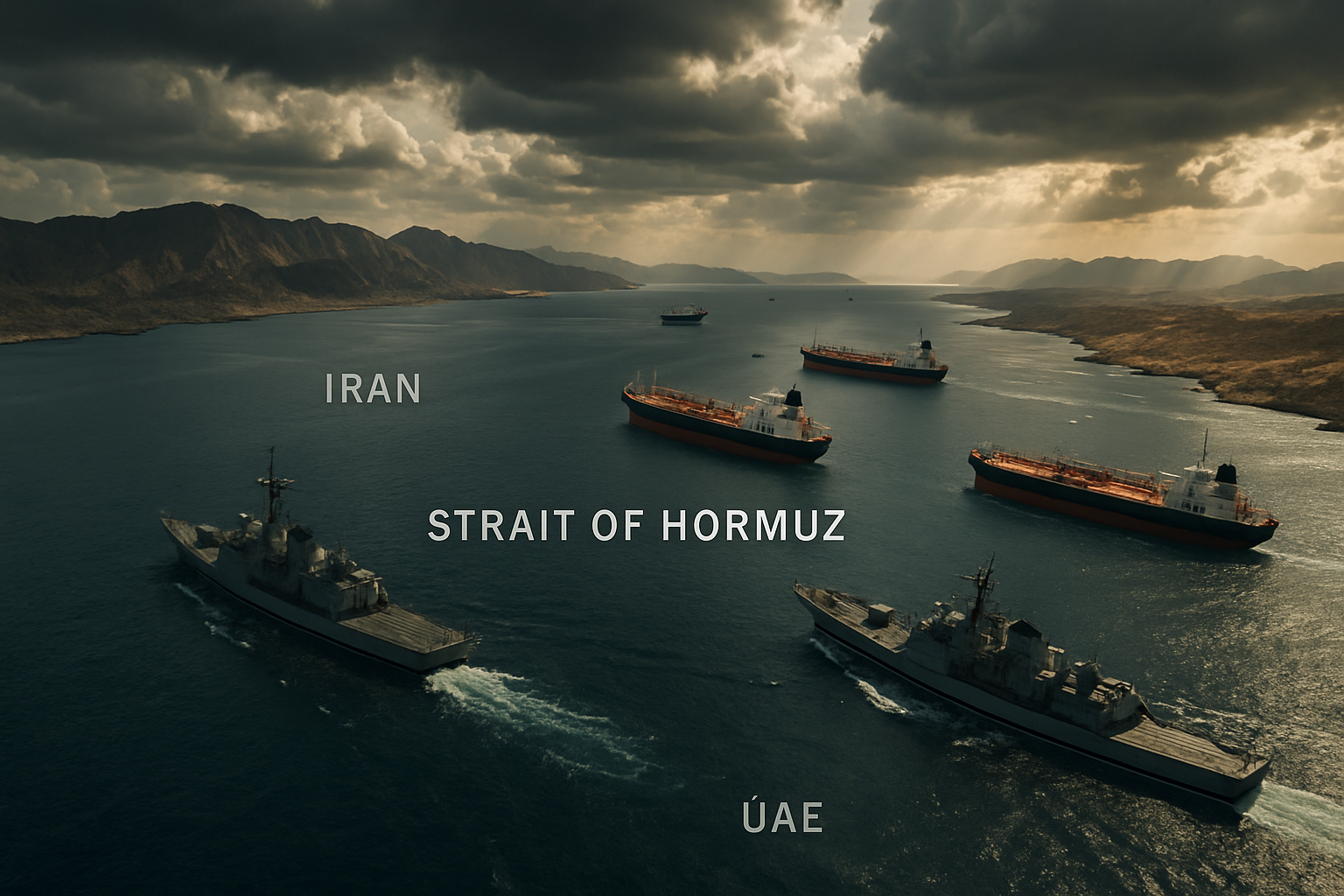
Iran's military command warned Wednesday that the world should prepare for oil prices to reach $200 per barrel as the Islamic Republic began deploying naval mines in the Strait of Hormuz, escalating the 12-day war with the United States and Israel to unprecedented levels.
The warning came as Iranian forces launched the 36th wave of "Operation True Promise IV," targeting Israeli and American positions across the Middle East while effectively blockading the critical waterway that carries 40% of the world's seaborne oil trade. Three commercial vessels came under attack in the strait Wednesday, including a Thai cargo ship that caught fire, requiring rescue operations for its 23-member crew.
"Get ready for oil to be $200 a barrel," Iranian military officials declared, as the Pentagon confirmed that U.S. forces destroyed 16 Iranian mine-laying vessels attempting to seed the narrow channel with explosives. The crisis has already pushed crude prices past $100 per barrel, with natural gas surging 24% in Europe and 78% in the United States.
Global Aviation Crisis Deepens
The conflict's impact on international travel reached crisis levels Wednesday, with over 18,000 flights cancelled worldwide—the most extensive disruption since the COVID-19 pandemic. Eight countries across the Middle East maintain simultaneous airspace closures, effectively creating a no-fly zone across the region's critical air corridors.
Dubai International Airport, the world's busiest with 86 million passengers annually, remains completely shuttered due to missile damage, while major carriers including Emirates, Air France-KLM, and Wizz Air have suspended operations indefinitely. The closure has stranded hundreds of thousands of passengers globally and severed crucial Asia-Europe flight routes.
American Casualties Mount
Pentagon sources confirmed Wednesday that U.S. military casualties have reached 140 wounded service members, with eight in critical condition. The figure represents the highest American casualty count in the Middle East since the 2003 Iraq invasion, underscoring the intensity of Iranian retaliation efforts.
The casualty toll comes as the USS Charlotte submarine achieved a historic milestone by sinking the Iranian frigate IRIS Dena off Sri Lanka, killing over 80 crew members—the first enemy vessel destroyed by a U.S. submarine since World War II. Defense Secretary Pete Hegseth called it a "quiet death" demonstrating America's "global military reach."
Energy Security Architecture Collapses
Iran's mining of the Strait of Hormuz represents a direct assault on global energy security, with intelligence reports indicating the deployment of dozens of naval mines from an estimated stockpile of 2,000-6,000 devices. The narrow 21-mile-wide channel at its narrowest point serves as the jugular of global oil supply, with over 150 tankers now stranded carrying billions of dollars worth of cargo.
Major shipping companies Maersk and MSC have suspended all operations in the Persian Gulf, while Qatar has halted liquefied natural gas production—cutting off approximately 20% of global LNG exports. The International Energy Agency announced Wednesday the release of 400 million barrels from strategic reserves, the largest such deployment in the agency's history.
"Should Japan's oil imports through Hormuz be completely cut off, we would face the greatest energy crisis since the 1970s oil shocks,"
— Japanese Prime Minister Sanae Takaichi
Trump Claims War Nearly Won
Despite the escalating crisis, President Donald Trump declared Wednesday that the war with Iran would end "soon" because "there's practically nothing left to target in Iran." Speaking to reporters, Trump claimed American and Israeli forces had achieved their primary objectives in the 12-day conflict, though he simultaneously threatened Iran would face "consequences never seen before" if the mines in Hormuz were not removed immediately.
The president's contradictory messaging reflects the complex dynamics of a conflict that has cost the Pentagon $5.6 billion in just the first 48 hours—the most expensive military operation since the 2003 Iraq invasion. Operation Epic Fury, the largest coordinated U.S.-Israeli campaign in history, has employed dual-carrier deployments representing approximately one-third of the active U.S. Navy fleet.
Iranian Leadership Crisis
The war began March 1 with the confirmed killing of Iran's Supreme Leader Ayatollah Ali Khamenei, ending his 37-year rule and creating an unprecedented succession crisis. His son, Mojtaba Khamenei, has emerged as the favored successor, marking what would be the first hereditary transition in the Islamic Republic's 47-year history.
However, CIA intelligence suggests that a Revolutionary Guards member is more likely to assume ultimate control, indicating a potential shift from clerical to military governance. The three-member transitional council currently managing the country includes President Masoud Pezeshkian, who confirmed Wednesday that Iran's new Supreme Leader is "injured but safe" after recent targeting attempts.
European Territory Under Attack
The conflict reached European shores for the first time since World War II when Iranian drones struck the RAF Akrotiri base in Cyprus. The unprecedented attack on European Union territory prompted an immediate naval coalition response, with HMS Dragon and frigates from Spain, Italy, France, the Netherlands, and Greece deploying to protect the eastern Mediterranean.
The European Union activated its ESTIA evacuation mechanism for the first time in the bloc's history, coordinating the largest international evacuation since the Arab Spring in 2011. Australia alone has 115,000 nationals trapped in the region, while Germany is working to evacuate 30,000 stranded tourists.
Nuclear Diplomacy in Ruins
The current military confrontation emerged from the complete breakdown of nuclear negotiations in Geneva, despite achieving what diplomats called "broad agreement on guiding principles"—the most promising progress since the 2018 collapse of the Joint Comprehensive Plan of Action (JCPOA).
Iran continues enriching uranium to 60% purity, approaching the 90% threshold needed for weapons-grade material, with an estimated 400 kilograms already stockpiled. The failure of diplomacy occurs against a backdrop of broader nuclear governance collapse, including the February expiration of the New START treaty—the first time in over 50 years that the U.S. and Russia operate without nuclear arms control constraints.
Regional Coalition Under Strain
The unprecedented coalition of Saudi Arabia, UAE, Qatar, and Egypt that had backed diplomatic efforts now faces severe strain as Iranian attacks have directly targeted their territories. Egyptian President Abdel Fattah el-Sisi condemned attacks on "sisterly countries," warning of "comprehensive chaos" spreading across the region.
Saudi Arabia's air defenses intercepted 21 Iranian drones and seven ballistic missiles targeting oil facilities and military bases, while Kuwait reported 32 foreign nationals injured in airport strikes. The attacks have fundamentally altered regional security calculations and strained traditional alliances.
Congressional Pressure Mounts
On Capitol Hill, bipartisan lawmakers are demanding answers about the war's strategy, costs, and potential for ground troop deployment. Senator Richard Blumenthal expressed being "more concerned than ever" about the possibility of American boots on the ground, as Pentagon officials quietly prepare for operations extending through September—far beyond the initial four-to-six-week timeline presented by the White House.
The conflict's unpopularity among Americans is "almost unprecedented" for early-stage military operations, with only 25% public support according to polling. Financial markets are emerging as the "ultimate constraint" on further escalation, with stock exchanges worldwide suffering dramatic losses.
Global Economic Shockwaves
The economic impact extends far beyond energy markets, with supply chains for automotive, electronics, and textile manufacturing severely disrupted due to dependence on Gulf logistics networks. Pakistan's stock exchange suffered its largest single-day decline in history, falling 8.97%, while the Dow Jones futures dropped 400-570 points.
The Persian Gulf's role as a critical Asia-Europe trade hub has been completely compromised, demonstrating the fundamental vulnerability of globalized systems to geopolitical shocks. PayPal postponed its $1.1 billion IPO citing market instability from the crisis.
Template-Setting Crisis
UN Secretary-General António Guterres has called the Iran crisis the "greatest test of multilateral cooperation and crisis management in the modern era." The rapid transition from diplomatic breakthrough to military confrontation demonstrates what analysts describe as the fragility of crisis management in the multipolar era.
The stakes extend far beyond the Middle East, as the international community grapples with template-setting precedents for 21st-century conflict resolution. Success in containing the crisis could provide a diplomatic framework for future nuclear disputes, while failure may accelerate the preference for military solutions over diplomatic engagement globally.
As the conflict enters its thirteenth day, the world faces a decisive moment that will reverberate through international relations for decades, affecting approaches to nuclear governance, energy security architecture, and the fundamental principles of the post-World War II international order.