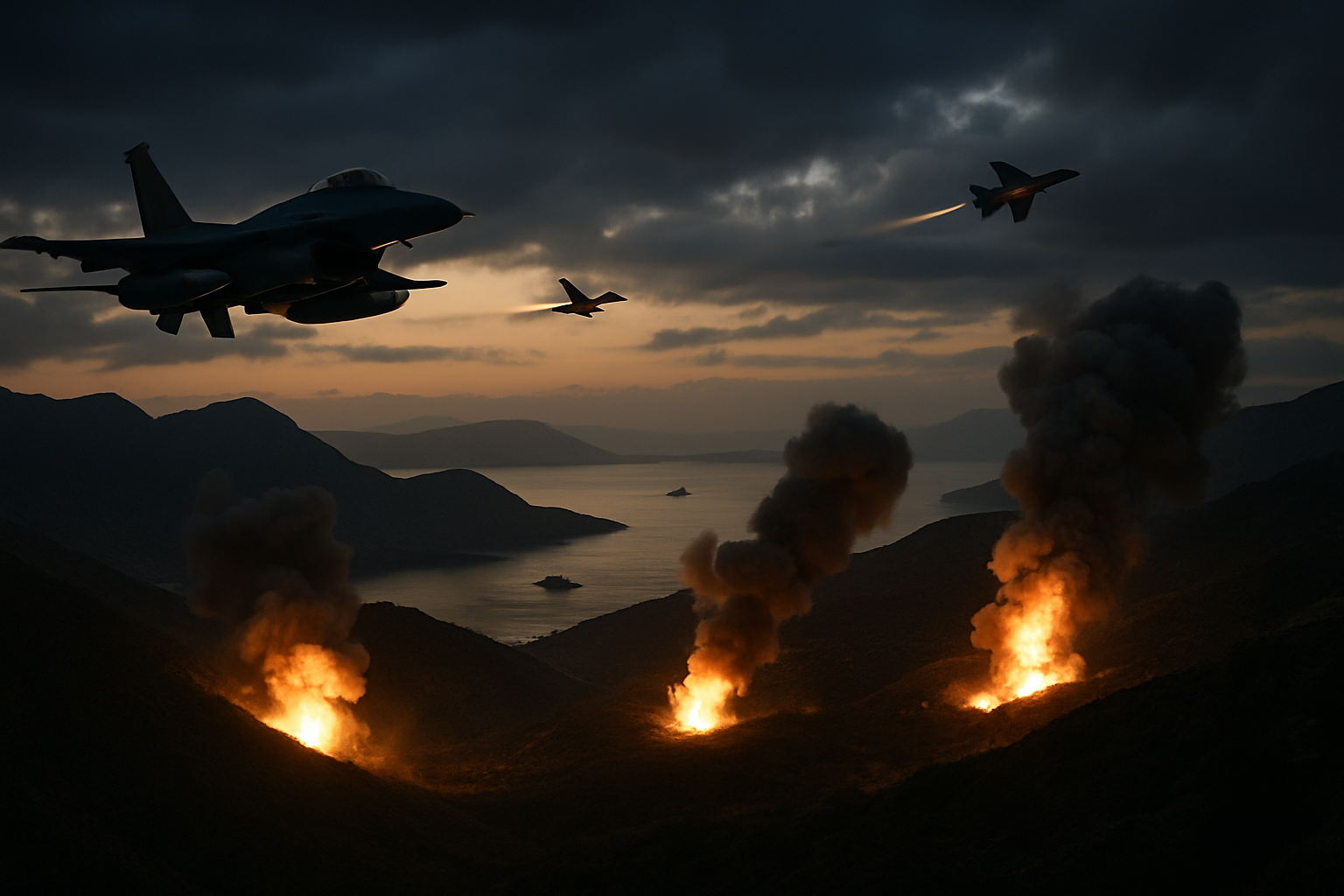
Yemen's Iran-aligned Houthis launched their first missile attack on Israel since the start of the US-Israeli war on Iran one month ago, while Iranian forces struck a US military base in Saudi Arabia, wounding American troops and marking a dangerous expansion of the conflict across the Middle East.
The escalation on March 28, 2026, represents the most significant broadening of hostilities since "Operation Epic Fury" began on February 28, with the entry of the Houthis opening a new front that threatens to further destabilize global energy markets and shipping routes through the Red Sea.
Houthis Enter War as Iran Strikes US Forces
Houthi spokesperson Yahya Saree announced Saturday that the Yemeni militant group launched ballistic missiles targeting "sensitive Israeli military sites" in southern Israel, marking their first direct involvement in the month-long conflict. The attack followed Iranian missile and drone strikes on Prince Sultan Air Base in Saudi Arabia that wounded 12 US service members, two seriously, according to US officials.
The Iranian attack on the Saudi base damaged several KC-135 aerial refueling aircraft and represents one of the most significant breaches of US regional air defenses since the war began. Combined missile and drone strikes overwhelmed defensive systems, highlighting Iran's evolving military capabilities.
"Yemen's armed forces have carried out a military operation against sensitive military targets of the Israeli enemy in the south of occupied Palestine with a batch of ballistic missiles," Saree said in a statement.
— Yahya Saree, Houthi Military Spokesperson
US Secretary of State Predicts Swift Resolution
Despite the escalating violence, US Secretary of State Marco Rubio told reporters Friday that Washington expects to conclude military operations against Iran "within weeks, not months," signaling confidence in achieving American objectives without deploying ground forces. The statement comes as the conflict approaches its second month with no clear diplomatic resolution in sight.
Rubio's timeline contrasts with Pentagon preparations for operations extending through September, suggesting internal disagreements over the war's scope and duration. The disconnect has drawn criticism from Congressional lawmakers demanding greater transparency about military strategy and costs.
Global Crisis Deepens
The expanding conflict has created unprecedented disruption to global systems. Over 18,000 flights have been cancelled worldwide—the most extensive aviation crisis since COVID-19—as eight Middle Eastern countries maintain simultaneous airspace closures. Dubai International Airport, the world's busiest, remains shuttered from missile damage.
Oil prices have surged past $80 per barrel, with Iran's closure of the Strait of Hormuz affecting 40% of global oil transit. The energy crisis has prompted the International Energy Agency to authorize its largest strategic reserve release in 50 years, dumping 400 million barrels onto markets to stabilize prices.
Iran's Nuclear Program and Leadership Crisis
The war began following the collapse of nuclear negotiations in Geneva, despite achieving what Iranian Foreign Minister Abbas Araghchi called "broad agreement on guiding principles"—the most progress since the 2018 JCPOA breakdown. Iran continues enriching uranium to 60% purity, approaching the 90% threshold needed for weapons, with an estimated 400kg of material that could be weaponized.
Iran faces a constitutional succession crisis following the confirmed death of Supreme Leader Ali Khamenei on March 1. His son Mojtaba Khamenei has emerged as the likely successor, representing the first hereditary succession in the Islamic Republic's 47-year history and consolidating Revolutionary Guard control over governance.
Congressional Opposition Mounts
Bipartisan lawmakers are demanding answers about strategy, costs, and the potential for ground troop deployment. Senator Richard Blumenthal said he is "more concerned than ever" about "boots on the ground," as conflict unpopularity reaches "almost unprecedented" levels with only 25% American public support.
Operation Epic Fury has cost $11.3 billion in its first week, with 150 US troops wounded and three confirmed killed—the first American deaths in the largest Middle East operation since 2003. Financial markets are emerging as the "ultimate constraint" on further escalation, with Pakistan's stock exchange posting its largest single-day decline in history.
Regional Coalition Under Strain
The unprecedented coalition of Saudi Arabia, UAE, Qatar, and Egypt that initially supported diplomacy is severely strained as Iranian retaliation has directly targeted member territories. Egyptian President Abdel Fattah el-Sisi condemned attacks on "sisterly Arab countries," warning of "comprehensive chaos" spreading across the region.
The Gulf states find themselves caught between their alliance with the United States and pressure from Iranian attacks, affecting decades-old security arrangements that have underpinned regional stability.
European Territory Attacked
Iranian drones struck RAF Akrotiri in Cyprus—the first attack on European territory since World War II—prompting an unprecedented naval coalition response. HMS Dragon and Spanish frigates are deploying alongside Italian, French, Dutch, and Greek vessels to protect Europe, marking a fundamental shift in the conflict's geographic scope.
The European Union activated its ESTIA evacuation plan for the first time in the bloc's history, with over 115,000 Australians trapped in the region and 30,000 Germans stranded as the largest international evacuation since the Arab Spring unfolds.
Humanitarian Crisis Escalates
Iran's Red Crescent reports 787+ civilian casualties from US-Israeli strikes, including the devastating attack on Minab elementary school that killed between 53-85 students and staff. The incident has drawn international condemnation and calls for Geneva Conventions investigations.
Lebanon has seen 394 killed, including 83 children, as Israeli strikes target Hezbollah positions following the group's entry into the conflict. Over 500,000 Lebanese are displaced, overwhelming shelter capacity across the country.
Global Economic Implications
Supply chains dependent on Gulf logistics networks are severely disrupted, affecting automotive, electronics, and textile manufacturing worldwide. Airlines have implemented emergency fuel surcharges as jet fuel costs jumped from $85-90 to $150-200 per barrel.
Qatar has halted LNG production, threatening European gas supplies as natural gas prices surge 24% in Europe and 78% in the United States. The Persian Gulf's role as a critical Asia-Europe trade hub has been completely compromised.
Nuclear Governance Crisis
The conflict occurs amid a broader nuclear governance crisis, with the New START treaty having expired on February 5—the first time in over 50 years without US-Russia nuclear constraints. Combined with China's nuclear expansion, UN Secretary-General António Guterres warns nuclear risks are at their "highest in decades."
The collapse of promising Iran negotiations raises fundamental questions about the viability of diplomatic solutions to modern nuclear crises, potentially setting precedents that could encourage military over diplomatic approaches globally.
Template-Setting Historical Moment
UN Secretary-General Guterres has called the crisis the "greatest test of multilateral cooperation and crisis management in the modern era." The rapid transition from diplomatic breakthrough to military confrontation demonstrates the fragility of crisis management mechanisms in the multipolar era.
Success in containing the conflict could provide a framework for future nuclear crisis resolution, while failure may accelerate military solutions for decades, encouraging proliferation globally and undermining diplomatic credibility worldwide.
As the conflict enters its second month with no diplomatic solution visible, the stakes extend far beyond the Middle East, affecting international approaches to conflict resolution, energy security architecture, and nuclear governance mechanisms that will shape 21st-century global stability for decades to come.