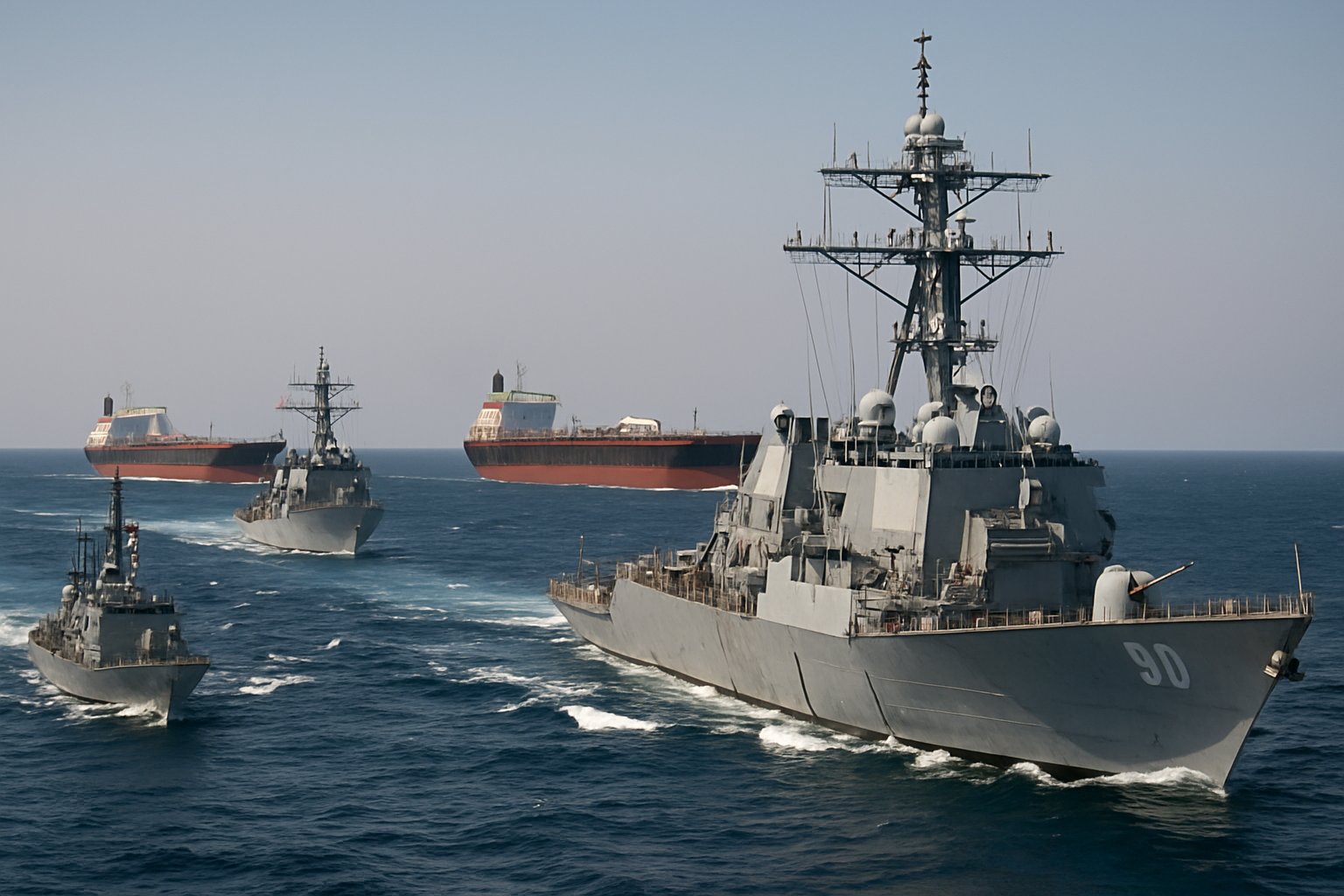
The US military has intercepted at least three Iranian-flagged oil tankers in Asian waters near India, Malaysia and Sri Lanka, while Iran's Revolutionary Guard has seized multiple commercial vessels in the Strait of Hormuz, marking a significant escalation in naval tensions that threatens global energy security and international shipping routes.
According to shipping and security sources, the US Navy has been working to redirect Iranian vessels away from key positions in the Indian Ocean and Southeast Asian waters, as part of what maritime security sources describe as efforts to counter Iranian shipping operations amid the ongoing conflict that began in February 2026.
The interceptions come as Iran has intensified its control over the critical Strait of Hormuz, seizing vessels including the MSC Francesca and Epaminondas for what Iran claims were "unauthorized operations" and "navigation system tampering." The UK Maritime Trade Operations confirmed that Iranian gunboats fired on merchant vessels without warning approximately 20 nautical miles northeast of Oman.
Strategic Waterway Under Iranian Control
Iran's Revolutionary Guard has maintained effective control over the Strait of Hormuz, a 21-mile waterway that handles approximately 40% of global seaborne oil transit. The maritime chokepoint has become a focal point in the broader US-Iran confrontation, with Iran deploying an estimated 2,000-6,000 naval mines throughout the waterway.
A maritime security source told reporters that the US Navy's actions are being coordinated to counter the threat of naval mines in the critical Middle Eastern waterway, with the Pentagon predicting that demining operations could take up to six months to complete.
The crisis has already led to historic disruption in global energy markets, with over 150 oil and LNG tankers stranded in the Persian Gulf carrying billions of dollars in cargo. Major shipping companies Maersk and MSC have suspended operations in the region indefinitely.
Background to the Naval Crisis
The current confrontation represents the culmination of a crisis that began with the collapse of US-Iran nuclear negotiations in February 2026, despite what officials described as "broad agreement on guiding principles" that represented the most progress since the 2018 JCPOA collapse.
The situation deteriorated rapidly after Pakistan-mediated peace talks in Islamabad failed in April, with negotiations breaking down over Iran's refusal to suspend 60% uranium enrichment and abandon its stockpile of weapons-grade nuclear material. Iran's Foreign Minister Abbas Araghchi declared that Iran would "never abandon enrichment even if war is imposed."
The "Lebanon loophole" proved particularly decisive in the talks' failure, with Israeli Prime Minister Netanyahu's explicit exclusion of Lebanon from any ceasefire creating what negotiators described as an "unbridgeable gap." Israeli strikes during the talks killed over 254 people in a single day, displacing 1.2 million Lebanese civilians.
International Response and Naval Blockade
President Trump subsequently ordered what military officials describe as a formal naval blockade of Iranian ports, which is generally considered an act of war under international law. The blockade involves over 10,000 US military personnel and 12 warships enforcing restrictions "against vessels of all nations entering or departing Iranian ports."
The response from NATO allies has been notably divided. UK Prime Minister Keir Starmer declared that Britain "will not be dragged into Iran war," while France and Germany have emphasized diplomatic approaches over military solutions. Australia and Japan declined to provide naval vessels, representing what analysts describe as the most significant rejection of American military leadership since the Iraq War in 2003.
Only Israeli Prime Minister Benjamin Netanyahu has offered "full support and close coordination" with US operations, highlighting growing divisions within traditional alliance structures.
Global Economic Impact
The naval confrontations have contributed to severe disruption of global energy markets, with oil prices surging to over $106 per barrel for Brent crude and $104 for WTI - the second time in 2026 that prices have exceeded $100.
The International Energy Agency has maintained its largest strategic petroleum reserve release in 50-year history, deploying 400 million barrels from 32 countries to stabilize markets. Japan is releasing 80 million barrels, marking its first such deployment since the 2011 Fukushima disaster.
Consumer impacts have been felt worldwide, with Bangladesh implementing fuel rationing for 170 million people, Pakistan adopting wartime austerity measures, and European nations seeing significant increases in heating costs. Qatar's halt of LNG production at key facilities represents approximately 20% of global exports.
Nuclear Governance Crisis
The naval confrontations occur against the backdrop of a broader nuclear governance crisis. The New START Treaty between the US and Russia expired in February 2026, marking the first time in over 50 years that the two nuclear superpowers operate without bilateral constraints.
Iran continues to maintain uranium enrichment at 60% purity, with an estimated 400kg of weapons-grade material - sufficient for multiple nuclear weapons if weaponized, according to former IAEA inspector Dr. Yusri Abu Shadi. UN Secretary-General António Guterres has warned that nuclear risks are at their "highest in decades."
Regional Coalition Under Strain
The crisis has placed unprecedented strain on regional coalitions, with Saudi Arabia, UAE, Qatar, and Egypt maintaining diplomatic unity despite Iranian attacks on their territories. During "Operation True Promise 4," Iran's retaliation campaign resulted in one civilian killed in Abu Dhabi, 32 injured at Kuwait airports, and 8 wounded in Qatar during missile interceptions.
Egyptian President Abdel Fattah el-Sisi has condemned attacks on "sisterly countries" and warned of "comprehensive chaos" if escalation continues, reflecting concerns about regional stability that extends far beyond the immediate US-Iran confrontation.
Humanitarian Toll and War Crimes Concerns
The Iranian Red Crescent reports over 787 civilian casualties in the conflict, including a Pentagon-confirmed elementary school strike that killed 165-185 students due to what officials described as "outdated targeting data." International war crimes investigations are ongoing under Geneva Conventions frameworks.
International evacuations have reached levels not seen since the Arab Spring, with Australia reporting 115,000 citizens trapped in the region and Germany evacuating 30,000. The European Union activated its ESTIA crisis mechanism for the first time in bloc history following Iranian drone attacks on RAF Akrotiri in Cyprus - the first attack on European territory since World War II.
Congressional Opposition and Costs
Domestic opposition to US military operations has reached historic levels, with only 25% of Americans supporting what has been designated "Operation Epic Fury." Senator Richard Blumenthal has expressed being "more concerned than ever" about potential ground troop deployments.
The operation has already cost $11.3 billion in its first week, with Pentagon officials projecting operations continuing through September - well beyond initial 4-6 week timelines. Financial markets have been described by analysts as the "ultimate constraint" on prolonged military confrontation.
Template-Setting Crisis for the 21st Century
UN Secretary-General Guterres has characterized the crisis as the "greatest test of multilateral cooperation in the modern era." The situation represents what many analysts view as a template-setting moment for how the international community will address territorial disputes, nuclear proliferation, and energy security challenges in the 21st century.
The stakes extend far beyond the immediate bilateral US-Iran dispute, affecting global energy security architecture, nuclear governance credibility, and international law enforcement mechanisms with implications that could extend decades beyond current events.
As Pakistan's innovative "message relay system" that briefly achieved diplomatic breakthrough in early April has collapsed, the world faces the prospect of either finding new diplomatic frameworks to address the crisis or witnessing a prolonged military confrontation that could reshape the post-World War II international order.
Looking Forward
The interception of Iranian tankers in Asian waters represents a significant geographic expansion of the confrontation beyond the Middle East, demonstrating how regional conflicts in the modern era can rapidly evolve into global crises affecting energy security, supply chains, and international stability.
With Iran categorically rejecting negotiations under current conditions and the US maintaining its naval blockade, the international community faces what experts describe as one of the most dangerous crises since the Cold War, with the potential to fundamentally reshape diplomatic versus military approaches to international conflict resolution for decades to come.