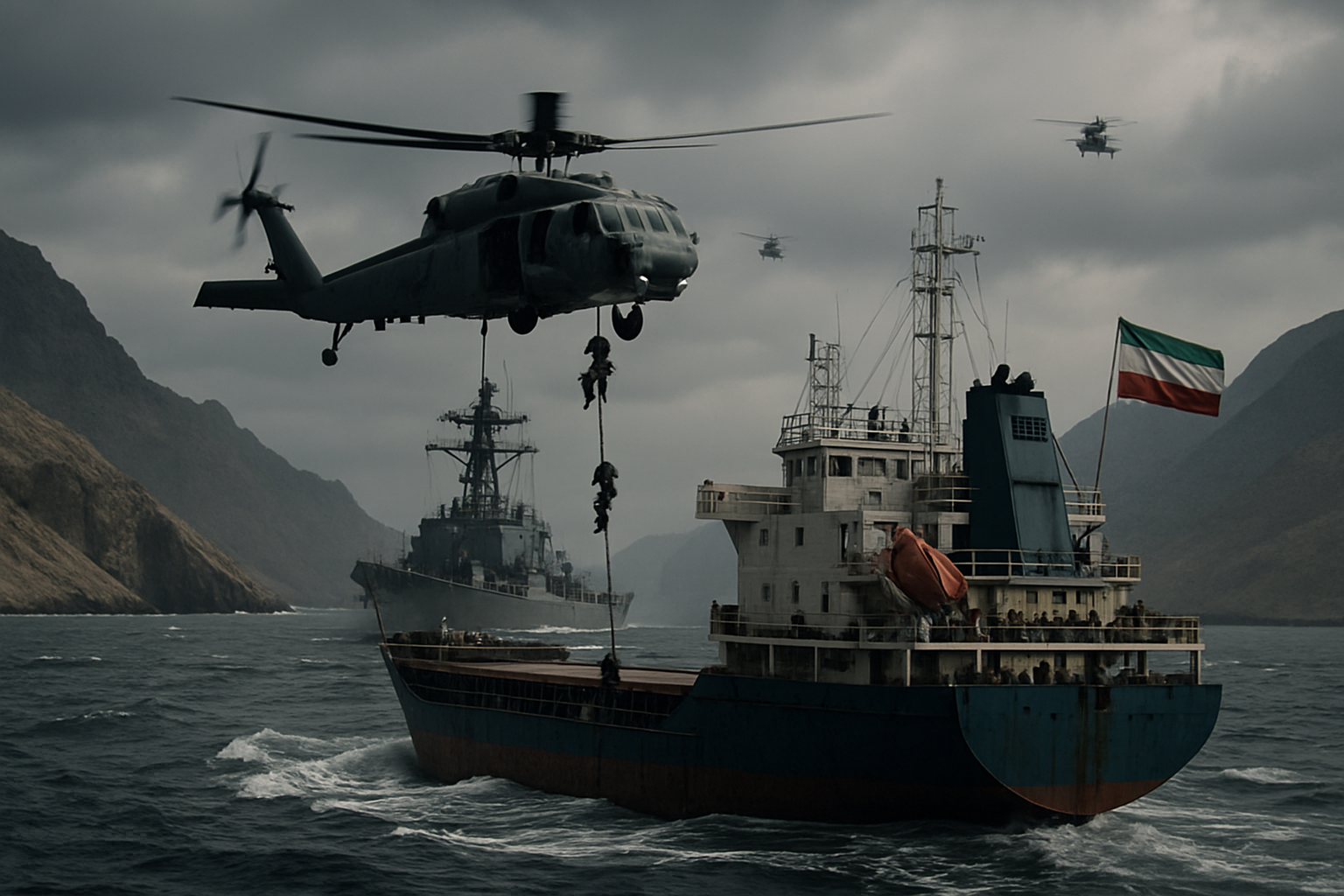
The United States military's forcible seizure of an Iranian-flagged cargo ship in the Gulf of Oman has derailed crucial peace negotiations between Washington and Tehran, with Iran announcing it will not participate in scheduled talks in Pakistan while vowing swift retaliation for what it calls "armed piracy."
US Central Command (CENTCOM) confirmed on Monday that Marines had boarded and seized the Iranian vessel M/V Touska following a prolonged standoff in waters near the Strait of Hormuz. Video footage released by the military showed US Marines descending from helicopters and taking control of the ship after warnings were ignored for more than six hours.
The operation, confirmed by President Donald Trump in a Truth Social post, came just hours before the scheduled second round of US-Iran negotiations in Islamabad, Pakistan. Trump said American forces had "full custody" of the vessel and were inspecting its cargo, describing the ship as having "a history of illegal activity" under US sanctions.
Iranian Response: "Armed Piracy"
Iranian authorities condemned the seizure as "armed piracy" and announced Tehran would not attend the planned talks in Pakistan. A military spokesperson, quoted by state media, warned that Iran's armed forces would respond to what they characterized as a violation of international maritime law.
"We warn that the armed forces of the Islamic Republic of Iran will soon respond and retaliate against this act of armed piracy"
— Iranian Military Spokesperson
Iran's Foreign Ministry spokesperson Esmaeil Baqaei stated that Tehran has "no plans" for new negotiations with the United States, citing Washington's "contradictory behaviors" and the ongoing US naval blockade of Iranian ports as key obstacles to diplomatic progress.
Pakistan's Mediation Efforts Under Strain
The ship seizure has placed enormous strain on Pakistan's unprecedented mediation efforts, which had previously achieved a historic breakthrough. Prime Minister Shehbaz Sharif and Field Marshal Asim Munir had successfully brokered the "Islamabad Accord" framework that prevented a global catastrophe by achieving a ceasefire just 88 minutes before Trump's previous deadline.
Pakistan's Interior Minister Mohsin Naqvi met with US Ambassador Natalie Baker on Monday to discuss security arrangements for potential renewed talks, despite Iran's rejection. The Pakistani framework had demonstrated innovative middle-power diplomacy, with China providing "full support" for the initiative.
Naval Confrontation Details
According to CENTCOM, the USS Spruance issued repeated warnings to the Iranian vessel as it sailed toward Iran's Bandar Abbas port. When the crew refused to comply, US forces opened fire on the ship's engine room, "blowing a hole" in it before Marines took control of the vessel.
Iran's military said the ship had been traveling from China to Iranian ports when it was intercepted. The incident marks a significant escalation in the naval standoff that has gripped the strategically vital Strait of Hormuz, through which approximately 40% of global seaborne oil transit passes.
Impact on Global Energy Markets
The latest escalation has sent oil prices surging, with Brent crude climbing above $106 per barrel and WTI reaching $104.29 - the second time in 2026 that prices have breached the psychologically important $100 mark. Iran maintains strict control over the Strait of Hormuz, with the Revolutionary Guard threatening to create a "deadly whirlpool" for any vessels that challenge Iranian sovereignty.
Major shipping companies including Maersk and MSC have suspended operations in the Persian Gulf, leaving more than 150 tankers stranded with billions of dollars worth of cargo. The International Energy Agency continues to maintain its record 400-million-barrel strategic petroleum reserve release - the largest in the agency's 50-year history.
International Coalition Fractures
The naval seizure has exposed significant fractures in the international coalition, with key NATO allies distancing themselves from US military actions. UK Prime Minister Keir Starmer declared that Britain "will not be dragged into Iran war," while France and Germany have emphasized diplomatic approaches over military solutions.
Australia and Japan declined to provide naval vessels to support US operations - marking the most significant rejection of American military leadership since the 2003 Iraq War. Only Israel has offered "full support and close coordination" with Washington, highlighting the isolation of US military policies.
Congressional Opposition Mounts
On Capitol Hill, opposition to military escalation has reached unprecedented levels, with only 25% of Americans supporting current operations according to recent polling. Senator Richard Blumenthal expressed being "more concerned than ever" about potential ground troop deployments, while Operation Epic Fury has already cost $11.3 billion in its first week.
The Pentagon projects operations could continue through September, far beyond initial 4-6 week timelines, with financial markets serving as what analysts describe as the "ultimate constraint" on prolonged military confrontation.
Nuclear Diplomacy Stalemate Persists
The ship seizure came against the backdrop of unresolved nuclear negotiations, with Iran maintaining its uranium enrichment at 60% purity - approaching weapons-grade levels. Tehran possesses more than 400 kilograms of weapons-grade material, sufficient for multiple nuclear weapons according to intelligence assessments.
The crisis has unfolded amid the broader context of nuclear governance challenges, including the expiration of the New START Treaty in February 2026 - the first time in more than 50 years that the world lacks US-Russia nuclear constraints.
Regional Coalition Under Pressure
The unprecedented consensus among Saudi Arabia, UAE, Qatar, and Egypt in supporting diplomatic solutions faces severe testing following Iranian retaliatory attacks. Iran's "Operation True Promise 4" has resulted in casualties across the region: one killed in Abu Dhabi, 32 injured at Kuwait airports, and eight wounded in Qatar despite Patriot missile interceptions.
Egyptian President Abdel Fattah el-Sisi's warnings about "comprehensive chaos in sisterly countries" are proving increasingly prophetic as diplomatic failures mount and regional tensions escalate.
Humanitarian Crisis Deepens
The Iranian Red Crescent reports more than 787 civilian casualties from US-Israeli strikes, including a Pentagon-confirmed elementary school attack that killed between 165-185 students due to what officials called "outdated targeting data." War crimes investigations are underway.
International evacuations have reached Arab Spring-scale proportions, with Australia reporting 115,000 people trapped and Germany evacuating 30,000 citizens. The EU activated its ESTIA crisis mechanism for the first time in the bloc's history following Iranian drone attacks on RAF Akrotiri in Cyprus.
Template-Setting Crisis
UN Secretary-General António Guterres has characterized the situation as "the greatest test of multilateral cooperation in the modern era." The crisis represents a watershed moment for 21st-century conflict resolution, determining whether diplomatic innovation can ultimately triumph over military confrontation.
The stakes extend far beyond the bilateral US-Iran dispute, affecting global energy security architecture, nuclear governance credibility, international law enforcement mechanisms, and post-WWII order sustainability with implications extending decades beyond current events.
As Pakistan continues to offer mediation services despite the setback, the coming days will determine whether diplomatic innovation can restore negotiations or whether the world faces a prolonged military confrontation with global implications affecting energy markets, nuclear proliferation mechanisms, and international stability frameworks worldwide.