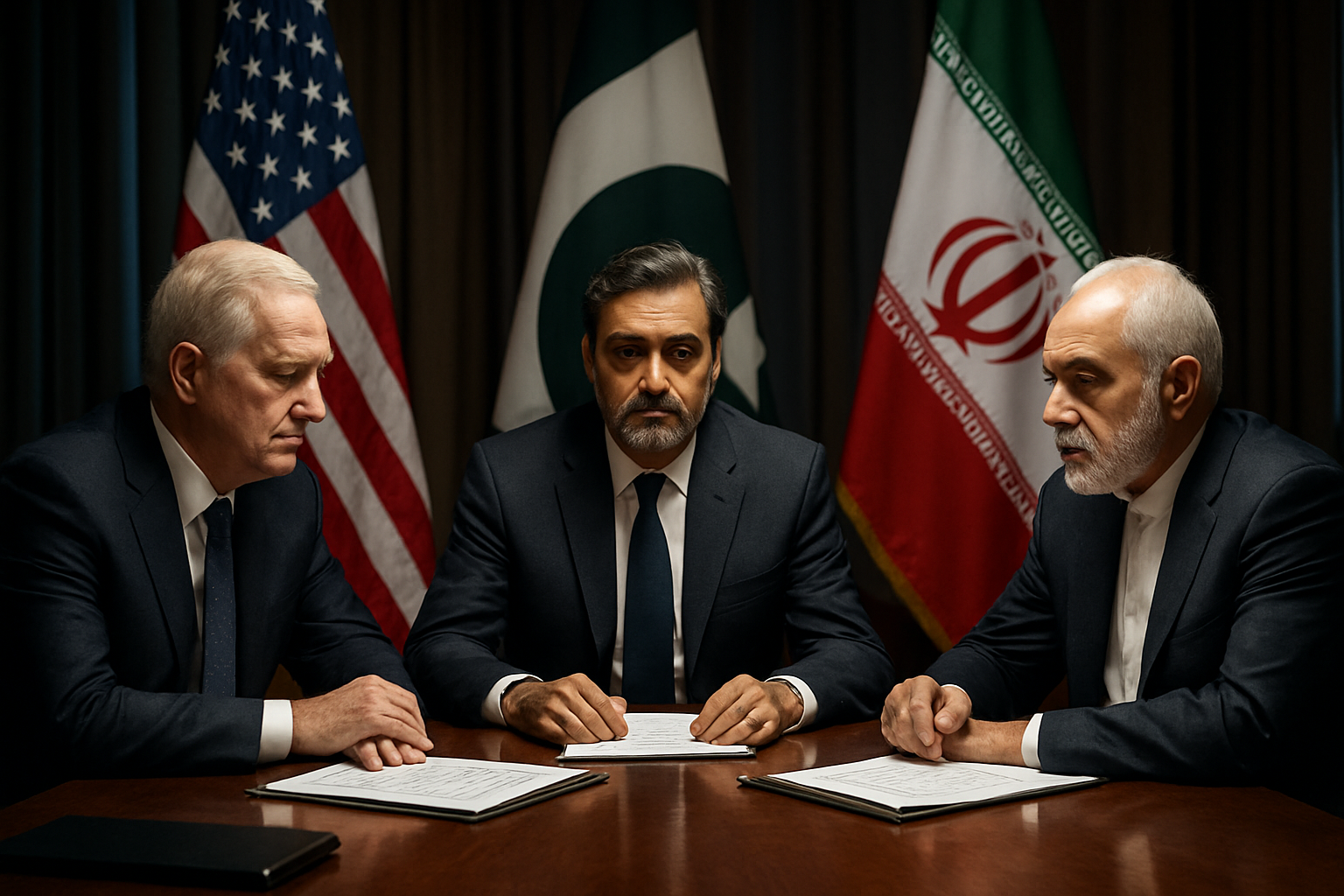
Pakistan has formally delivered a United States-proposed 15-point peace plan to Iran amid the most dangerous international crisis since the Cold War, as global tensions reach unprecedented levels with over 18,000 flights cancelled worldwide and oil prices surging past $100 per barrel.
The diplomatic initiative comes as President Trump claims victory while Iran categorically denies any negotiations are taking place, creating contradictory signals about the conflict's trajectory at a critical juncture where multiple international sources confirm the crisis has spiraled beyond initial objectives.
Pakistan Emerges as Critical Mediator
Prime Minister Shehbaz Sharif has formally offered Pakistan as host for "meaningful and conclusive talks" between the United States and Iran to reach a "comprehensive settlement" of the ongoing conflict. Pakistani sources confirm they have delivered the US-proposed 15-point document to Tehran, marking the most significant diplomatic intervention since the crisis began.
According to senior Iranian officials speaking to Reuters, Pakistan has conveyed the US proposal, with both Pakistan and Turkey under consideration as potential venues for direct talks. The Iranian source, speaking on condition of anonymity, confirmed receipt of the document but did not disclose specific details of the 15-point framework.
"Either Turkey or Pakistan was under consideration as the venue for such talks. Pakistan has been instrumental in facilitating communication between the adversaries."
— Senior Iranian Official, Reuters
Contradictory Diplomatic Claims
The diplomatic landscape remains clouded by contradictory statements from both Washington and Tehran. President Trump announced via Truth Social that he had postponed military strikes against Iranian power plants for five days, citing "very good and productive conversations" regarding a "complete and total resolution."
However, Iran's Fars news agency swiftly contradicted these claims, stating there were "no direct or indirect communications with the US" and dismissing Trump's assertions as "fake news and psychological warfare." Iran's Revolutionary Guards spokesperson declared the US was "negotiating with itself."
European diplomatic sources suggest the contradictions may reflect Iran's complex internal dynamics, with different factions sending mixed messages while unprecedented external pressure mounts from the ongoing military campaign.
Global Crisis Reaches Critical Mass
The conflict has generated the most severe global disruption since the COVID-19 pandemic, with aviation networks paralyzed and energy markets in chaos. Eight Middle Eastern countries have simultaneously closed their airspace, creating what industry experts describe as an "aviation black hole" severing critical Asia-Europe corridors.
Dubai International Airport, the world's busiest with 86 million annual passengers, remains completely shuttered due to missile damage. Major carriers including Emirates, Air France-KLM, and Wizz Air have suspended Middle Eastern operations indefinitely, affecting hundreds of thousands of passengers globally.
Energy markets have responded with extreme volatility, as Iran has effectively closed the Strait of Hormuz through naval mining operations. The waterway, critical to 40% of global oil transit, has over 150 tankers stranded worth billions in cargo. The International Energy Agency has released a record 400 million barrels from strategic reserves in its largest intervention in the agency's 50-year history.
American Public Opinion Shifts
Domestic pressure on the Trump administration is mounting as new polling reveals 59% of Americans believe the military operation in Iran has "gone too far," according to the Associated Press and NORC Center for Public Affairs Research. This represents almost unprecedented early-stage unpopularity for a major military operation.
Congressional scrutiny has intensified on a bipartisan basis, with Senator Richard Blumenthal stating he is "more concerned than ever" about potential ground troop deployment. Operation Epic Fury has already cost $27 billion in its first weeks, running at approximately $1 billion daily – making it one of the most expensive military campaigns since the 2003 Iraq invasion.
The Pentagon has confirmed 150 US troops have been wounded, with 8 in critical condition and 3 deaths confirmed. These represent the first American casualties in the largest Middle East operation since 2003, as dual-carrier deployment represents approximately one-third of the active US Navy fleet.
Iranian Leadership Transition Under Fire
The crisis has been complicated by Iran's ongoing succession crisis following the confirmed death of Supreme Leader Ali Khamenei on March 1. His son, Mojtaba Khamenei, has emerged as the favored successor in what would be the first hereditary succession in the Islamic Republic's 47-year history.
US intelligence sources suggest that Revolutionary Guards influence over the succession process indicates a historic shift from traditional clerical governance to military control during active warfare conditions. This transformation could significantly impact any potential negotiations.
Iran's operational response, designated "Operation True Promise 4," has demonstrated the Revolutionary Guard's declaration that "no red lines remain." Regional casualties from Iranian retaliation include one civilian killed in the UAE, 32 injured in Kuwait airport strikes, and 8 wounded in Qatar despite Patriot missile intercepts.
European Territory Attacked for First Time Since WWII
The conflict reached a historic milestone when Iranian drones struck RAF Akrotiri in Cyprus – marking the first attack on European territory since World War II. This escalation prompted an unprecedented naval coalition response, with HMS Dragon leading British, Spanish, Italian, French, Dutch, and Greek vessels to protect European interests.
The European Union activated its ESTIA evacuation plan for Cyprus for the first time in the bloc's history, underscoring how the Middle Eastern crisis has direct implications for European security architecture.
Regional Coalition Under Severe Strain
The unprecedented coalition of Saudi Arabia, UAE, Qatar, and Egypt that had supported diplomatic efforts now faces severe strain as Iranian retaliation has directly targeted their territories. Egyptian President Abdel Fattah el-Sisi condemned attacks on "sisterly Arab countries," warning of "comprehensive chaos" across the region.
This departure from the remarkable unity that had previously supported diplomacy reflects the challenge of maintaining regional consensus when member states face direct attacks. Gulf states have expressed frustration with US crisis management, complaining of insufficient advance warning before the initial February 28 strikes.
Nuclear Diplomacy Completely Collapsed
The current military confrontation emerged from the complete breakdown of Geneva nuclear negotiations despite achieving what diplomats described as "broad agreement on guiding principles" – the most promising diplomatic opening in years since the 2018 JCPOA collapse.
The fundamental obstacle remains unchanged from decade-old diplomatic efforts: Iran excludes ballistic missiles and regional proxy activities as "red lines" from nuclear-only discussions, while the US insists on comprehensive agreements addressing missiles, armed groups, and human rights concerns.
Iran continues uranium enrichment at 60% purity with over 400 kilograms of material approaching weapons-grade threshold, sufficient for multiple weapons if weaponized. This occurs within a broader nuclear governance crisis, as the New START treaty between the US and Russia expired in February 2026 – the first time in over 50 years without bilateral nuclear constraints between the superpowers.
Template-Setting Crisis for 21st Century
UN Secretary-General António Guterres has described the situation as "the greatest test of multilateral cooperation and crisis management in the modern era." The rapid transition from promising diplomatic engagement to military confrontation demonstrates the fragility of crisis management mechanisms in the multipolar era.
The stakes extend far beyond the Middle East, affecting global energy security, nuclear governance credibility, and international law enforcement mechanisms. Success in containing the crisis could provide a diplomatic framework for future interventions, while failure might accelerate military approaches to international disputes for decades to come.
Five-Day Window for Diplomacy
Despite contradictory claims about whether negotiations are actually occurring, Trump's announced five-day postponement of strikes against Iranian energy infrastructure has created a narrow window for potential diplomatic breakthrough. Pakistani mediation efforts represent what may be the last major diplomatic opening before further military escalation.
Revolutionary Guards maintain they have "surprises" and "special plans" in preparation, while Iranian sources suggest they prefer negotiations with Vice President Vance rather than Trump's Middle East team. Qatar and Turkey have expressed support for swift diplomatic efforts to prevent broader regional war.
The coming days will be decisive in determining whether Pakistani mediation can bridge the fundamental disagreements that have prevented breakthrough for over a decade, or whether the most dangerous international crisis since the Cold War will reshape Middle Eastern geopolitics through continued military confrontation with global consequences extending far beyond current events.
International Evacuations Reach Historic Scale
The humanitarian dimension of the crisis has reached the scale of the largest coordinated evacuation since the 2011 Arab Spring. Australia has 115,000 nationals trapped in the region, while Germany is attempting to evacuate 30,000 stranded tourists. Multiple European governments have ordered immediate evacuations from Iran due to "extremely uncertain" security conditions.
The crisis represents a watershed moment in international relations, testing whether diplomatic innovation can resolve modern nuclear crises or whether military solutions will dominate 21st-century conflict resolution approaches. The template established by this crisis will reverberate through international relations for decades, affecting everything from territorial sovereignty principles to nuclear governance credibility globally.